Hindi
‘Qissa’ to release in India on 26 September

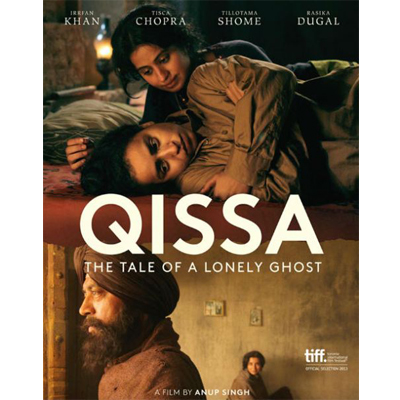
NEW DELHI: Anup Singh’s Qissa, which has already been released in Germany and shown in various film festivals including London and Durban, is to be released in India and Canada on 26 September.
The film had its world premiere at the Toronto International Film Festival almost exactly a year ago. The movie was released in Germany in July 2014 and was released earlier this week in France.

The film is an official co-production between Heimat film (Germany), NFDC (India), Augustus Film (Netherlands) and Cine-sud Promotion (France) with Match Factory as the sales agent.
A partition drama featuring Tillotama Shome, Rasika Dugal and Irrfan Khan, Qissa won the NETPAC award for Best Asian Film at Toronto International Film Festival 2013, The Dioraphte Award at the International Film Festival Rotterdam (IFFR) 2014; and a Special Mention by the International Jury and Inalco Jury Award at the Vesoul International Film Festival of Asian Cinema this year.
Set amidst the ethnic cleansing and general chaos that accompanied India’s partition in 1947, this sweeping drama stars Khan as a Sikh (Umber Singh) attempting to forge a new life for his family while keeping their true identities a secret from their community.
It is here that the story takes a remarkable turn. Having already fathered daughters, Singh now wants a son. When his next child is born he celebrates his wish come true, but there is one problem: the baby is in fact a girl. As Umber’s daughter is raised as a boy, the characters are propelled with greater and greater urgency towards their inevitable fates.
Qissa is originally an Arabic word meaning folk tale. Both the word and the idea migrated from the Gulf into the Punjab, still connected by the ancient oral narratives handed down in communal settings. Working within this tradition, director Anup Singh gives his film both the grand themes and elemental emotions of classic storytelling.




Hindi
Dhurandhar the revenge storms past Rs 1,000 crore in a week, rewrites box office records
Aditya Dhar’s spy thriller sets fastest run to Rs 1,000 crore with record-breaking weekday hold

MUMBAI: The box office has a new juggernaut—and it is moving at breakneck speed. Dhurandhar the revenge has smashed past the Rs 1,000 crore mark worldwide in just a week, clocking a staggering Rs 1,088 crore and resetting the rules of the blockbuster game.
Backed by Jio Studios and B62 Studios, and directed by Aditya Dhar, the spy action sequel opened to the biggest weekend ever for an Indian film globally—and then refused to slow down. Unlike typical tentpole releases that taper off after Sunday, this one powered through the weekdays with rare muscle, posting Rs 64 crore on Monday, Rs 58 crore on Tuesday, Rs 49 crore on Wednesday and Rs 53 crore on Thursday.
The numbers stack up to a formidable first-week haul. India collections stand at Rs 690 crore nett and Rs 814 crore gross, while overseas markets have chipped in Rs 274 crore, taking the worldwide total to Rs 1,088 crore in just eight days.
The film’s opening weekend alone delivered Rs 466 crore, laying the foundation for what is now being billed as the fastest climb to the Rs 1,000 crore club in Indian cinema. Every single day of its first week has set fresh benchmarks, from the highest opening weekend to the strongest weekday hold—metrics that typically separate hits from phenomena.
A sequel to the earlier hit Dhurandhar, the film has not just built on its predecessor’s momentum but obliterated previous records, emerging as the biggest global blockbuster run by an Indian film to date.
At this pace, the film is not merely riding a wave—it is creating one.








