News Headline
Prasar Bharati’s woes on vacant key positions

NEW DELHI: The union cabinet has decided to maintain status quo in Prasar Bharati with regard to recruitment of people up to the age of 62 to allow the public broadcaster to fill key positions that have been lying vacant or are likely.
These include the posts of Member (Finance) who has put in his papers but whose resignation has not yet been accepted, Member (Personnel) whose tenure has ended, and Board Chairperson Mrinal Pande whose tenure is ending on 30 April.

The cabinet decision came on a proposal by the ministry of information and broadcasting.
Interestingly, a group of ministers (GoM) had earlier recommended that the age for these positions be lowered to 55 years and that recommendation has been under the consideration of the government. However, since the tenure of this government is ending and the implementation of GoM recommendations for lowering the age requires an amendment to the Prasar Bharati Act.
Prasar Bharati CEO Jawhar Sircar told indiantelevision.com that he was unhappy that no steps had been taken to fill important posts, which he feels should have been done before they become vacant.
Meanwhile, reliable Prasar Bharati sources told indiantelevision.com that a majority of the 1150 critical posts for programme executives, production assistants and duty officers recommended by the GoM had been filled. Prasar Bharati had received clearance early last year for immediately filling up 1150 posts out of the 3452 posts which had been identified as critical and approved by the GoM in June 2009.
The pubcaster has not had any senior-level recruitment since it came into being in September 1997, and the sources said that those posts which could not be filled out of these were held up because there is no Prasar Bharati recruitment board.
The source said steps are being taken to set up the board at the earliest so that the pubcaster does not face such difficulties in future.
In March last year, the pubcaster had in a notice in ‘Employment News’ notified ‘combined recruitment for the post of programme executive and transmission executive examination’ for 1166 posts to be filled after interviews by the staff selection committee (SSC).
As of early 2013, there were 1362 vacancies in Group A, 1,584 in Group B, 4863 in Group C and 2272 in group D in All India Radio (AIR). In Doordarshan (DD), 724 posts are vacant in Group A, 1140 in Group B, 2871 in Group C, and 1451 in Group D.
AIR and DD had total staff strength of 33,800 against a total sanctioned strength of 48,022, leaving a gap of 14,222 posts.
The most critically affected areas were the programme wing and the news services division (AIR)/DD News.
The Committee for Information Technology in 2012 regretted that Prasar Bharati had failed to live up to the assurance given by then Prasar Bharati CEO that the recruitment boards for Prasar Bharati would be set up by 31 March 2011.
It is understood that the union public service commission and SSC had both refused to select for a non-governmental organization, thus creating a new problem for the ministry/Prasar Bharati.
The Proposal for setting up a Prasar Bharati recruitment board was approved by Prasar Bharati Board on 21 July 2010 and discussed in the ministry and a final proposal was referred to the department of personnel and training (DoPT) on 15 February 2011. DoPT concurred with the proposal in June 2011 and the comments of the department of expenditure (DOE) were also received on 28 September 2011.
The DoE had requested that a separate proposal be formulated for creation of posts for the secretariat of Prasar Bharati Recruitment Board and also requested for drafting of agreement containing terms and conditions of the members of the board. This had been done and the proposal sent to DoE in February 2012 and then to the law ministry.





NEW DELHI: Hamdard Laboratories gathered a cross-section of India’s achievers in New Delhi on Friday, handing out the Hakeem Abdul Hameed Excellence Awards to figures who have left their mark across healthcare, education, sport, public service and the arts.
The ceremony, attended by minister of state for defence Sanjay Seth and senior officials from the ministry of Ayush, celebrated individuals whose work blends professional success with a sense of public purpose. It was as much a roll call of achievement as it was a reminder that influence is not measured only in profits or podiums, but in people reached and lives improved.
Among the headline awardees was Alakh Pandey, founder and chief executive of PhysicsWallah, recognised for turning affordable digital learning into a mass movement. On the sporting front, Arjuna Awardee and kabaddi player Sakshi Puniya was honoured for her contribution to the game and for pushing women’s participation onto bigger stages.
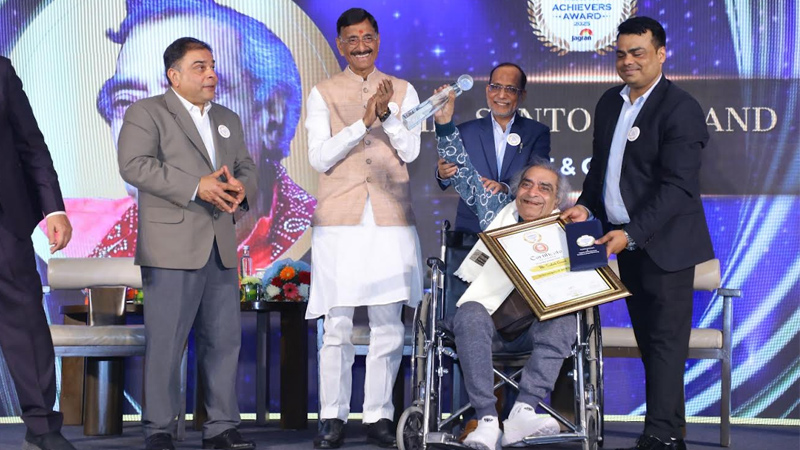
The cultural spotlight fell on veteran lyricist and poet Santosh Anand, whose songs have echoed across generations of Hindi cinema. At 97, Anand accepted the honour with characteristic humility, reflecting on a life shaped by perseverance and hope.
Healthcare honours spanned both modern and traditional systems. Manoj N. Nesari was recognised for strengthening Ayurveda’s place in national and global health frameworks. Padma shri Mohammed Abdul Waheed was honoured for his research-backed work in Unani medicine, while padma shri Mohsin Wali received recognition for his long-standing contribution to patient-centred care.
Education and social development also featured prominently. Padma shri Zahir Ishaq Kazi was honoured for decades of work in education, while former Meghalaya superintendent of Police T. C. Chacko was recognised for public service. Goonj founder Anshu Gupta received an award for his dignity-centred rural development initiatives, and the Hunar Shakti Foundation was honoured for empowering women and young girls through skill development.
The Lifetime Achievement Award went to former IAS officer Shailaja Chandra for her long career in public healthcare and governance, particularly in the traditional systems under Ayush.
Speaking at the event, Hamdard chairman Abdul Majeed said the awards were a tribute to those who combine excellence with empathy. “These awardees reflect Hakeem Sahib’s belief that healthcare, education and public service must ultimately serve humanity,” he said.
Minister Seth struck a forward-looking note, saying India’s young population gives the country a unique opportunity to become a global destination for learning, health and wellness by 2047.
The ceremony also featured the trailer launch of Unani Ki Kahaani, an upcoming documentary starring actor Jim Sarbh, set to premiere on Discovery on 11 February.
Instituted in memory of Unani scholar and educationist Hakeem Abdul Hameed, the awards have grown into a national platform that celebrates those building a more inclusive and resilient India. For one evening at least, the spotlight was not just on success, but on service with substance.







