News Broadcasting
Prasar Bharati spectrum issue may go to TRAI for final decision

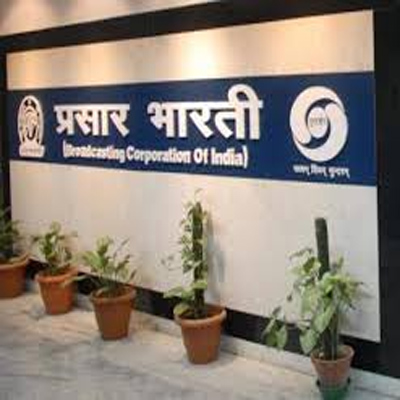
NEW DELHI: An internal panel of the Department of Telecom (DoT) has recommended that the note from the Information and Broadcasting Ministry seeking exemption from auction for spectrum to be allocated to Prasar Bharti be referred to the Telecom Regulatory Authority of India (TRAI).
Prasar Bharati said “Spectrum to Prasar Bharti would be allocated on rates fixed by Government of India.”

Meanwhile, a committee has been set up to examine the conditions for allotment of airwaves through routes other than auction, according to Minister of State for Communications and Information Technology Milind Deora.
The DoT panel will examine various issues related to allotment and pricing of spectrum, “Including conditions which need to be satisfied in order to adopt auction as the preferred/sole mode of allotment of spectrum, conditions and types of spectrum for which administrative allotment of spectrum should be adopted as the norm,” Deora said in Parliament earlier this week.
Telecom minister Kapil Sibal had earlier said that adopting auction route every time for allocating spectrum “does not make sense” and that the cabinet would decide on the issue based on the committee’s report.
It is also learnt that the DoT may seek sector regulator TRAI’s views on the process to be adopted for allocation of spectrum to telecom operators without auction, following the draft recommendation in this regard by its internal committee.
The last spectrum allocation through administrative process for mobile telephony was done in 2009. But later it was put on hold following series of controversial reports regarding spectrum allocation made in 2008 for 122 2G telecom licenses. Later, the Supreme Court in its judgment on February 2, 2012 cancelled these licenses and asked government to allocate the freed spectrum through auction.
DoT formed an internal committee to look into conditions where auction cannot be always suitable for spectrum allocation. This is especially in cases like allocation of small amount of airwaves to telecom operators who were earlier allocated 4.4 megahertz of frequencies to bring them in sync with new rules of five Mhz spectrum allocation, or for duration in between their license period of 20 years.
DoT’s Committee on Allotment/Assignment and Pricing of Spectrum, in its draft report, is learnt to have suggested that the department seek recommendation of TRAI on the matter of spectrum assignment and allocation meant for commercial use without auction. The committee in its report said the reference to TRAI be made on “terms of reference of the committee – conditions which need to be satisfied in order to adopt auction as the preferred or sole mode of allotment/assignment of spectrum for the services.” The committee, however, has suggested that airwaves frequencies allocated to organisations for internal use need not be referred to the sector regulator.






News Broadcasting
Network18 channels lead YouTube news viewership in March 2026
CNN-News18, News18 India and CNBC channels top categories with record views
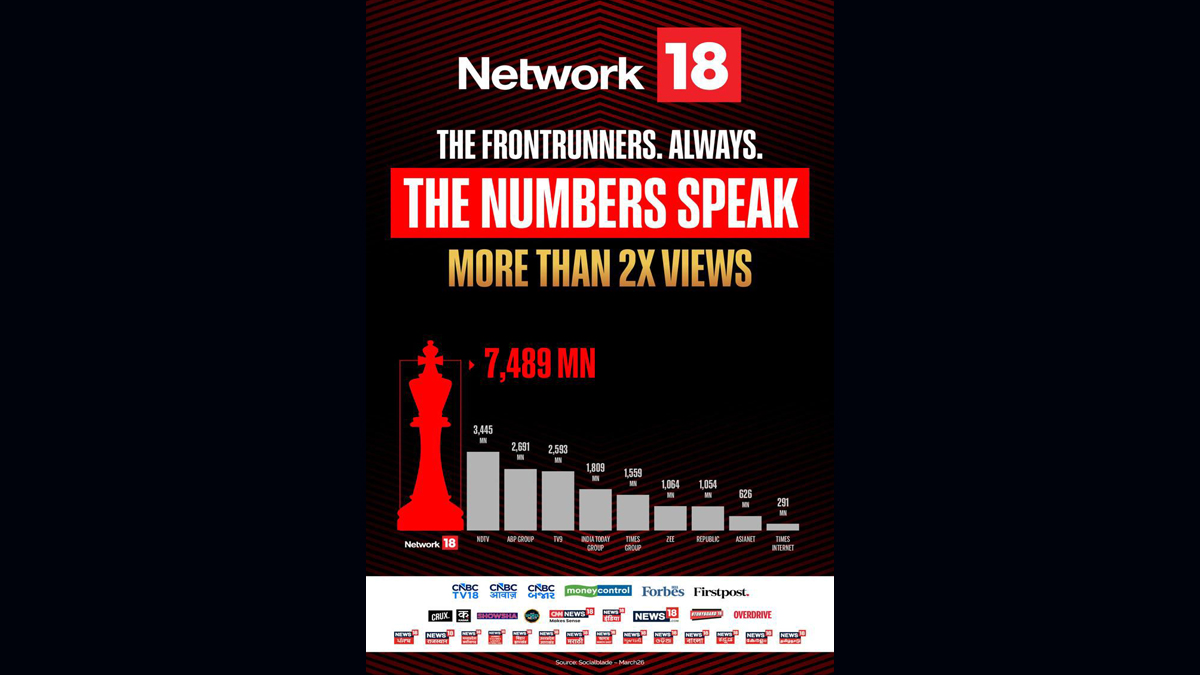
MUMBAI: When the world hit refresh on breaking news, Network18’s channels were already streaming ahead. As geopolitical tensions and war-driven headlines fuelled a surge in global news consumption, the network’s digital playbook delivered big clocking record Youtube viewership across English, Hindi and business news categories in March 2026.
At the forefront was CNN-News18, which emerged as the clear leader in the English news segment with 130 million live and video-on-demand views. The channel edged past competitors such as Times of India (126.5 million), Times Now (101.1 million), India Today (88.2 million) and NDTV (77.5 million), according to Databeings data for March.
In the Hindi news arena, News18 India delivered a commanding performance, racking up a staggering 3,297 million views on YouTube. The channel comfortably outpaced NDTV India, which recorded 3,119 million views, underlining its deep reach and consistent engagement with mass audiences, as per Playboard data.
The network’s dominance wasn’t confined to general news. In the Hindi business segment, CNBC Awaaz topped the charts with 92 million views, narrowly ahead of Zee Business (90 million) and well ahead of ET Now Swadesh (57 million). Meanwhile, its English counterpart CNBC-TV18 posted a strong 58 million views, reinforcing the network’s cross-category strength.
The spike in viewership reflects a broader shift in audience behaviour, with viewers increasingly turning to digital platforms particularly Youtube for real-time updates and in-depth coverage during high-intensity news cycles. For Network18, the numbers signal more than just scale; they underline the effectiveness of a multi-platform strategy that blends speed, credibility and continuous coverage.
In a month where the news never paused, it seems viewers chose to stay tuned where the stream never stopped.






