News Broadcasting
Post-pandemic, 50% commuters anticipate continued remote working


Mumbai: More than half of commuters around the world plan to continue working remotely, at least in part, after the pandemic. This, together with a growing preference for healthier modes of transport, but also a resurgence in commuting by car, means the next year will be pivotal in shaping the transport infrastructure and the future of mobility. New research from Kantar’s Mobility Futures study, based on deep analysis conducted across almost 10,000 city dwellers ahead of June’s Movin’ On World Summit on Sustainable Mobility revealed that the pandemic resulted in a 30 per cent drop in travel volume to work, places of education and leisure activities.
Of those surveyed, 50 per cent respondents who commute to their workplaces anticipate continuing to remotely to some extent post-pandemic. Furthermore, public transport has experienced a 5.6 per cent loss of share as hygiene concerns became a factor with the outbreak of Covid.
Car usage has experienced a 3.8 per cent increase in share of journeys during the pandemic and looks set to stick as preference for post-pandemic travel. A five per cent shift in share of journeys across Western Europe to healthy modes of transport, walking, cycling and scooting, during the pandemic, with an increase in those saying it will be their preferred mode of transport.

In the newest research, conducted as the world starts to think about life after the pandemic, city planners and transport infrastructure professionals adapt to the new travel patterns. Kantar predicts that remote working will play a significant part in the ‘New Normal’ after pandemic restrictions lift. Currently, around two in three residents of major urban areas are working from home globally and the study shows that on average half plan to keep working remotely in the future.
Healthier modes of transport have seen a noticeable increase in this period especially in Europe. With limited transport sharing options, Europeans have favoured walks and bike rides for their daily journeys. Kantar has observed a 4.8 per cent rise in the use of healthy modes of transport in Europe, with walking being the most preferred of these means and scoring a 78 out of 100 on the satisfaction chart. US cities however have seen only a slight increase in use of healthy transport means (0.6 per cent year-on-year), mainly due to large distances and car-centric infrastructures.
The pandemic has created an increased focus on localism and shorter trips. This trend could positively impact the ‘15-minute city’ concept – moving away from being car-centric and offering all the amenities for people’s essential and daily needs within a 15-minute walk or bike ride. Kantar data supports this by revealing that walking and biking are currently the highest scoring means of transport in terms of satisfaction.
Despite the health-kick, there has also been an increase in car usage. Social distancing measures and health concerns led to more people choosing to drive alone during the pandemic to reduce exposure to the Coronavirus. Driving remains one of the preferred ways to travel, despite the negative environmental impact of petrol-powered cars, with usage growing 3.6 per cent and preference +1.9 per cent – making driving the second most popular mode of transport after walking.
In contrast, public transport has taken a serious hit during the pandemic, dropping by 5.6 per cent YoY in usage and scoring only 37 out of 100 for satisfaction, as a result of restrictions on its use, social distancing and people choosing individual means of transport (i.e. walking or biking). The challenge for cities will be how to entice members of the public back onto these services in order to reduce traffic congestion and limit environmental damage in cities.
Kantar executive VP & practice lead – automotive & mobility, South Asia, Anang Jena said, “The pandemic in India has fundamentally changed the way people process and consume mobility, especially with more serious manifestation in the current wave. There will be an inherent psychological restriction towards public transportation which is likely to be fairly long term, especially amongst those who had opted for public transportation even if they could afford personal mobility solutions such as personal vehicles. The large part of India’s migrant population will continue to rely on public mobility solutions with a lot of caution and sensitivity. Public mobility suppliers need to gear up to address these sensitivities going forward. The last mile connectivity will continue to thrive as social distancing practice can be applied effectively – this could create a clear and significant opportunity for e-mobility.”






News Broadcasting
Business Today MindRush returns to Mumbai, spotlight on India’s edge in a fractured world
Policymakers and corporate heavyweights gather to map supply chains, energy security and markets
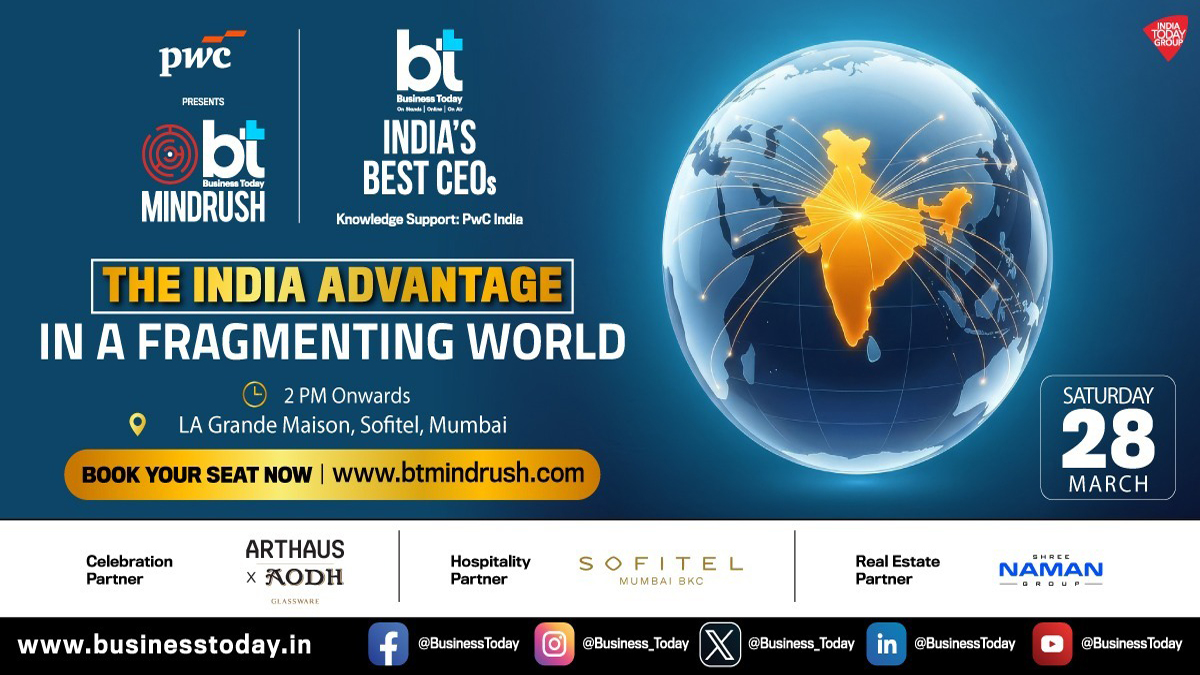
MUMBAI: As fault lines widen across global trade and geopolitics, Business Today is doubling down on India’s moment. The 14th edition of Business Today MindRush & Best CEOs Awards lands in Mumbai on March 28, pitching India’s strategic edge at the centre of a fragmenting world.
The day-long summit, presented by PwC, will bring together a tight mix of policymakers, industry leaders and market voices to decode shifting supply chains, maritime strategy, defence priorities, energy security and capital markets—sectors now deeply entangled with geopolitics.
M Nagaraju, secretary, department of financial services, ministry of finance, will headline the event, setting the tone for discussions that aim to track how India is repositioning itself amid disrupted trade routes and volatile energy dynamics.
The speaker slate reads like a cross-section of India Inc’s command centre. Krishna Swaminathan will zero in on sea lanes and supply chains, while Prashant Ruia is set to push the case for self-reliance in oil and gas. Ashish Chauhan will weigh in on capital markets at a pivotal juncture, as a panel featuring Vibha Padalkar, Sanjiv Mehta, Amish Mehta and Sanjeev Krishan debates navigating economic uncertainty.
Leadership under pressure will be another running theme. Madhavkrishna Singhania, Sharvil Patel, Karan Bhagat and Anurag Choudhary will unpack how businesses are steering through disruption. Arun Alagappan will turn the spotlight on fertilisers, Arundhati Bhattacharya will reflect on leadership transitions, while Anish Shah and S Vellayan will outline blueprints for building future-ready conglomerates.
The event will close with Aroon Purie setting the broader editorial lens, before the Best CEOs Awards recognise standout corporate leadership across sectors.
At a time when the global order looks increasingly splintered, MindRush 2026 is positioning itself as more than a conference—it is a signal that India intends not just to navigate the churn, but to shape it.








