News Broadcasting
PM Modi to meet NBF delegation to put focus on future of news industry

Mumbai: The News Broadcasters Federation (NBF), a news broadcaster, will be meeting prime minister Narendra Modi on Thursday in New Delhi to discuss the future of the new broadcast industry. The delegation of the NBF will be led by Republic Media Network chairman and NBF founding president Arnab Goswami.
As the largest news industry body with more than 50 news broadcaster members, NBF sees the meeting as an opportunity to apprise the prime minister of the seminal role it plays as an institution of democracy. It would also be an occasion to get an insight into the prime minister’s vision in shaping of the future of broadcast news television in India. The NBF will also seek the prime minister’s support in crafting structural policies that will shape the news industry’s future.
Arnab Goswami, who has been at the helm of raising news industry concerns via the NBF is slated to lead the briefing at the meeting and apprise the prime minister on the present situation within the news industry. The NBF is set to raise issues such as the challenges faced by national and regional channels and concerns regarding the lack of transparency and data sharing within the present systems.

The meeting is happening in the backdrop of the prime minister’s recent call for Indian media to get a global voice. The NBF firmly shares the prime minister’s vision and it is expected that the meeting would have some exchange of thoughts on the same.
Arnab Goswami and the NBF delegates are also likely to discuss the need for the evolution of the rating measurement system in synchronization with the Government of India’s policy and emphasis on transparency of data and digitization.
The NBF differentiates itself as an industry grouping that is mostly comprised of non-corporate media owners, who have successfully built their respective organizations without big corporate support so as to keep news independent and democratic. NBF member organizations have created thousands of jobs for the youth of the country without big corporate funding that comes with strings attached.
Under the leadership of Goswami, the NBF has been a vocal body, standing for the independent and democratic ethos of the news industry. The NBF has batted for an absolute level playing field within the Indian news industry- for broadcasters large and small- by raising concerns at various levels and forums against restrictive trade practices.
The meeting with prime minister Narendra Modi comes at a time when the wave of broadcast news television is on the uptake and the viewership through Connected Televisions (CTVs) is seeing phenomenal growth for broadcast news consumption, thereby laying the ground for the possibility of critical transformative frameworks that can take the voice of the Indian media to the global scale.
Founding president of the NBF and Republic Media Network chairman Arnab Goswami will lead the delegation which includes News Industry Stalwarts, Media Owners and Top Editorial Minds from across national and regional Media in India. The Delegation will include Industry Stalwarts such as Barun Das, the MD & CEO at TV9 Group, Riniki Bhuyan Sarma, the Chairperson and Managing Director of Pride East Entertainments, Kartikeya Sharma, Founder of ITV Network, Jagi Mangat Panda, Co-Founder & MD Odisha Television Network Ltd (OTV), Shankar Bala, Chief Executive Officer of Fourth Dimension Media Solutions Pvt Ltd which represents Puthiyathalaimurai and leading Telugu News Channel V6 News, Angad Deep Singh of Living India News which has a deep presence across the North Indian states and Sanjive Narain, Founder of Prag News. The Delegation will also include industry conglomerates in the news media represented by Sreekandan Nair, Managing Director of Insight Media City, Manoj Gairola, Editor-in-Chief of News Nation Network, Suresh Goel, Chairman of IBC 24, Subramaniam, the Managing Director of News7 Tamil, Aishwarya Sharma, Promoter, ITV Network and Director of The Sunday Guardian Foundation, Jagdish Pawra, the Channel Head for VTV Network, Prashant Neema, Channel Head of Sandesh News, Pravindra Kumar, leads the Editorial operations at Network 10 and NBF Secretariats R Jai Krishna and Eshita.
The NBF is a body with more than 50 news broadcasters that disseminates news in over 14 languages, across more than 25 states of India.




News Broadcasting
News18 India launches Command Centre war explainer with Arya
New show shifts from debates to decoding global conflicts and impacts
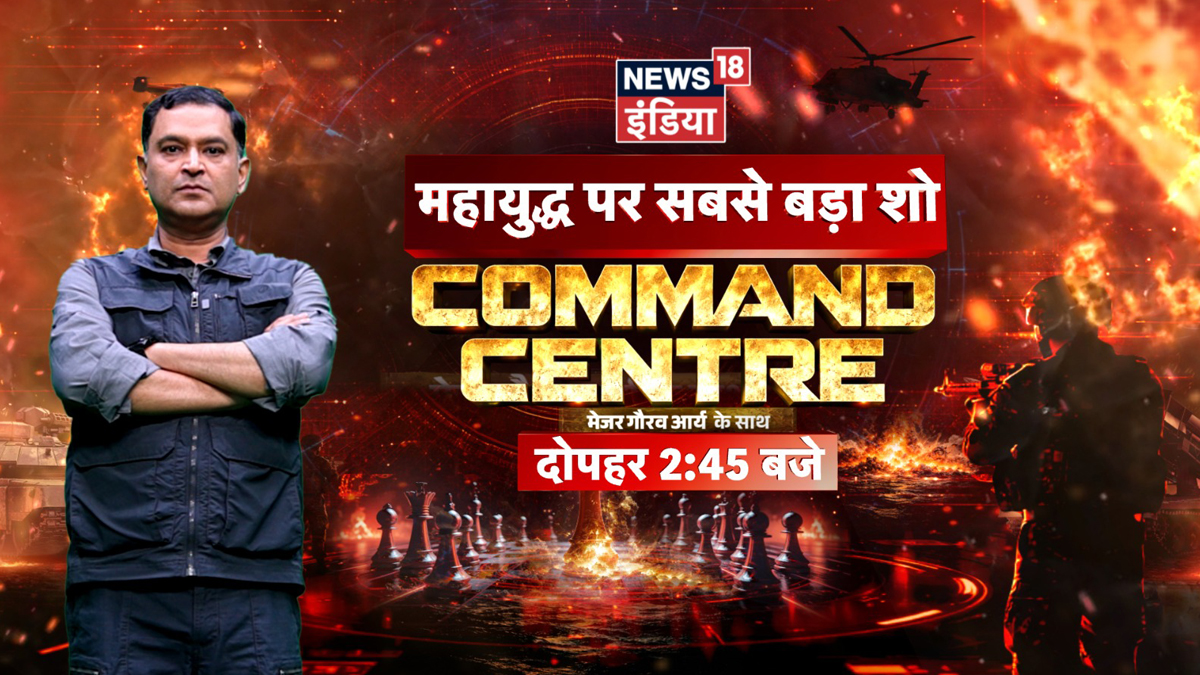
MUMBAI: News18 India has rolled out a new war-focused programme, Command Centre, featuring Gaurav Arya, as it looks to offer viewers a sharper, more grounded take on global conflicts amid rising tensions in West Asia.
Positioned as an “insider war room”, the show moves away from conventional panel debates and instead focuses on explaining military developments, decoding strategy and connecting global events to their everyday impact, from fuel prices to economic shifts.
The format leans heavily on visuals and data. The studio has been designed like a command hub, complete with large LED war maps, real-time graphics and an alert system to track developments as they unfold.
At the centre of it all is Arya, who brings his military background to simplify complex war strategies for viewers. His signature line, “Seedhi baat samjhiye”, anchors the show’s promise of clarity over noise.
News18 India managing editor Jyoti Kamal said, “Command Centre, featuring Major Gaurav Arya is designed to deliver accurate insights and a clear perspective on how evolving conflicts impact everyday life, from household budgets to national security. With expert voices analysing every development in real time, the show goes beyond headlines to decode what’s happening now, what it means, and what could come next.”
Echoing the intent, Gaurav Arya added, “In times of war, confusion is the biggest threat. With News18 India’s Command Centre, we are bringing viewers inside the war room, decoding strategies, tracking every escalation, and explaining, in the simplest terms, what it means for India and for every household. Seedhi baat samjhiye, this is where you understand not just what is happening, but what happens next.”
The weekday show will air in the afternoon slot and will also feature Gaurav Shukla, adding to its editorial depth.
With its mix of analysis, visuals and a clear focus on impact, the show reflects a broader shift in news consumption. Viewers are no longer just watching events unfold, they are looking to understand what those events mean for them.







