News Broadcasting
Peace TV Saga: 24 TV channels identified unfit for telecast in 2015 by India


NEW DELHI: As some South Asian countries scramble to plug loopholes to stop re-transmission of unlicensed TV channels in the aftermath of Dhaka massacre perpetrators being allegedly influenced by Peace TV sermons, India identified 24 channels as not fit for telecast in 2015.
Peace TV from Dubai and as many as 14 television channels from Pakistan figured in a list of 24 channels that India’s Ministry of Home Affairs (MHA) identified as ‘not conducive to the security environment in the country’ in 2012.
The list included Pakistani channels like PTV, PTV Home, PTV World, Geo TV, Dawn, Express, Waqat, Q TV, Madni TV, Noor TV, Hadi TV, Aaj, Filmax and STV.

Out of the other ten, there were two from Nepal (one identified as Nepal, and the other as Kantipur), one channel each from Bangladesh (NTV Bangladesh), Maldives (TV Maldives) and Bhutan (Bhutan Broadcasting Service), and the United Kingdom-based Ahmedia Channel.
The other channels were from Arab countries like Saudi TV, while the Indian security agencies had not disclosed identities of two channels, ARY TV and XYZ TV.
These TV channels were denied downlinking licences by the Indian government. However, industry observers maintain some of the aforementioned channels continued to be available illegally on some networks in some parts of the country owing to “pressure from local cable TV subscribers and lax or indulgent policing.”
Last week, Ministry of Information and Broadcasting (MIB) warned distribution platforms against re-transmitting unlicensed TV channels, including Peace TV, in India and said action under law will be taken against defaulters.
Interestingly, junior minister at MIB Rajyavardhan Rathore informed Parliament in December 2015 that the ministry had formulated a detailed guideline for setting up of state and district level monitoring committees to oversee content transmitted by India’s 60,000-odd cable operators with a view to curb illegal channels.
These committees, comprising various cross sections of the society, were intended to aid and advise authorized government officials in ensuring compliance of the provisions of the Cable TV networks Regulation Act, Rathore had said in Parliament.
This Ministry had proposed certain amendments in the Cable Television Networks (Regulation) Act 1995 too to address the problem of illegal telecast of foreign channels.
The Cable Television Networks (Regulation) Second Amendment Bill 2011 containing these amendments was introduced in the Lok Sabha on December 15, 2011 and was referred to the Parliamentary Standing Committee concerned for examination. The Committee opined that the proposed amendment to the Act would be redundant in view of the proposed complete digitalization of cable networks. The Bill was introduced in the 15th Lok Sabha but lapsed following the dissolution of the House.
Cable Organisations Support Govt Action
Meanwhile, reacting to the warning issued by MIB against distribution of unlicensed channels like Peace TV, National Cable and Telecommunication Association (NCTA) President Vikki Choudhri said he had flagged this issue with the government several times in the past.
A letter from NCTA to the government in January 2008 had highlighted some distribution platforms carried on their networks unlicensed foreign-based TV channels in India.
Choudhri was of the opinion that “strict action’ was the only way to stop such irregularities and added in August 2010 had also advised the police on seven local operators who were telecasting such unlicensed channels.
Cable Operators Federation of India (COFI) President Roop Sharma said she had been, from time to time, sending out advisories to Federation’s LCO members to guard against re-transmitting TV channels that were not permitted by the government and did not have proper landing rights in India.
“All you need to do is pick up the phone and expose offenders. We do not encourage airing channels that might lead to communal tensions,” Sharma added, urging viewers too to come out and complain against such illegal TV channels.
All India Aavishkaar Dish Antenna Sangh President A K Rastogi reiterated his industry colleagues’ stand saying MIB had laid down strict guidelines in this regard and any violator should be “punished” without any discrimination.
Maharashtra Cable Operators Foundation (MCOF) president Arvind Prabhu said that the foundation had asked all member MSOs at various times to ensure such illegal channels were not re-transmitted.
Pointing out that “any MSO or LCO who is a real Indian at heart will immediately switch off these channels if they are being shown”, Prabhu told
indiantelevision.com that the number of MSOs who might be showing such channels was “miniscule”.
Bangladesh Bans Peace TV
Reliance Industries Ltd-owned English news channel CNN-News18, meanwhile, reported that Islamic preacher Zakir Naik collected large amounts of money in the name of his UK-based charity Islamic Research Foundation International and later diverted it to Peace TV.
The CNN-News18 investigation has also revealed that Mumbai-based Harmony Media prepares production content for Peace TV and that the offices of the production house and Naik’s Mumbai NGO were located in the same building in Mumbai.
In a related development, PTI reported from Dhaka that Bangladesh government on Sunday banned the broadcasting of India-based controversial preacher Zakir Naik’s Peace TV.
The decision to ban Peace TV Bangla was taken during a special meeting of Cabinet Committee on Law and Order, PTI reported, quoting Bangla Industry Minister Aamir Hossain Amu who chaired the meeting.
ALSO READ
Indian govt warns against re-transmission of Peace TV illegally





News Broadcasting
Induction cooktop demand spikes 30× amid LPG supply concerns
Supply worries linked to West Asia tensions push households and restaurants to turn to electric cooking alternatives
MUMBAI: As geopolitical tensions in West Asia ripple through global energy supply chains, the familiar blue flame in Indian kitchens is facing an unexpected challenger: electricity.
What began as concerns over the availability of liquefied petroleum gas (LPG) has quickly evolved into a technology-driven shift in cooking habits. Households across India are increasingly turning to induction cooktops and other electric appliances, initially as a backup but now, for many, a necessity.
A sudden surge in demand
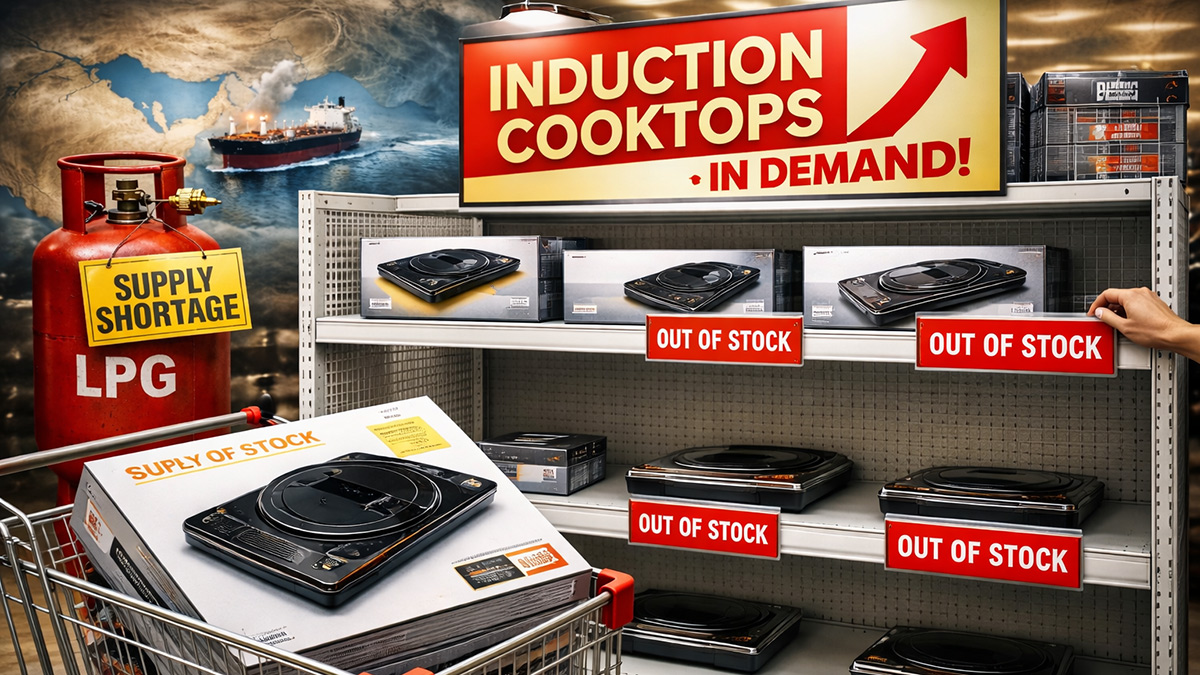
Recent data from quick-commerce and grocery platform BigBasket highlights the scale of the shift. According to Seshu Kumar Tirumala, the company’s chief buying and merchandising officer, demand for induction cooktops has risen dramatically.
“Induction cooktops have seen a significant surge in demand, recording a fivefold jump on 10 March and a thirtyfold spike on 11 March,” Tirumala said.
The increase stands out sharply when compared with broader kitchen appliance trends. Most appliance categories are growing within 10 per cent of their typical demand levels, while induction cooktops have witnessed explosive growth as households rush to secure an alternative cooking option.
Major e-commerce platforms including Amazon and Flipkart have reported rising searches and orders for induction stoves. Quick-commerce apps such as Blinkit and Zepto have also witnessed stock shortages in major metropolitan areas including Delhi, Mumbai and Bengaluru.
What was once considered a convenient appliance for hostels, small kitchens or occasional use has suddenly become an essential addition in many homes.
A crisis thousands of miles away
The trigger for this shift lies far beyond India’s kitchens.
Escalating conflict in the Middle East has disrupted shipping routes through the Strait of Hormuz, one of the world’s most critical energy corridors. Nearly 85 to 90 per cent of India’s LPG imports pass through this narrow waterway, making the country particularly vulnerable to supply disruptions.
The ripple effects have been swift.
India currently meets roughly 60 per cent of its LPG demand through imports, and tightening global supply has already begun to affect domestic availability and prices.
Earlier this month, the price of domestic LPG cylinders increased by Rs 60, while commercial cylinders rose by more than Rs 114.
To discourage panic buying and hoarding, the government has also extended the mandatory waiting period between domestic refill bookings from 21 days to 25 days.
Restaurants feel the pressure
The strain is not limited to households. Restaurants, hotels and roadside eateries are also grappling with supply constraints as commercial LPG availability tightens under restrictions imposed through the Essential Commodities Act.
In cities such as Bengaluru and Chennai, restaurant associations report that commercial LPG availability has dropped by as much as 75 per cent, forcing many establishments to rethink their kitchen operations.
Some restaurants have reduced menu offerings, while others are rapidly installing high-efficiency induction systems, creating hybrid kitchens where electricity now shares the workload with gas.
For smaller eateries and roadside dhabas, the shift is less about sustainability and more about survival.
A potential structural shift
The government has maintained that there is no nationwide LPG crisis and has directed refineries to increase production to stabilise supply.
Nevertheless, the developments of March 2026 may already be triggering a longer-term behavioural shift.
For decades, LPG has been the backbone of cooking in Indian households. However, recent disruptions have highlighted the risks of relying on a single fuel source.
Increasingly, households appear to be hedging against uncertainty by adopting electric cooking options to guard against price volatility and delivery delays.
If the current trend continues, the induction cooktop, once viewed as a niche appliance, could emerge as a quiet symbol of India’s evolving kitchen economy.