iWorld
OTT poses regulatory challenges but govt committed to digitisation

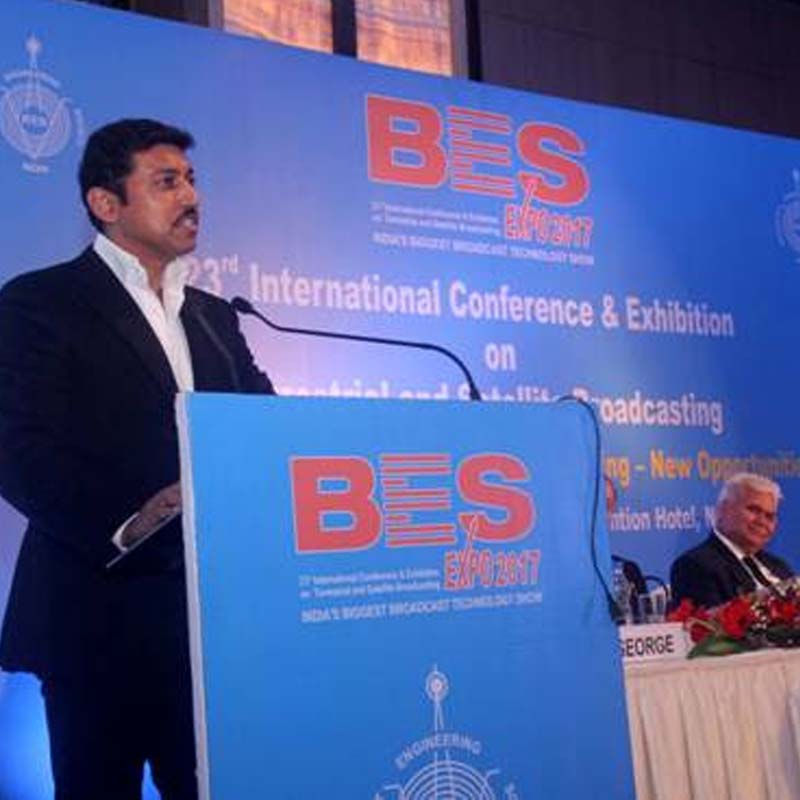
NEW DELHI: Minister of State for Information and Broadcasting (MIB) Rajyavardhan Rathore has said that digital technology platform acted as an equalizer ensuring level playing field and providing equal opportunities for all irrespective of age, region and economic background, but cautioned that techs like OTT posed regulatory challenges too.
Digital technology apart from providing better services, also ensured transparency that enabled plugging leakages at every levels so that the intended benefits trickle down to every citizen, the Minister said here yesterday at the inaugural ceremony of the 23rd International Conference & Exhibition on Terrestrial and Satellite Broadcasting, organised by the Broadcasting Engineering Society (BES) that also is holding the BES Expo 2017.
Also present on the occasion were TRAI chairman RS Sharma and Member of Parliament and Zee chairman Subash Chandra. The theme of the event is `Hybrid Technologies in Broadcasting’.

Rathore said that while digital technology offered immense opportunities to reach out to people, it also posed many challenges with regards to content regulation, illegal broadcasts that demanded innovative solutions to address the concerns. The Over the Top (OTT) applications have democratized the reach of content providing a wide range of services especially to young people with smart gadgets.
However, the OTT applications were a concern for regulatory authority as they were not governed by any law, Rathore said, adding that the government was committed to digitization and the latest Union Budget 2017 had included digital economy as one of the key themes that had allotted Rs 10,000 crore (Rs. 100,000 million) for the Digital India program launched by PM Narendra Modi.
The Minister, along with Chandra and Sharma, also felicitated the winners of the awards constituted by Broadcast Engineering Society in various categories such as broadcasting, engineering, training and innovation. The life time achievement award was conferred to BB Srivastava for his outstanding contributions to the radio FM industry.






iWorld
Veto onboards B4U Network channels to boost its entertainment offering
Partnership adds films, music and regional fare as platform sharpens its large-screen pitch

NEW DELHI: Veto is stacking its content deck. The family-first CTV-focused OTT platform has onboarded B4U Network, plugging in a slate of Bollywood, music and regional programming to widen its appeal in India’s living rooms.
The tie-up brings B4U Movies, B4U Music, B4U Kadak and Bhojpuri+ onto Veto, offering a broader mix of films, songs and vernacular content aimed at diverse audience cohorts. The move is designed to deepen engagement and nudge growth as competition in connected TV heats up.
Ritu Dhawan, managing director, Veto, framed the partnership as a scale play. “At Veto, our vision is to redefine large-screen entertainment for Indian households by creating a trusted, free, and unified viewing experience. Partnering with B4U Network strengthens our ability to offer deeply engaging and regionally relevant content, helping us connect more with audiences across India,” Dhawan said. “As we grow, our focus remains on delivering relevant, high-quality entertainment that families can enjoy together.”
The integration is expected to expand Veto’s audience base while improving content discovery and depth. The platform positions itself as a no-login, large-screen-first service, bundling live TV, news, sports, movies, music, podcasts and on-demand programming into a single interface tailored for connected TVs.
As streaming fragments and screens multiply, Veto is betting on aggregation and simplicity. More content, fewer clicks, broader reach—the pitch is clear, and the living room is the battleground.








