iWorld
OTT players up the ante with niche content

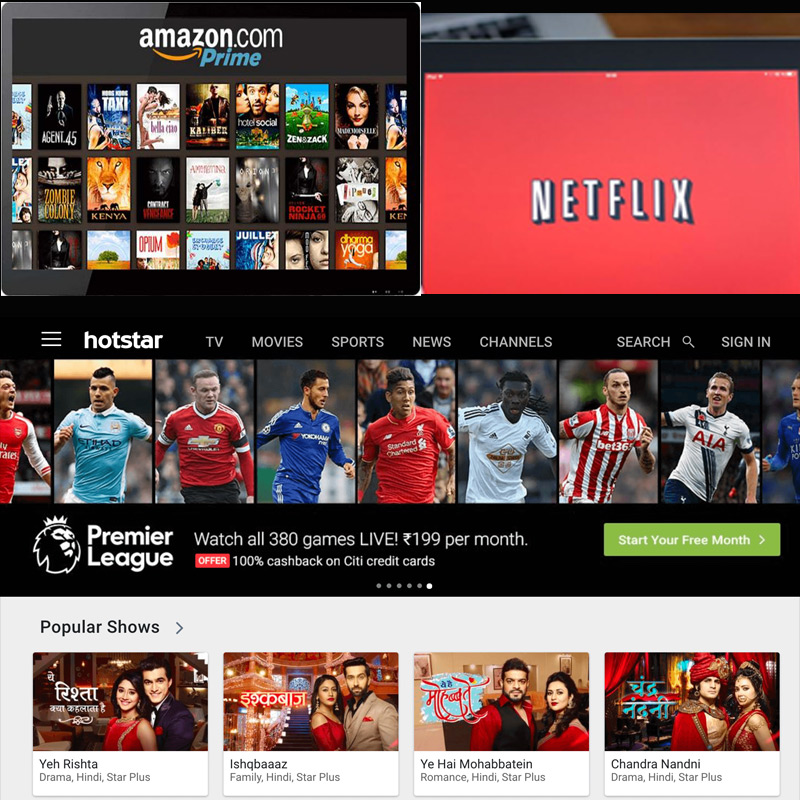
MUMBAI: With the digital era progressing at a geometric rate, India’s media and entertainment industry has seen the proliferation of a number of over-the-top (OTT) players, including many international players. As a result, several niche genres of content are finding a place to grow. Viewers are coming to associate each platform with a type of personality represented through its content.
According to FICCI’s 2018 report, digital subscription in 2017 grew by 50 per cent, riding on the back of niche content. Global content, sports and, increasingly, OTT-only content are also other factors behind the whopping growth of rising viewership on digital.
India’s burgeoning OTT market already has more than 40 OTT players according to estimates. To draw viewers, each platform has to make a separate identity for itself. Subscription-based video on demand has, however, a long way to go as only three per cent of Indian households are paid subscribers of online video-streaming services. To attract more paying subscribers, the video platforms need to come up with content which users will think are worth paying.

Despite making inroads into several developed countries, Netflix is yet scraping the surface of the Indian arena. Its major international competitor, Amazon, has left it far behind here. However, Netflix has created its signature with its large number of original series such as The Crown, House of Cards, Bojack Horseman, Stranger Things etc. Moreover, other than the originals, Breaking Bad, Better Call Saul, Rick and Morty, Brooklyn Nine-Nine and Sherlock are streaming on Netflix attracting a large number of binge watchers. A report by Netflix stated that 88 per cent of its Indian viewers are binge watchers, the third highest in the world. The country finishes series in three days compared to the global average of four days.
But the country lacks in good local content. Though it has added some famous Hindi movies to its library, it does not have enough regional content to offer. Realising the demand, Netflix announced a new multilingual original series in partnership with Shah Rukh Khan’s Red Chillies Entertainment.
Compared to Netflix, Amazon Prime Video is doing good business in India. According to App Annie’s February report, Amazon Prime Video had 13.4 million active users but Netflix had 6 million active users. One of the main reasons for its success is that Amazon has a brilliant movie library for India’s Bollywood crazy fans. The e-commerce major has potential deals with five big long production houses-Yash Raj Films, Excel Entertainment, Dharma Productions, Vishesh Films, and T-Series. Data shows that Indians don’t mind consuming longer content on data connections. Viewers love to watch Hindi movies on the platform. Amazon realised early on that in multi-lingual India, you can’t make do with just Hindi and so delved into regional content as well.
Star India’s OTT arm Hotstar is sprinting here with its large content library. The live streaming of sports matches is one of its best features. For multi-lingual audience, it offers a wide range of catch-up content in several languages while urban folks can watch shows from HBO, Disney, Fox such as Game of Thrones and Westworld.
IPL streaming on Hotstar is one of the biggest boosts for it. This year, it will be telecast in six languages – Hindi, English, Tamil, Telugu, Kannada, and Bengali.
Among other platforms, Voot has youth-centric TV shows including Big Boss, MTV Unplugged, Roadies, Splitsvilla. Gaurav Gandhi’s successor as Voot COO is likely to bring some change. Sony Liv also has exclusive rights of cricket matches from several countries.
Amidst a huge number of OTT platforms and a long list of contents, content discoverability is a major issue. In this context, almost every platform is unable to satisfy audience with proper suggestions despite having a large variety of contents. To enhance their recommendation engines, the platforms have to implement artificial intelligence and machine learning. However, a recent study showed that none of these are yet able to beat good old word of mouth.
OTT players have the work cut out for them here. From branding themselves to ensuring there’s something for everyone, the challenges lie spread out.
Also Read :
Hotstar Trends 2017: Women, small town, cross-language consumption rises
Amazon’s content spend at $5 bn a year, confirms report




iWorld
Bill Ackman’s Pershing Square makes $64 billion bid to acquire Universal Music Group
Ackman pitches NYSE relisting plan as UMG board weighs unsolicited offer

The hedge fund has proposed a business combination that values UMG at €30.40 per share, representing a hefty 78 per cent premium to its current trading price. The offer includes €9.4 billion in cash alongside stock in a newly formed entity, with shareholders set to receive €5.05 per share in cash and 0.77 shares in the new company for each UMG share they hold.
Under the proposal, UMG would merge with Pershing Square SPARC Holdings Ltd and re-emerge as a Nevada-based entity listed on the New York Stock Exchange. The move is designed to boost investor visibility and potentially secure inclusion in major indices such as the S&P 500.
Pershing Square Capital Management ceo Bill Ackman argued that while UMG’s operational performance remains strong, its market valuation has lagged due to external factors. “UMG’s stock price has languished due to a combination of issues that are unrelated to the performance of its music business,” Ackman said, pointing to concerns ranging from shareholder overhang to delayed US listing plans.
Ackman also flagged what he sees as untapped potential in UMG’s balance sheet and a lack of clear capital allocation strategy. He added that the market has not fully recognised the value of UMG’s €2.7 billion stake in Spotify, alongside gaps in investor communication.
The proposed transaction would also result in the cancellation of around 17 per cent of UMG’s outstanding shares, while maintaining its investment-grade balance sheet. Pershing Square has said it will fully backstop the equity financing, with debt commitments secured at signing. The deal is targeted for completion by the end of the year.
UMG, however, has struck a measured tone. The company confirmed that its board has received the non-binding proposal and will review it with advisers. It reiterated confidence in its current strategy and leadership under Lucian Grainge, signalling no immediate shift in stance.
The proposal comes at a time when global music companies are navigating evolving investor expectations, streaming economics and capital allocation pressures. For Pershing Square, the bet is clear: sharpen the financial story, relist in the US, and let the music play louder in the markets.
Whether UMG’s board is ready to change the tune remains to be seen, but the spotlight on its valuation just got a lot brighter.






