News Broadcasting
OpenTV previews its vision for the future at IBC 2006


MUMBAI: OpenTV, which provides enabling technologies for advanced digital television services, will showcase its latest technologies under the banner of “television is changing … open it up!” at the IBC show in Amsterdam.
The event takes place from 8-12 September 2006.
The theme, grounded by the premise that today’s television viewers are demanding greater choice, flexibility, and access, encompasses the entire range of OpenTV’s products on display. By ‘opening up’ the technologies that serve as a foundation for set-top boxes and digital television, OpenTV says that it is taking a leadership position by enabling the adoption of flexible business models and compelling viewer experiences in the television industry.

OpenTV chairman and CEO James A. (Jim) Chiddix says, “Today, the central technologies for building and maintaining social networks around the world are the phone and the internet.
“OpenTV believes that TV is next, and that the way to survive in this changing world is to embrace explore, and enable that change. When we say we are ‘opening up’ television, we are extending our tradition of pioneering middleware and related solutions to new content sources, new navigation models, new forms of television advertising, and new experiences in participation with television.”
Featured products at IBC will include solutions for advanced digital
television; advanced advertising; and participation television.
— OpenTV Vision: Supporting its theme for IBC, OpenTV will debut a supermodal, zoomable user interface (ZUI) that fundamentally changes the way viewers navigate and make viewing choices from the massive amounts of available content, by providing navigation tools that create relevance and match interests.
— Advanced Digital Television:– OpenTV will showcase a number of live HDTV services from OpenTV customers as well as a wide array of HD set-top boxes from ADB, Pace, Philips, Scientific Atlanta, and Thomson.
— OpenTV will demonstrate the power of its popular Core2/PVR2
set-top software through the demonstration of a HD guide
developed by Nagravision. The guide features key elements such
as time-shifting, scheduling, and series linking, as well as
push VOD.
— OpenTV will demonstrate IPTV, highlighting a solution for
hybrid IPTV deployments by cable and satellite operators.
— OpenTV Core2/PVR2 supports multiple application execution
environments including HTML and Flash(R). OpenTV will showcase
its Flash solution, based on the award-winning MachBlue(TM)
from Bluestreak Network, supporting rapid authoring of enhanced
programming using standard Adobe(R) Flash authoring tools.
OpenTV will also demonstrate its industry -leading HTML
solution with home networking applications.
— OpenTV has also integrated technologies with ICTV(TM) and will
be demonstrating a personalized mosaic that delivers
alternative navigation and Internet-type programming and
advertising capabilities to OpenTV-enabled set-top boxes.
As far as advanced advertising:solutions are concerned the company will conduct demonstrations that will feature an end-to-end production system for enhanced advertising that engages audiences by enabling compelling, interactive advertising applications to be created, validated, scheduled, and launched more quickly and less
expensively.
— Also shown will be OpenTV’s advertising sales and inventory
management solutions with a demonstration of OpenTV’s ad
decision engine for dynamic insertion of targetted ads.






News Broadcasting
UDF poised to return to power in Kerala, says Manorama-CVoter survey
Massive opinion poll projects shift in Kerala politics ahead of 2026 Assembly elections.
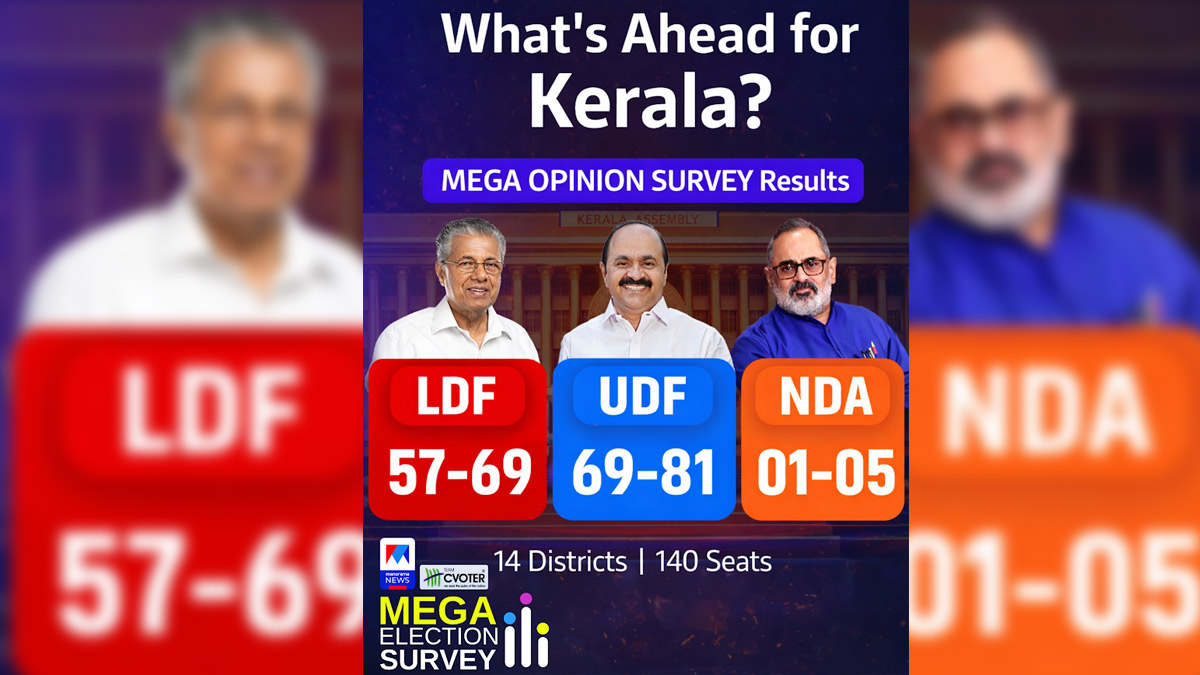
MUMBAI: The winds of change appear to be blowing through Kerala’s political landscape and this time, they seem to favour the United Democratic Front. A comprehensive mega opinion survey conducted by Manorama News in partnership with CVoter projects a potential comeback for the UDF in the upcoming Kerala Legislative Assembly Elections 2026. The survey, covering all 140 constituencies with a massive sample size of nearly 90,000 respondents, predicts the UDF could win between 69 and 81 seats.
The ruling Left Democratic Front (LDF) is expected to secure 57 to 69 seats, a significant drop from the 99 seats it won in the 2021 elections. This would mean the LDF losing 30 to 42 of its sitting seats. Meanwhile, the National Democratic Alliance (NDA), which drew a blank in 2021, is projected to open its account with 1 to 5 seats.
Region-wise, the UDF is expected to make strong gains in Malabar, winning 25 to 34 out of 48 seats, and in Central Kerala, where it could bag 29 to 33 out of 53 seats. In South Kerala, the LDF is likely to retain an edge with 21 to 25 seats, while the UDF may improve to 12 to 16 seats. The NDA could pick up 1 to 3 seats in the southern region.
The survey was conducted between 14 and 26 March 2026, with additional tracker and snap polls carried out from December 2025 to March 2026. A total of 89,693 respondents participated, ensuring representation across all demographics and social segments.
Manorama News has a strong track record of accuracy, with its previous projections closely matching the actual results of the 2019 and 2024 Lok Sabha elections as well as the 2021 Kerala Assembly polls.
In Kerala’s famously fierce political battles, this survey suggests the pendulum may be swinging back. Whether the final verdict matches these numbers or throws up another surprise, one thing is clear, the 2026 Assembly elections are shaping up to be one of the most keenly watched contests in the state’s history.






