News Broadcasting
On CNBC, corporate crime ‘Uncovered’


MUMBAI: Though crime shows across channels have shown sustained TRPs; one has not seen much footage on corporate crime and consumer fraud in the country. What happens when companies go bust after the initial ballistic high? What happens to investors’ money when companies do the vanishing act? Stocks that are not allocated, fake drugs manufactured and sold in the retail market, price fixing and manipulated stock market highs.
One is here talking of savings fraud, white-collar crimes, corporate frauds, economic offences and scams amounting to public corruption. These are not violent crimes, as a street crime; be it murder or rape but many would agree that corporate crime is a ‘silent killer’ inflicting violence on the lives of people, and leaving the economy bleeding of billions of rupees.
Business news channel CNBC TV18 is all set to roll out a new show Uncovered, which promises to cover all this and much more. The weekly, half-hour show, which premiers tonight (5 November) at 8:30 pm, will track a hard hitting story every week; investigate the crime perpetrated on investors and consumers and talk about the economic offences that are assuming serious proportions in the country. The show tries to go in search of criminals, reveal their modus operandi, question the authorities on their failure to curb crime and then suggest ways in which the consumer can fight back.

Elaborating on the format of the new show, head marketing, CNBC TV18, Ajay Chacko, says “the show will not have an element of gossip or drama around it and it’s not competing with other crime shows in the market. We look at two broad aspects – one is corporate crime, and the other aspect is fake drugs, to counterfeiting of trademarks, insider trading, stock manipulation, fraud billing, and excessive billing, unsettled insurance claims.”
Chaco adds, “The idea is to find out the nature of the problem, the scale at which it operates. The manufacturing of fake drugs itself would cost more than Rs 3000 crores (Rs 30 billion) to the drug manufacturers.”
The show promises to give an insider scoop to things which are regularly known by people but are perhaps too difficult to report. With systematically identified sectors, specific issues have been dealt with keeping the consumer angle in mind. Apart from the repercussions of using a bad shampoo or a fake drug on consumers, the losses incurred by companies, the show also gets the law enforcing machinery into the loop.
So, will the channel be taking names, exposing scams and investigating old ones like say the Harshad Mehta scam? “Well, there are too many new scams to explore, says editor, consumer affairs, Vivek Law. “Names will be taken if need be, because the idea here is not just to sensationalise, but to be pretty handy and practical which goes with the CNBC style of reportage.”
But viewers can definitely expect a lot of drama on-air, with criminals being tracked on board with cold raw footage brought in from the manufacturing dens. One issue will be tackled per episode to bring out the nature of the problem and an attempt made to find a solution.
Adds Law, “We’ve spoken to criminals who’ve duped millions of rupees off the economy. These are caught by the police machinery and let off on bail the next day.”
“Powerful and accountable names will definitely be in the studios. And if a guy has cheated you, we show you the guy who has cheated you.”
Refusing to divulge any of the companies `uncovered’, with four episodes all ready and packed in, the channel has the entire work force in terms of reporters available as and when required for the show. Promising to be the first of its kind, the channel had a few pilots before finalising the format.
With a law machinery that is extremely poor as far as consumer rights are concerned, the show will discuss the recourses available for consumers if they are cheated. But will it be in the business of tracking down corporate crooks?
Explains Vivek, “We’re not in a live mode and many of the criminals are absconding. Also, it’s not really a witch-hunt show. Not glamorous but a matter-of-fact kind of show. We talk about the problem, supported with a lot of research, instead of highlighting or targeting one particular company. Awareness builds pressure. We expect people to become more vigilant and the police machinery to gear up.”






News Broadcasting
UDF poised to return to power in Kerala, says Manorama-CVoter survey
Massive opinion poll projects shift in Kerala politics ahead of 2026 Assembly elections.
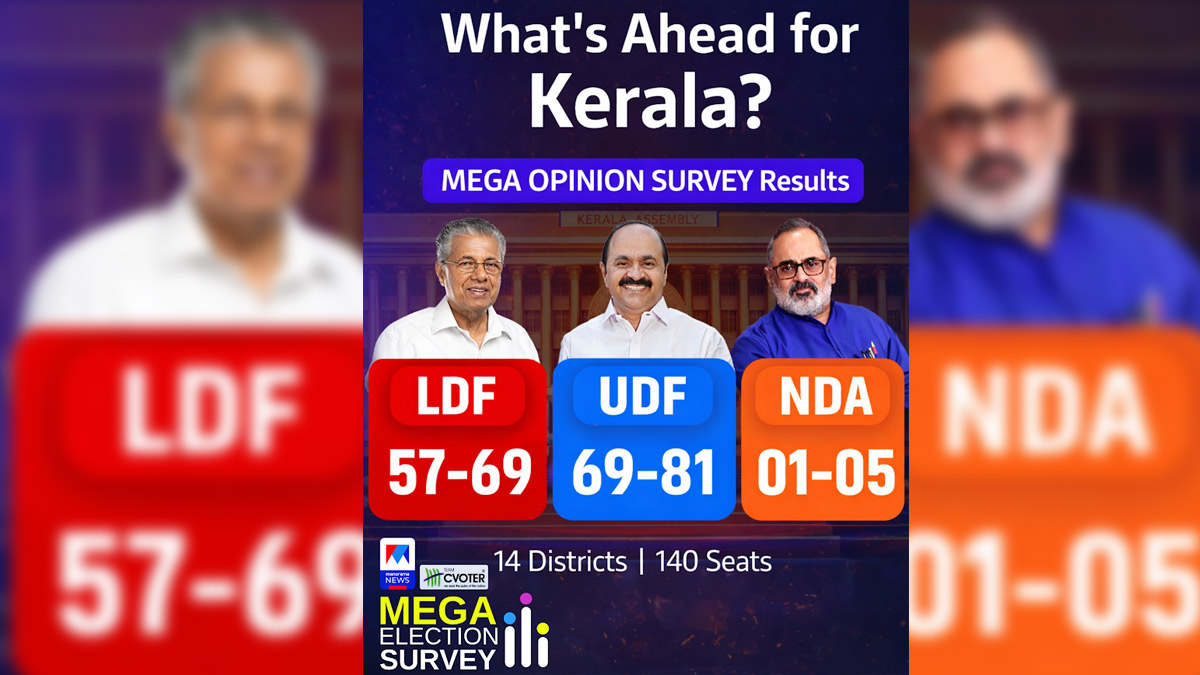
MUMBAI: The winds of change appear to be blowing through Kerala’s political landscape and this time, they seem to favour the United Democratic Front. A comprehensive mega opinion survey conducted by Manorama News in partnership with CVoter projects a potential comeback for the UDF in the upcoming Kerala Legislative Assembly Elections 2026. The survey, covering all 140 constituencies with a massive sample size of nearly 90,000 respondents, predicts the UDF could win between 69 and 81 seats.
The ruling Left Democratic Front (LDF) is expected to secure 57 to 69 seats, a significant drop from the 99 seats it won in the 2021 elections. This would mean the LDF losing 30 to 42 of its sitting seats. Meanwhile, the National Democratic Alliance (NDA), which drew a blank in 2021, is projected to open its account with 1 to 5 seats.
Region-wise, the UDF is expected to make strong gains in Malabar, winning 25 to 34 out of 48 seats, and in Central Kerala, where it could bag 29 to 33 out of 53 seats. In South Kerala, the LDF is likely to retain an edge with 21 to 25 seats, while the UDF may improve to 12 to 16 seats. The NDA could pick up 1 to 3 seats in the southern region.
The survey was conducted between 14 and 26 March 2026, with additional tracker and snap polls carried out from December 2025 to March 2026. A total of 89,693 respondents participated, ensuring representation across all demographics and social segments.
Manorama News has a strong track record of accuracy, with its previous projections closely matching the actual results of the 2019 and 2024 Lok Sabha elections as well as the 2021 Kerala Assembly polls.
In Kerala’s famously fierce political battles, this survey suggests the pendulum may be swinging back. Whether the final verdict matches these numbers or throws up another surprise, one thing is clear, the 2026 Assembly elections are shaping up to be one of the most keenly watched contests in the state’s history.






