News Broadcasting
NT awards recognise the best in TV news


NEW DELHI: In a fitting finale to a year that saw some very tumultuous coverage for television news channels highlighted among others by the Indian victory of the ICC Cricket World Cup and the anti-corruption movement of Anna Hazare, the best in the world of the electronic media were felicitated at the gala event of the 5th News Television Awards here this evening.
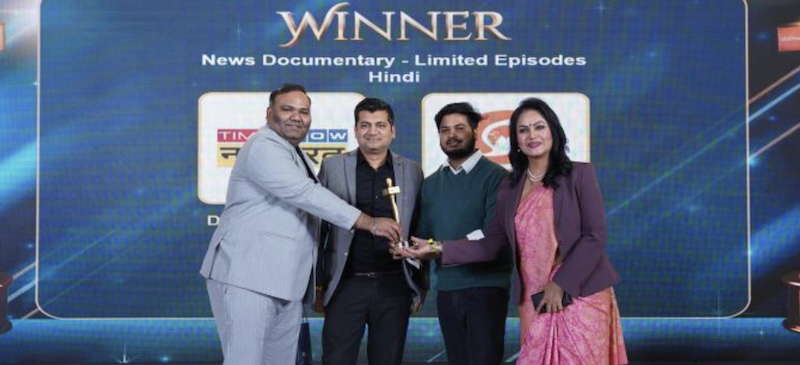
Over 135 awards in different categories in four languages – English, Hindi, Marathi and Telugu – were presented amidst huge cheers by a large number of high profile dignitaries from the world of television, performing arts, sports, fashion, bureaucracy, and politics.
While presenting the awards, Indiantelevision.com founder and CEO Anil Wanvari said ethics and credibility will be the key to news coverage with the changeover to digital technology. He therefore advised media persons to find the right model for news according to their viewership.

There were three cases where the awards were shared amongst two channels, but there were several individual programmes or individual newspersons and anchors who received more than one award.
The awards gala was hosted by television actress Manini Dey Mishra and TV presenter Denzil O’Connell, who made some interesting comments on the way news is presented or about politics and personalities in general, leaving the audience in splits.
Indiantelevision.com general manager Anoop Wanvari referred in his opening remarks that the awards were aimed at encouraging young people in doing better, and echoed the sentiments of Anil Wanvari, when he called for more channels to send entries for these awards – which were the first to be instituted especially for news TV channels.
Awards were given for the best in categories like crime shows, sports shows, gadget and auto programmes, documentaries with limited duration, news presentation, anchors and news readers, business news programmes, investigative reporting, current affairs, prime time news cast, popular news show, use of graphics, set design (actual and virtual), cameraperson, promos, show packaging, news reporters and presenters, entertainment critics and news anchors, business programmes, public debates, and lifestyle and fashion.
Special awards were given for coverage of two major events of 2011 – the World Cup win for India, and the agitation for a Lok Pal by Anna Hazare. There was also a special award for the best news person under 24 years of age.
Those who had come to give away the awards included Central Information Commission chief Wajahat Habbibullah, Birju Maharaj, Aman Ali Khan, HK Dua, politicians Dr Subramaniam Swamy and Jaya Jaitley, Kiran Bedi, fashion designer Ritu Beri, danseuse Shovana Narayan, former cricket player Bishen Singh Bedi, former RBI chief Bimal Jalan, Doordarshan deputy director general Raj Shekhar Vyas, Rashmi Rizhwani, Babbal Sabharwal, Shaswati Sen, industrialist Mohit Burman, Francis Wacziarg of Neemrana Hotels, and veteran media person Kuldip Nayyar.
The awards function came at the end of a news summit on ‘Seeking a growth injection: Is digitisation the answer for the news television business’ which saw representatives of leading news channels, direct-to-home platforms and others in the television news industry taking part in four different sessions on ‘Tech Trends’, ‘A look at the Genre’, ‘Content’, and ‘The Leader Panel’.


News Broadcasting
UDF poised to return to power in Kerala, says Manorama-CVoter survey
Massive opinion poll projects shift in Kerala politics ahead of 2026 Assembly elections.
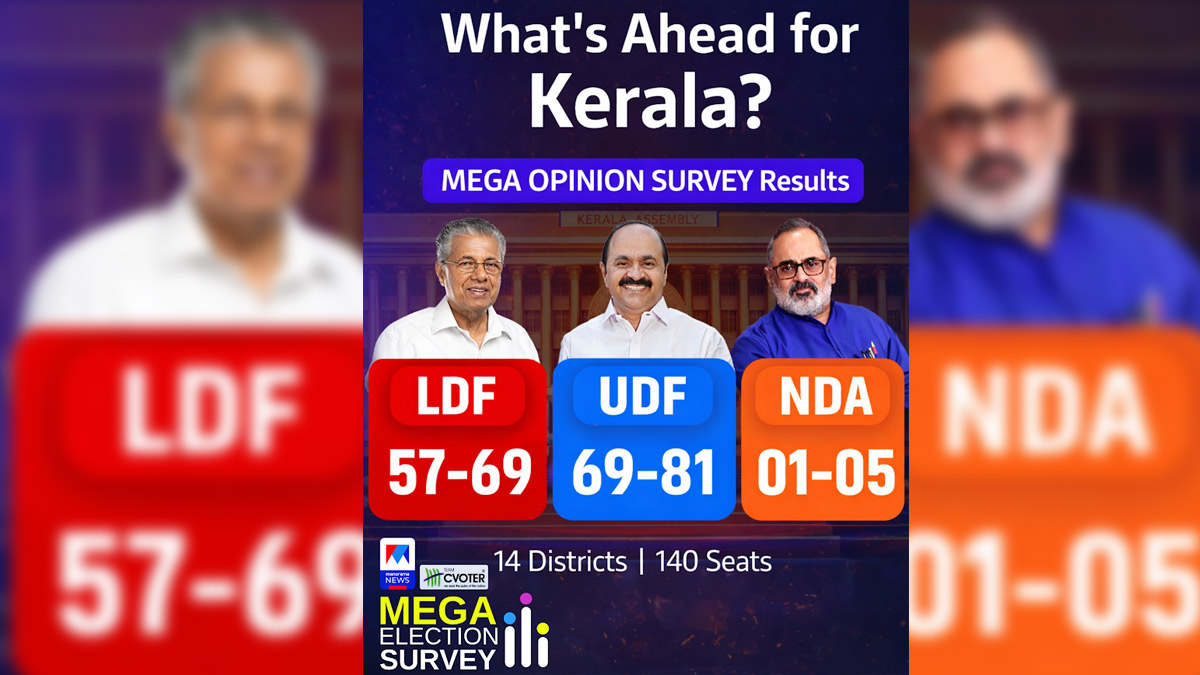
MUMBAI: The winds of change appear to be blowing through Kerala’s political landscape and this time, they seem to favour the United Democratic Front. A comprehensive mega opinion survey conducted by Manorama News in partnership with CVoter projects a potential comeback for the UDF in the upcoming Kerala Legislative Assembly Elections 2026. The survey, covering all 140 constituencies with a massive sample size of nearly 90,000 respondents, predicts the UDF could win between 69 and 81 seats.
The ruling Left Democratic Front (LDF) is expected to secure 57 to 69 seats, a significant drop from the 99 seats it won in the 2021 elections. This would mean the LDF losing 30 to 42 of its sitting seats. Meanwhile, the National Democratic Alliance (NDA), which drew a blank in 2021, is projected to open its account with 1 to 5 seats.
Region-wise, the UDF is expected to make strong gains in Malabar, winning 25 to 34 out of 48 seats, and in Central Kerala, where it could bag 29 to 33 out of 53 seats. In South Kerala, the LDF is likely to retain an edge with 21 to 25 seats, while the UDF may improve to 12 to 16 seats. The NDA could pick up 1 to 3 seats in the southern region.
The survey was conducted between 14 and 26 March 2026, with additional tracker and snap polls carried out from December 2025 to March 2026. A total of 89,693 respondents participated, ensuring representation across all demographics and social segments.
Manorama News has a strong track record of accuracy, with its previous projections closely matching the actual results of the 2019 and 2024 Lok Sabha elections as well as the 2021 Kerala Assembly polls.
In Kerala’s famously fierce political battles, this survey suggests the pendulum may be swinging back. Whether the final verdict matches these numbers or throws up another surprise, one thing is clear, the 2026 Assembly elections are shaping up to be one of the most keenly watched contests in the state’s history.






