News Broadcasting
Nielsen launches Streaming Signals for more efficient CTV advertising


Mumbai: Nielsen has announced the launch of Streaming Signals, a new solution for connected TV (CTV) operators and advertisers to better understand who is watching a show within the household. As a solution that unbundles household viewing, it will be the next step towards better presenting advertising at the personal level, said the company.
Streaming Signals is well suited for Nielsen Digital Ad Ratings (DAR) clients since these two solutions together enable them to both optimise and measure CTV reach for more efficient advertising. Using custom machine learning models based on historical viewership data to determine who is in the household, it delivers a signal to CTV operators within 50 seconds to indicate who is currently streaming program content, said the statement. “Streaming Signals enables both media buyers and media sellers to optimise and measure CTV reach for more efficient advertising, maximising ad revenue, and for delivery to streaming audiences,” it added.
The elimination of delivering irrelevant advertising to viewers results in advertisers and agencies making better and faster choices to reach their target audiences. In turn, with ad inventory that is more accurately packaged, media owners can attract more media dollars by delivering real-time advertising to the right audience.

“Nielsen Streaming Signals brings a layer of unmatched real-time, person-level demographic precision to audience optimisation,” said Nielsen GM digital and advanced TV Ameneh Atai. “We know that the media industry is going through accelerated change and switching to a streaming-first approach with an audience watching programming whenever, wherever, and on a number of devices. Nielsen is the only one that is unbundling the household because we are the only ones that sit at the intersection of the streaming behaviour and audience data.”
This solution is made possible by using machine learning algorithms, viewing from Nielsen’s gold-standard panel data, and the CTV provided viewership data to assign person-level demographics instantly. Once integrated, the CTV provider will notify the Nielsen system and will receive a signal containing information regarding who is most likely watching within the household. The CTV provider can then play a more ideal advertisement instead of playing the previous ad that was reserved, said the company.
Traditionally, clients have looked at on-target percentage when evaluating advertising on CTV. Streaming Signals empowers them to positively impact that percentage by knowing who is behind the CTV screen before the ad is served.
Nielsen’s Digital Ad Ratings (DAR) enables clients to understand who was reached by age and gender during the CTV advertising campaign. In turn, advertisers would rely on using either behavioural targeting (tracking digital behaviours aggregated at the household level) or contextual targeting (displaying an ad based on genre of content) to try and deliver the right ad to the right person. Streaming Signals brings the best of these solutions together to deliver a higher threshold of ad accuracy and relevance.







News Broadcasting
Network18 channels lead YouTube news viewership in March 2026
CNN-News18, News18 India and CNBC channels top categories with record views
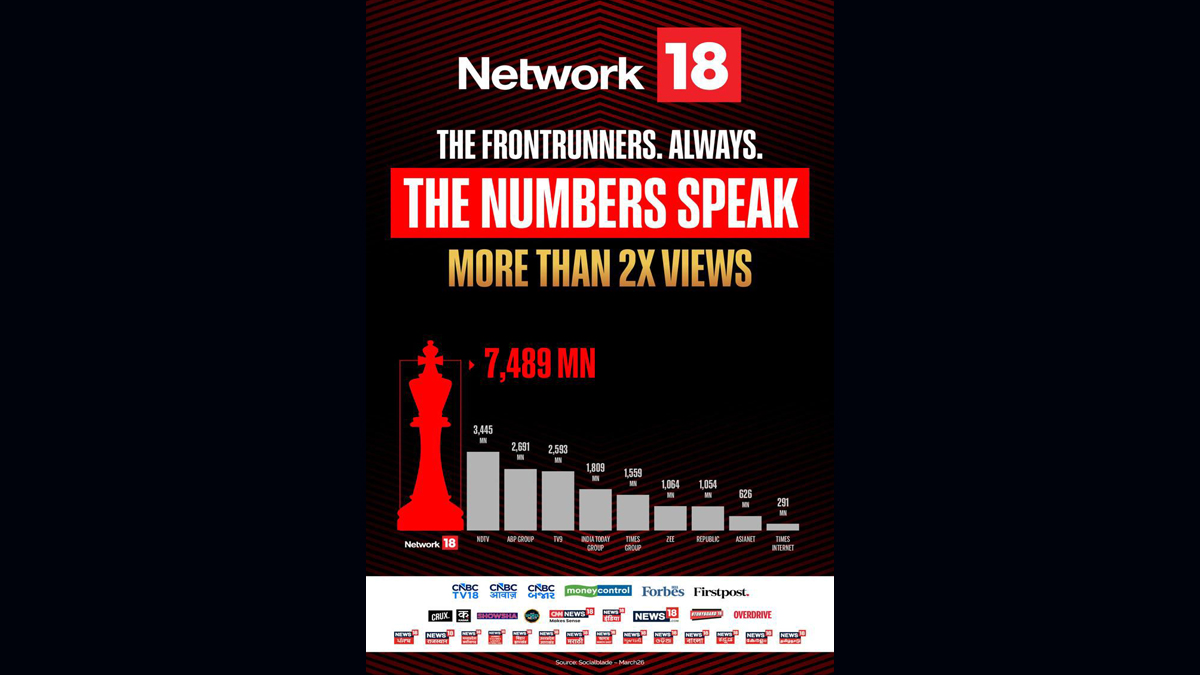
MUMBAI: When the world hit refresh on breaking news, Network18’s channels were already streaming ahead. As geopolitical tensions and war-driven headlines fuelled a surge in global news consumption, the network’s digital playbook delivered big clocking record Youtube viewership across English, Hindi and business news categories in March 2026.
At the forefront was CNN-News18, which emerged as the clear leader in the English news segment with 130 million live and video-on-demand views. The channel edged past competitors such as Times of India (126.5 million), Times Now (101.1 million), India Today (88.2 million) and NDTV (77.5 million), according to Databeings data for March.
In the Hindi news arena, News18 India delivered a commanding performance, racking up a staggering 3,297 million views on YouTube. The channel comfortably outpaced NDTV India, which recorded 3,119 million views, underlining its deep reach and consistent engagement with mass audiences, as per Playboard data.
The network’s dominance wasn’t confined to general news. In the Hindi business segment, CNBC Awaaz topped the charts with 92 million views, narrowly ahead of Zee Business (90 million) and well ahead of ET Now Swadesh (57 million). Meanwhile, its English counterpart CNBC-TV18 posted a strong 58 million views, reinforcing the network’s cross-category strength.
The spike in viewership reflects a broader shift in audience behaviour, with viewers increasingly turning to digital platforms particularly Youtube for real-time updates and in-depth coverage during high-intensity news cycles. For Network18, the numbers signal more than just scale; they underline the effectiveness of a multi-platform strategy that blends speed, credibility and continuous coverage.
In a month where the news never paused, it seems viewers chose to stay tuned where the stream never stopped.






