News Broadcasting
News9 Plus’ investigative documentary reveals Indian Diplomat Ravindra Mhatre’s killer 40 years after murder


Mumbai: In what could be termed as the biggest revelation of 2023, News9Plus Investigation has tracked the murderer of Indian diplomat Ravindra Mhatre nearly 40 years after his brutal killing in Birmingham of United Kingdom.
Ravindra Mhatre was an Assistant Commissioner in India’s Consulate at Birmingham. On 3 February 1984, four terrorists abducted him from outside his office. The next morning, an unknown group called Kashmir Liberation Army (KLA), claimed responsibility for the abduction.
The abductors demanded the release of terrorist Maqbool Butt from New Delhi’s Tihar Jail and nine others, along with one million pounds as ransom. On the evening of 5 February, a motorist found Mhatre’s body with two gunshot wounds on his head. Fearing that their plan could fail any moment, the abductors had assassinated Mhatre in cold blood.

“Both the UK and India failed to bring the killer of Ravindra Mhatre to justice. That is the reason we had to step in and do their job, even if four decades later,” said Aditya Raj Kaul.
News9Plus investigation traced the killer of Ravindra Mhatre, identified as Malik Massarat, in Kotli of Pakistan Occupied Kashmir (PoK).
“Our investigation hit a lot of roadblocks but finally we were able to corroborate from multiple sources location and present state of the terrorist Malik Massarat who lives a shadowy life in Kotli of PoK since last 40 years. He fears even today that he would be arrested or killed for the killing he committed in 1984. Yet now that UK and Indian Government have the names, witnesses, evidence and location, the ball is in their court to act or remain a mute spectator as before”, Aditya Raj Kaul who interviewed two witnesses added.
“I can confirm that the order to kill Ravindra Mhatre was given by Amanullah Khan. He was the Chairman of Jammu & Kashmir Liberation Front (JKLF). Khan felt that Police would be able to arrest the arrest the kidnappers and that would disgrace the JKLF, hence a new identity of KLF was given to the kidnappers”, said JKLF former secretary general Shabir Chaudhary in an interview from UK.
“Masarat Iqbal was involved in this abduction. He was Amnullah Khan’s tenant. He called Amanullah Khan and told him that Police could be reaching them soon, what should we do? Amanullah Khan told him in front of me, ‘Shoot him Dead and dispose off the body’. I opposed Amanullah and told him not to kill this innocent man”, revealed Hashim Qureshi, a close associate of Amanullah Khan and India’s first hijacker of the Ganga Aircraft in 1971.
For the last few months, Indian diplomats in the United States and Canada have been receiving death threats from designated Khalistani terrorists. Death threats to our envoys cannot be taken lightly. The ongoing investigation of News9Plus began tracking the trail of intimidation. It led us to the sensational and yet unsolved murder of an Indian diplomat in the United Kingdom 40 years ago.
External affairs minister Dr. Subrahmanyam Jaishankar had denounced the “atmosphere of intimidation” against Indian diplomats in Canada.
News9 Plus investigation spread across months also revealed a failed attempt to assassinate a former Indian Prime Minister in the UK and a conspiracy to kill a former Indian ambassador to France in 1985-86.
“This is a story that we should all feel touched by because what happened to him could have happened to anybody. It happened to an Indian diplomat, and it happened in this country. When people think that this was just one incident, I want them to remember that this has a grave implication for the way diplomats are treated and looked after worldwide,” said Vikram Doraiswami, India’s High Commissioner to the UK.
Ravindra Mhatre’s daughter Asha D’souza wants the killers to be brought to justice. “I wouldn’t advocate killing anybody, but have a trial, and then convict that person so that people know what they’ve done.”
Watch the two-part documentary here: https://www.news9plus.com/webseries/murder-of-an-indian-diplomat







News Broadcasting
Induction cooktop demand spikes 30× amid LPG supply concerns
Supply worries linked to West Asia tensions push households and restaurants to turn to electric cooking alternatives
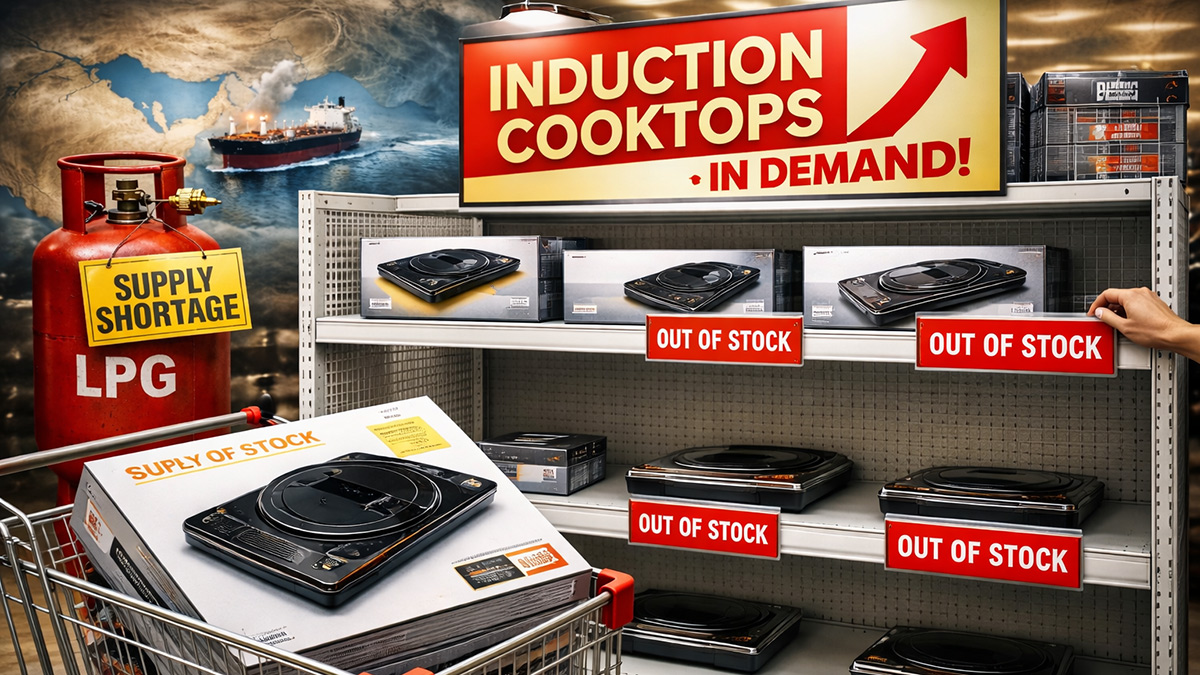
MUMBAI: As geopolitical tensions in West Asia ripple through global energy supply chains, the familiar blue flame in Indian kitchens is facing an unexpected challenger: electricity.
What began as concerns over the availability of liquefied petroleum gas (LPG) has quickly evolved into a technology-driven shift in cooking habits. Households across India are increasingly turning to induction cooktops and other electric appliances, initially as a backup but now, for many, a necessity.
A sudden surge in demand
Recent data from quick-commerce and grocery platform BigBasket highlights the scale of the shift. According to Seshu Kumar Tirumala, the company’s chief buying and merchandising officer, demand for induction cooktops has risen dramatically.
“Induction cooktops have seen a significant surge in demand, recording a fivefold jump on 10 March and a thirtyfold spike on 11 March,” Tirumala said.
The increase stands out sharply when compared with broader kitchen appliance trends. Most appliance categories are growing within 10 per cent of their typical demand levels, while induction cooktops have witnessed explosive growth as households rush to secure an alternative cooking option.
Major e-commerce platforms including Amazon and Flipkart have reported rising searches and orders for induction stoves. Quick-commerce apps such as Blinkit and Zepto have also witnessed stock shortages in major metropolitan areas including Delhi, Mumbai and Bengaluru.
What was once considered a convenient appliance for hostels, small kitchens or occasional use has suddenly become an essential addition in many homes.
A crisis thousands of miles away
The trigger for this shift lies far beyond India’s kitchens.
Escalating conflict in the Middle East has disrupted shipping routes through the Strait of Hormuz, one of the world’s most critical energy corridors. Nearly 85 to 90 per cent of India’s LPG imports pass through this narrow waterway, making the country particularly vulnerable to supply disruptions.
The ripple effects have been swift.
India currently meets roughly 60 per cent of its LPG demand through imports, and tightening global supply has already begun to affect domestic availability and prices.
Earlier this month, the price of domestic LPG cylinders increased by Rs 60, while commercial cylinders rose by more than Rs 114.
To discourage panic buying and hoarding, the government has also extended the mandatory waiting period between domestic refill bookings from 21 days to 25 days.
Restaurants feel the pressure
The strain is not limited to households. Restaurants, hotels and roadside eateries are also grappling with supply constraints as commercial LPG availability tightens under restrictions imposed through the Essential Commodities Act.
In cities such as Bengaluru and Chennai, restaurant associations report that commercial LPG availability has dropped by as much as 75 per cent, forcing many establishments to rethink their kitchen operations.
Some restaurants have reduced menu offerings, while others are rapidly installing high-efficiency induction systems, creating hybrid kitchens where electricity now shares the workload with gas.
For smaller eateries and roadside dhabas, the shift is less about sustainability and more about survival.
A potential structural shift
The government has maintained that there is no nationwide LPG crisis and has directed refineries to increase production to stabilise supply.
Nevertheless, the developments of March 2026 may already be triggering a longer-term behavioural shift.
For decades, LPG has been the backbone of cooking in Indian households. However, recent disruptions have highlighted the risks of relying on a single fuel source.
Increasingly, households appear to be hedging against uncertainty by adopting electric cooking options to guard against price volatility and delivery delays.
If the current trend continues, the induction cooktop, once viewed as a niche appliance, could emerge as a quiet symbol of India’s evolving kitchen economy.