News Broadcasting
News18 Kannada ends TV9’s 20-year reign to claim no. 1 spot


MUMBAI: In a landmark moment for Karnataka’s television news ecosystem, News18 Kannada has unseated TV9 Kannada after 20 uninterrupted years at the top. The latest Barc ratings confirm a seismic shift in regional viewership, marking the first time since 2006 that TV9 Kannada has slipped from the no. 1 position.
News18 Kannada clinched the lead with 33,757 AMA 000s, capturing a robust 25.4 percent market share. TV9 Kannada followed closely at 32,937 AMA 000s with a 24.8 percent share. (Source: TG: NCC 15+; Week 46’25: 15–11–2025 to 21–11–2025 vs Week 45’25: 08–11–2025 to 14–11–2025, All)
The breakthrough underscores News18 Kannada’s growing resonance across the state, powered by its quick, reliable and sharply focused journalism. Viewers appear to be gravitating towards channels offering richer ground reporting, deeper local connect and stronger digital integration, signalling what industry observers call a broader “south-side shift” in news consumption behaviour.

With this feat, News18 Kannada joins the wider Network18 regional line-up, which includes strong performers such as News18 Kerala, News18 Tamil Nadu, News18 Gujarati, News18 Lokmat, News18 Bangla and News18 Assam/NE, among others.
The latest ratings not only place News18 Kannada at the peak for the first time in two decades but also confirm a changing tide in Karnataka’s news preferences. For viewers, it signals fresh energy in the regional news race. For the industry, it marks the beginning of a new chapter.







News Broadcasting
UDF poised to return to power in Kerala, says Manorama-CVoter survey
Massive opinion poll projects shift in Kerala politics ahead of 2026 Assembly elections.
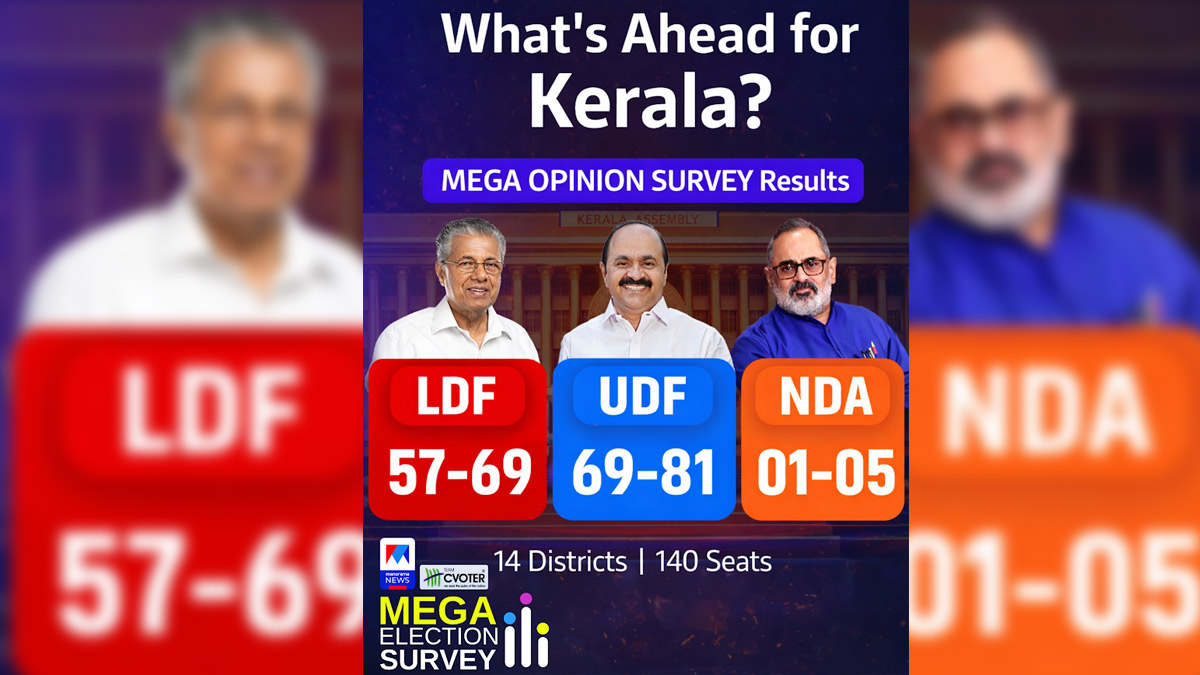
MUMBAI: The winds of change appear to be blowing through Kerala’s political landscape and this time, they seem to favour the United Democratic Front. A comprehensive mega opinion survey conducted by Manorama News in partnership with CVoter projects a potential comeback for the UDF in the upcoming Kerala Legislative Assembly Elections 2026. The survey, covering all 140 constituencies with a massive sample size of nearly 90,000 respondents, predicts the UDF could win between 69 and 81 seats.
The ruling Left Democratic Front (LDF) is expected to secure 57 to 69 seats, a significant drop from the 99 seats it won in the 2021 elections. This would mean the LDF losing 30 to 42 of its sitting seats. Meanwhile, the National Democratic Alliance (NDA), which drew a blank in 2021, is projected to open its account with 1 to 5 seats.
Region-wise, the UDF is expected to make strong gains in Malabar, winning 25 to 34 out of 48 seats, and in Central Kerala, where it could bag 29 to 33 out of 53 seats. In South Kerala, the LDF is likely to retain an edge with 21 to 25 seats, while the UDF may improve to 12 to 16 seats. The NDA could pick up 1 to 3 seats in the southern region.
The survey was conducted between 14 and 26 March 2026, with additional tracker and snap polls carried out from December 2025 to March 2026. A total of 89,693 respondents participated, ensuring representation across all demographics and social segments.
Manorama News has a strong track record of accuracy, with its previous projections closely matching the actual results of the 2019 and 2024 Lok Sabha elections as well as the 2021 Kerala Assembly polls.
In Kerala’s famously fierce political battles, this survey suggests the pendulum may be swinging back. Whether the final verdict matches these numbers or throws up another surprise, one thing is clear, the 2026 Assembly elections are shaping up to be one of the most keenly watched contests in the state’s history.






