News Broadcasting
News channels encash ‘taali bajao, thaali bajao’ initiative to gain more traction


MUMBAI: News channels across genre certainly tried to chance upon the opportunity to engage viewers during the ‘taali bajao, thaali bajao’ event. An initiative called by prime minister Narendra Modi as a tribute to the heroes, who are the vanguard of fighting against coronavirus.
On 19 March, PM Modi urged citizens to voluntarily participate in the ‘Janta curfew’ from 7 am to 9 pm on 22 March to stop the spread of novel coronavirus. He also urged people to send a tribute to the doctors, nurses, and police, among others, on the same day at 5 pm by either clapping, banging utensils or ringing a bell from the balcony or at the doorstep.
In this regard, news channels across genres, apart from broadcasting the people’s participation in the ‘taali bajao, thaali bajao’ initiative from various corners of India, also tried to engage with them proactively on social media as well as on live news channels of the network.

TV Today Network’s news channels, both English and Hindi, urged viewers to make a video while participating in the ‘taali bajao, thaali bajao’ initiative with a hashtag #5baje5minute and send to the network which will be shown on their channels.
According to India Today, the group had asked citizens to send videos of what they did to express gratitude for thousands of those fighting against Coronavirus across the country. Selected videos were broadcast on both India Today and AajTak.
“The campaign — #5baje5minute – become a massive hit as the network received one lakh videos on the WhatsApp numbers shared while announcing the campaign. Meanwhile, the hashtag has also witnessed over 1.87 lakh tweets with a reach to at least 26 million people,” said a channel spokesperson.
Times Network’s president – strategy and business head – English entertainment cluster, Vivek Srivastava says: “The network also ably supported PM’s fervent appeal for a ‘Janta Curfew’ call on 22 March, 2020 by running a pledge campaign on news brands to mobilise awareness and participation from the viewers by sending in their video messages supporting the initiative.”
“India TV has also run two successful social media campaigns so far, the first one was to ask people to support ‘Janta Curfew’, a call by PM Narendra Modi and the second one was to answer common queries of the people getting anxious due to a huge influx of information, attempting to debunk the myths surrounding the issue”, says India TV marketing manager Aruna Jamwal.
Meanwhile, all other network channels such as ABP News Network, New Delhi Television, Zee News, Republic Media Network and Network18, among others, opted for traditional methods to grab eyeballs during the ‘taali bajao, thaali bajao’ initiative. The difference all these channels had were the visuals of people participating in the initiative shown on the TV screen.
At least half a dozen reporters of respective news channels were stationed at various prominent locations to speak to the people supporting PM Modi’s call. The channels also showed the visuals of politicians, ministers and Bollywood actors participating in an initiative called by PM Modi.






News Broadcasting
UDF poised to return to power in Kerala, says Manorama-CVoter survey
Massive opinion poll projects shift in Kerala politics ahead of 2026 Assembly elections.
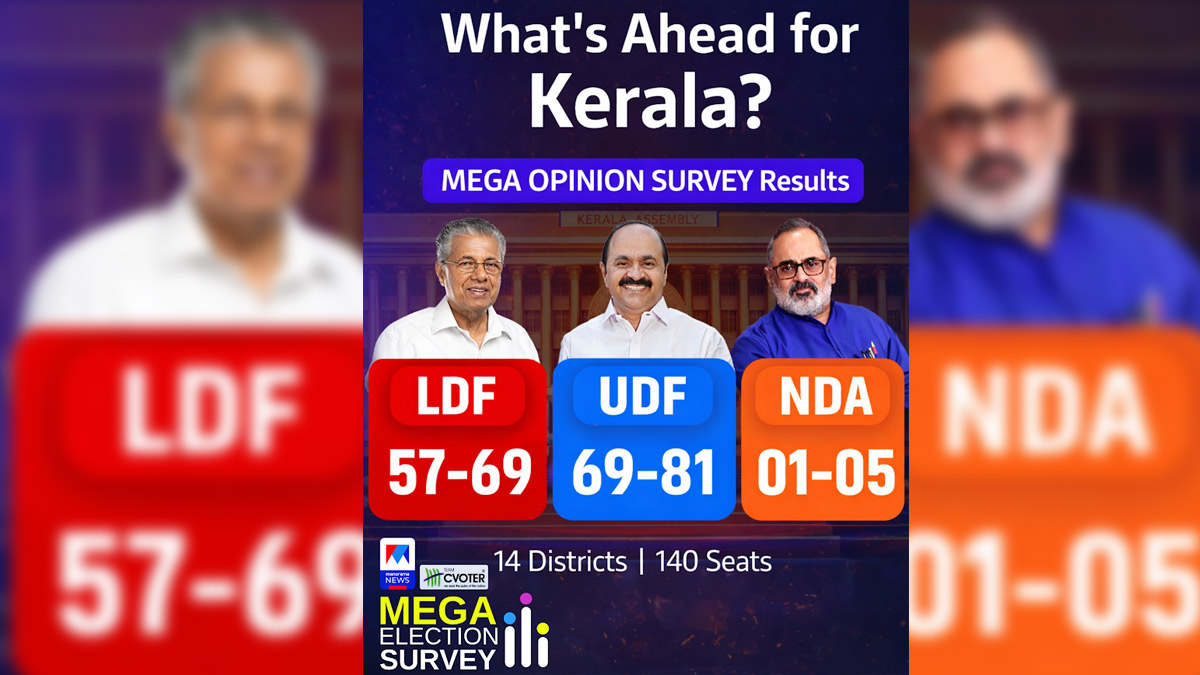
MUMBAI: The winds of change appear to be blowing through Kerala’s political landscape and this time, they seem to favour the United Democratic Front. A comprehensive mega opinion survey conducted by Manorama News in partnership with CVoter projects a potential comeback for the UDF in the upcoming Kerala Legislative Assembly Elections 2026. The survey, covering all 140 constituencies with a massive sample size of nearly 90,000 respondents, predicts the UDF could win between 69 and 81 seats.
The ruling Left Democratic Front (LDF) is expected to secure 57 to 69 seats, a significant drop from the 99 seats it won in the 2021 elections. This would mean the LDF losing 30 to 42 of its sitting seats. Meanwhile, the National Democratic Alliance (NDA), which drew a blank in 2021, is projected to open its account with 1 to 5 seats.
Region-wise, the UDF is expected to make strong gains in Malabar, winning 25 to 34 out of 48 seats, and in Central Kerala, where it could bag 29 to 33 out of 53 seats. In South Kerala, the LDF is likely to retain an edge with 21 to 25 seats, while the UDF may improve to 12 to 16 seats. The NDA could pick up 1 to 3 seats in the southern region.
The survey was conducted between 14 and 26 March 2026, with additional tracker and snap polls carried out from December 2025 to March 2026. A total of 89,693 respondents participated, ensuring representation across all demographics and social segments.
Manorama News has a strong track record of accuracy, with its previous projections closely matching the actual results of the 2019 and 2024 Lok Sabha elections as well as the 2021 Kerala Assembly polls.
In Kerala’s famously fierce political battles, this survey suggests the pendulum may be swinging back. Whether the final verdict matches these numbers or throws up another surprise, one thing is clear, the 2026 Assembly elections are shaping up to be one of the most keenly watched contests in the state’s history.






