News Broadcasting
Network18 topline almost doubles in Q3 2020


BENGALURU: Mukesh Ambani’s Network18 Media and Investments Ltd (Network18) consolidated profit after tax (PAT) for the quarter ended 31 December 2019 (Q3 2020, quarter or period under review) was up 92.2 percent at Rs 148.29 crore from Rs 77.16 crore in the corresponding year-ago quarter Q3 2020. The company had reported a consolidated loss after tax of Rs 24.68 in the immediate trailing quarter (Q2 2020).
The company reported consolidated total comprehensive income of Rs 134.74 crore for the quarter under review which was 189.5 percent more than the Rs 46.55 crore in Q3 2019. Network18 had reported a consolidated total comprehensive loss of Rs 18.78 crore in Q2 2020. Consolidated operating EBITDA for the period at Rs 268.25 crore was 204.3 percent more than the Rs 88.14 crore in Q3 2019 and was 247.4 percent more than the Rs 77.21 crore in Q2 2020.
Network18 consolidated revenue from operations in Q3 2020 at Rs 1,473.70 crore was 3.3 percent lower than the Rs 1,524.01 crore in the corresponding year ago quarter and was 25.5 percent more than the Rs 1,58.87 crore in the trailing quarter. Consolidated total income for the period at Rs 1,490.52 crore was 3.1 percent lower than the Rs 1,538.04 crore in Q3 2019 but was 25 percent more than the Rs 1,192.09 crore in Q2 2020.

Let us look at the other numbers reported by Network18 for Q3 2020
Consolidated total expenses in Q3 2020 at Rs 1,304.38 crore was 14.6 percent lower than the Rs 1,525.88 crore in Q3 2019, but was 8.2 percent more than the Rs 1,205.05 crore in Q2 2020. Consolidated operating costs during the quarter under review declined 18.3 percent year-on-year (y-o-y) to Rs 636.56 crore in Q3 2019 from Rs 779 crore and increased 29.7 percent quarter-over-quarter (q-o-q) from Rs 490.67 crore in Q2 2020.
Marketing, distribution and promotional expenses in Q3 2020 declined 4.6 percent y-o-y to Rs 230.12 crore from Rs 241.12 crore and declined 6 percent q-o-q from Rs 244.88 crore in Q2 2020. Employee benefits expense in Q3 2020 at Rs 243.65 crore declined 13.3 percent y-o-y from Rs 280.88 crore and declined 9.2 percent q-o-q from Rs 268.45 crore.
Finance costs in the period under review increased 1 percent y-o-y in Q3 2020 to Rs 56.78 crore from Rs 56.20 crore, but declined 8.1 percent q-o-q from Rs 61.77 crore. Other expenses in Q3 2020 declined 30.5 percent y-o-y to Rs 93.42 crore from Rs 134.36 crore, but increased 1.3 percent q-o-q from Rs 92.20 crore.
Company speak
Network18 chairman Adil Zainulbhai said: “Across broadcasting and digital, our emphasis has been on delivering value to the consumer, expanding the partner ecosystem and raising profitability. We are constantly adjusting our programming and business model for the continual technology, consumer and regulatory changes in the business. We continue to invest in key areas of growth, expand our reach, and explore new avenues of monetization.”
The company says in its investor release that linear TV subscription benefits (B2C) continued to accrue; 40 percent y-o-y revenue growth in Q3 2020. It says that implementation of the NTO (New Tariff Order) has created a transparent and non-discriminatory B2C regime, which continues to boost Network18’s TV subscription revenue. Improved distribution tie-ups across cable and telcos have brought the consumer closer to its content bouquet at an affordable optimum price.
It says further that monetisation of content through digital partnerships (B2B) was driving step-up in profitability: In line with its strategy of being platform agnostic, the Network 18 group stitched multiple partnerships with notable digital platforms for serving their users a discerning selection of its content.
The company says that though advertising recovered around the festive season, but it continued to remain under pressure: The prevalent weakness in macro-environment and sluggish spending appetite by advertisers continued to drag ad-revenue down y-o-y for both News and Entertainment. Shift of channels from DD Freedish to the Pay ecosystem continued to impact Hindi GEC ad-revenues for all the top broadcasters. The company feels that government initiatives to boost growth and a natural refresh-and-recalibration of ad-budgets should revive ad-growth as we head towards the new fiscal.
Network18 claims that its digital-only subscription (B2C) was being incubated as a growth driver for the future. Further, Voot’s freemium version with offerings like digital- exclusive and digital-first broadcast content, as well as original content behind a pay-wall, is slated to be launched soon.






News Broadcasting
Network18 channels lead YouTube news viewership in March 2026
CNN-News18, News18 India and CNBC channels top categories with record views
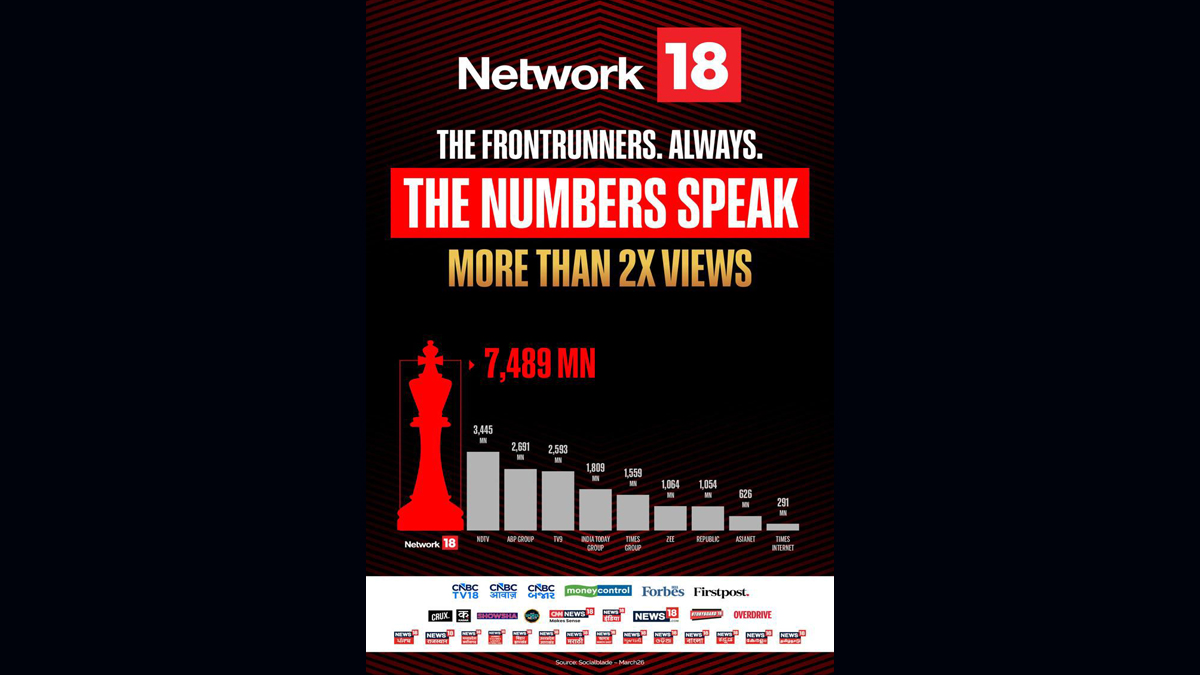
MUMBAI: When the world hit refresh on breaking news, Network18’s channels were already streaming ahead. As geopolitical tensions and war-driven headlines fuelled a surge in global news consumption, the network’s digital playbook delivered big clocking record Youtube viewership across English, Hindi and business news categories in March 2026.
At the forefront was CNN-News18, which emerged as the clear leader in the English news segment with 130 million live and video-on-demand views. The channel edged past competitors such as Times of India (126.5 million), Times Now (101.1 million), India Today (88.2 million) and NDTV (77.5 million), according to Databeings data for March.
In the Hindi news arena, News18 India delivered a commanding performance, racking up a staggering 3,297 million views on YouTube. The channel comfortably outpaced NDTV India, which recorded 3,119 million views, underlining its deep reach and consistent engagement with mass audiences, as per Playboard data.
The network’s dominance wasn’t confined to general news. In the Hindi business segment, CNBC Awaaz topped the charts with 92 million views, narrowly ahead of Zee Business (90 million) and well ahead of ET Now Swadesh (57 million). Meanwhile, its English counterpart CNBC-TV18 posted a strong 58 million views, reinforcing the network’s cross-category strength.
The spike in viewership reflects a broader shift in audience behaviour, with viewers increasingly turning to digital platforms particularly Youtube for real-time updates and in-depth coverage during high-intensity news cycles. For Network18, the numbers signal more than just scale; they underline the effectiveness of a multi-platform strategy that blends speed, credibility and continuous coverage.
In a month where the news never paused, it seems viewers chose to stay tuned where the stream never stopped.






