News Broadcasting
NBF decries Congress president Sonia Gandhi’s suggestion to ban media ads

MUMBAI: The News Broadcasters Federation (NBF) has appealed to the prime minister to reject the suggestion by Congress president Sonia Gandhi for a “complete ban on media advertisements- television, print and online – by the government and public sectors undertakings (PSUs) for a period of two years”. The NBF also requests Gandhi to withdraw her suggestions in this regard.
The NBF says: “At a time when other industries and sectors are scaling down resources and expenses, we, the news broadcasters of India are facing increased costs as we provide emergency and essential service at the time of national crisis. We request the government to support the news broadcasters through all means to ensure their survival.”
News broadcasters serve as an influential, public awareness and emergency communications system to get information on the doorsteps of the common citizens across the length and breadth of the country, especially in current times of national lockdown due to the world health emergency of COVID-19. Due to this, news television viewership has increased exponentially by 298 per cent, according to BARC, says the NBF release.

The NBF also requested the government to consider advertising spends by private and public sector companies to news broadcasters disseminating public awareness campaigns/information/publicity during the current period to prevent the spread of COVID-19, to be considered as a corporate social responsibility activity.
“The advertising revenue contribution by government and PSUs is minuscule in comparison to the overall advertising market which is pegged at less than 0.5 per cent to India’s GDP. But in contrast, the advertising sector acts as a key catalyst to create mass and expeditious awareness among citizens, creating demand among consumers and leading to higher spending which creates employment to millions, directly and indirectly, and ultimately benefiting the exchequer in terms of tax revenue.”
“Advertising revenue forms the backbone for sustenance of FTA news broadcasters, especially at such crucial time when the operational cost has increased by more than 20 per cent, as news channels are scaling up their effort, by putting hundreds of experts, doctors, public health experts, civil and police personnel, and government officials on air in a massive effort to disseminate the right information and counter the barrage of fake news by reaching out to the largest part of India’s 1.3 billion people at the time of national crisis while themselves at risk,” it goes on to add.







News Broadcasting
Network18 channels lead YouTube news viewership in March 2026
CNN-News18, News18 India and CNBC channels top categories with record views
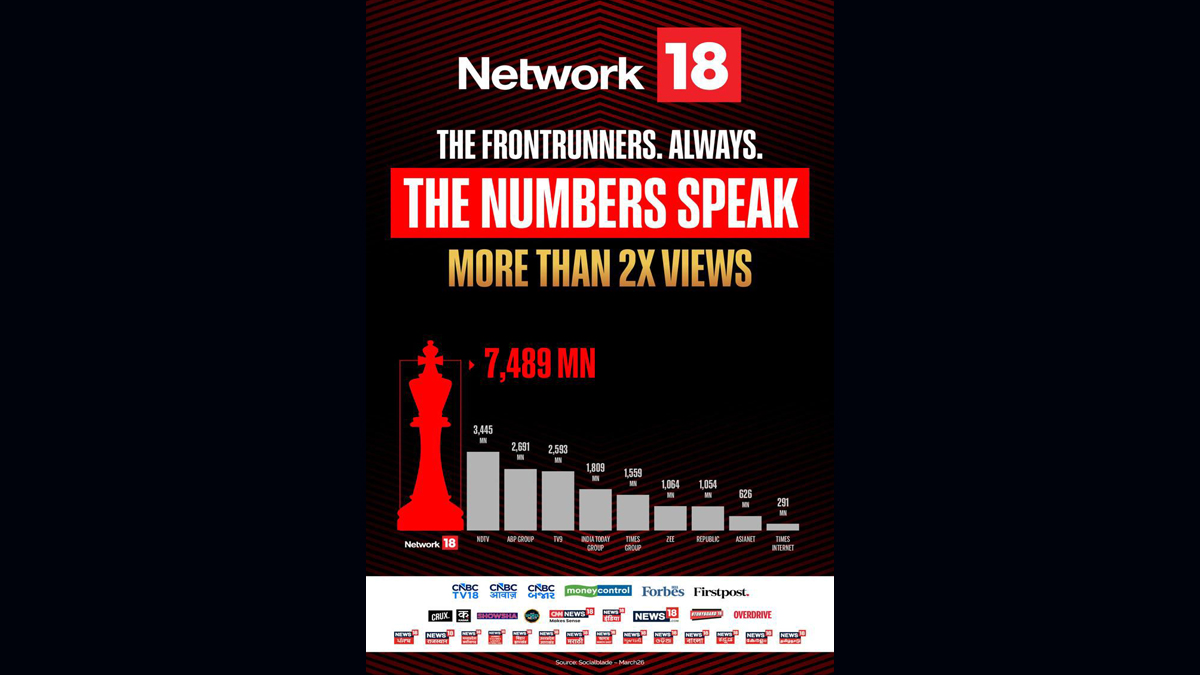
MUMBAI: When the world hit refresh on breaking news, Network18’s channels were already streaming ahead. As geopolitical tensions and war-driven headlines fuelled a surge in global news consumption, the network’s digital playbook delivered big clocking record Youtube viewership across English, Hindi and business news categories in March 2026.
At the forefront was CNN-News18, which emerged as the clear leader in the English news segment with 130 million live and video-on-demand views. The channel edged past competitors such as Times of India (126.5 million), Times Now (101.1 million), India Today (88.2 million) and NDTV (77.5 million), according to Databeings data for March.
In the Hindi news arena, News18 India delivered a commanding performance, racking up a staggering 3,297 million views on YouTube. The channel comfortably outpaced NDTV India, which recorded 3,119 million views, underlining its deep reach and consistent engagement with mass audiences, as per Playboard data.
The network’s dominance wasn’t confined to general news. In the Hindi business segment, CNBC Awaaz topped the charts with 92 million views, narrowly ahead of Zee Business (90 million) and well ahead of ET Now Swadesh (57 million). Meanwhile, its English counterpart CNBC-TV18 posted a strong 58 million views, reinforcing the network’s cross-category strength.
The spike in viewership reflects a broader shift in audience behaviour, with viewers increasingly turning to digital platforms particularly Youtube for real-time updates and in-depth coverage during high-intensity news cycles. For Network18, the numbers signal more than just scale; they underline the effectiveness of a multi-platform strategy that blends speed, credibility and continuous coverage.
In a month where the news never paused, it seems viewers chose to stay tuned where the stream never stopped.






