Hindi
Navin Shetty’s Nube Studios gets new Baselight facility


NEW DELHI: Nube Studio, set up to provide uncompromised grading services for the Indian market, has opened with a Baselight Two grading workstation as its centrepiece.
The colour-driven facility is providing services for commercials, music videos, television and film throughout the region. As a facility aimed at the top end of production, an important requirement is the potential to work natively with raw files from any camera on the same timeline.

The Baselight system is renowned for its ability to accommodate all professional formats and also fully supports grading metadata of any complexity, including primaries, secondaries, keys, shapes, tracks, LUTs and Truelight Colour Spaces. This allows the colourist to explore all the details from the camera, and achieve the look the cinematographer intended.
Open only since June 2015, Nube already boasts an impressive 100+ TVCs, with a client register including BMW, Philips, Godrej Air, Cadbury, Flip Kart, Maruti, Amazon, Dabur, Yardley, Myntra, Pepperfry, OLX, Sunsilk, Intex, KIT KAT, Kohler, Honda, Nescafe, Britannia, Nerolac, TATA, Airtel, Grofers, STAR TV, EPSON, Mahindra, Olay, Jaguar, Lava, Lifebuoy, Renault, Mentos and Solly Sport.
“Baselight delivers on every feature without restricting the creative process. I am able to concentrate on grading and never compromise on quality or inspiration,” said senior colourist and Nube Studio co-founder Navin Shetty.
“Even at HDR 4K, Baselight delivers real-time playback as soon as the content is in the system,” added Shetty. “Clients are not kept waiting, and with the help of the superior grading tools they can see the final result immediately. For clients, the faster system equals staying within budget.”
FilmLight CEO Wolfgang Lempp said, “We are proud to be associated with India’s leading colourist, Navin Shetty. He is very particular about the quality and output of his films. What he and his business head, Ranjan Karkera, have recognised is that directors and producers want to come to a post house and see great pictures just the way they imagined them. At FilmLight we developed our core systems to provide real-time performance even when there is a multi-level grade on top of the raw image. Baselight takes away the technical constraints of transcoding, proxies and unpredictable performance and leaves the colourist to achieve the best look in the shortest time.”
FilmLight will be demonstrating the capabilities of its real-time, render-free grading approach using FilmLight’s BLG interchange format at Broadcast India on the stand of their partners, RED and Avid at Broadcast India 2015 to be held at Bombay Exhibition Centre, Mumbai, 15 to 17 October.







Hindi
Remembering Gyan Sahay, the lens behind film, television and advertising
From a puppet rabbit selling poppadums to Hindi cinema, he framed it all.
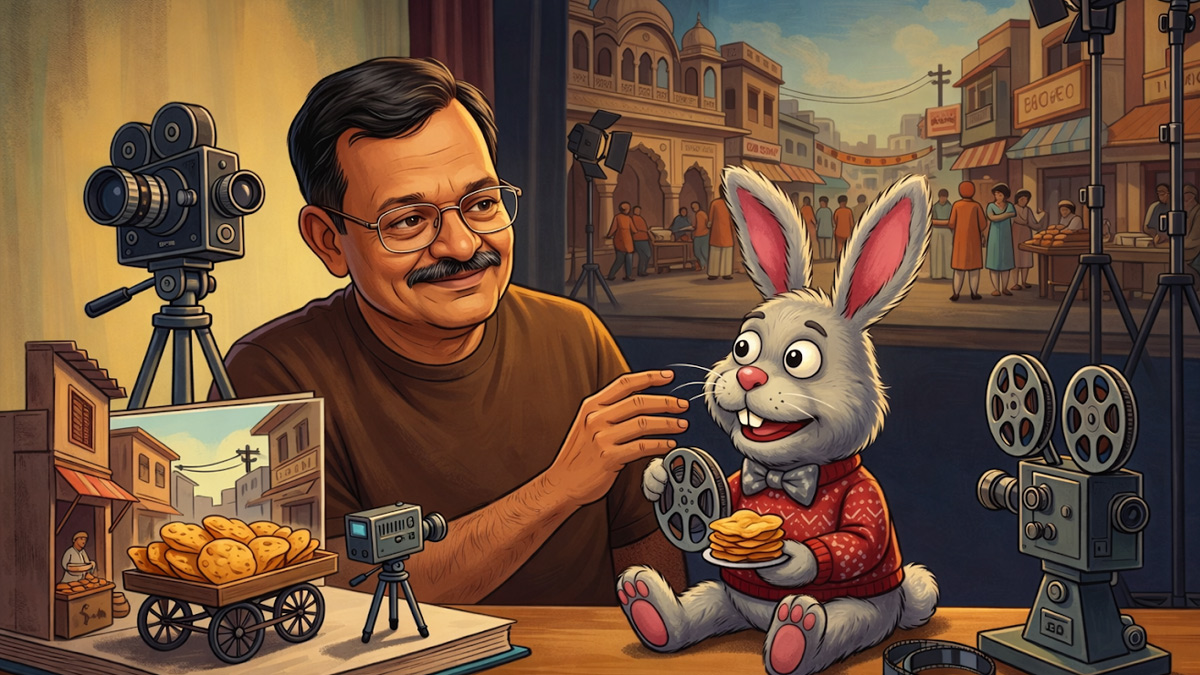
MUMBAI: There are careers, and then there are canvases. Gyan Sahay, the veteran cinematographer, director, and producer who passed away on 10 March 2026 in Mumbai, had one of the latter. Over several decades in the Indian film and television industry, he turned lenses, lights, and the occasional puppet rabbit into something approaching art.
A graduate of the Film and Television Institute of India (FTII) in Pune, Sahay built his reputation as a director of photography across a career that stretched from the early 1970s all the way to the digital age. He was the kind of craftsman who understood that a well-composed shot is not merely a technical achievement but a quiet act of storytelling.
For most Indians of a certain age, however, Sahay will forever be the man behind the rabbit. His direction of the iconic long-running television commercial for Lijjat Papad, featuring its now-legendary puppet bunny, gave the country one of its most cheerfully persistent advertising images. It was the sort of work that sneaks into the national subconscious and takes up permanent residence.
His big-screen credits as cinematographer include Anokhi Pehchan (1972), Pagli (1974), Pas de Deux (1981), and Hum Farishte Nahin (1988). In 1999, he stepped behind a different kind of camera altogether, making his directorial debut with Sar Ankhon Par, a drama that featured Vikas Bhalla and Shruti Ulfat, with a cameo by Shah Rukh Khan for good measure.
On television, Sahay was particularly prized for his command of multi-camera production setups, a skill that made him a go-to technician for large-scale shows and reality programmes. In an industry that has never been especially patient with complexity, he was the calm hand on the rig.
In later life, Sahay turned teacher. He participated regularly in masterclasses and Digi-Talks, often hosted by organisations such as Bharatiya Chitra Sadhna, sharing hard-won wisdom on cinematography, the comedy of timing in a shot, and the sweeping changes brought by the shift from celluloid to digital. He was also said to have been involved in a project concerning a biographical film on Infosys co-founder N.R. Narayana Murthy.
Tributes from the film industry poured in following the news of his passing, with colleagues remembering him as a senior cameraman who served as a rare bridge between two entirely different eras of Indian cinema. That is, perhaps, the finest thing one can say of any craftsman: he kept up, and he brought others along with him.







