News Broadcasting
MTV in content, advertising alliance with Chinese search engine Baidu


MUMBAI: US broadcaster MTV has announced a content and advertising alliance with Chinese search engine Baidu.com.
The new strategic partnership will give China’s 123 million Internet users easy access to 15,000 hours of MTV and Nickelodeon original video content and music videos licensed by five top Chinese and Asian music companies for online viewing or download through www.baidu.com.
As part of the agreement, MTV will provide the first-ever branded area featured on Baidu – MTV Zone, which will include advertising at launch by Motorola and P&G. This deal extends MTV China’s digital media position, where MTV claims to have 100 per cent reach of the country’s mobile subscribers through partnerships with China Mobile and China Unicom.

MTV International president Bill Roedy commented, “This breakthrough relationship with Baidu delivers Chinese audiences a major digital platform for non-stop, 24-hour access to MTV and Nickelodeon programming content for the first time – from SpongeBob SquarePants, to Pimp My Ride, to MTV China’s local original programming like MTV Tian Lai Cun and MTV Music Wire. This alliance with China’s number one Internet search engine is also a key milestone in our digital media position in China and advances our long-term commitment to expanding our brands and local content in China.”
Baidu.com chairman and CEO Robin Li said, “We are excited to expand our powerful online entertainment platform at Baidu through this first-of-its-kind alliance with MTV Networks. With a diverse offering of original programming, animation and music, Chinese users will be able to experience high quality entertainment on MTV Zone. Content owners and artists will be compensated through this revenue share agreement, which also offers exciting new opportunities for advertisers to reach the online youth demographic in China. We look forward to working with MTV Networks to build on this partnership over the long-term.”
MTV China will provide four categories of content for MTV Zone on Baidu’s portal, including:
– MTV China’s locally produced shows such as Music Wire, Tian Lai Cun, MTV Chart Countdown, MTV English, MTV Mega Star and live music events.
– MTV hit reality shows including Pimp My Ride, Cribs and Laguna Beach.
– Nickelodeon’s shows, including SpongeBob SquarePants and Dora the Explorer, as well as live action series Unfabulous and Drake and Josh.
– Music videos from four Chinese labels, as well as one Asian label.
Content will vary in length, from 10 minutes to 30 minutes. Internet users will be able to access the high-resolution video content via viewing online, as well as downloading using Baidu’s BaiduXsetup software that enables fast downloading. Some downloaded content will require payment, such as music videos, while most will be downloadable free of charge after viewing advertisements. MTVN, Baidu, and where applicable, the record labels, share the revenues.
MTV and Baidu will also share ad revenues. Motorola and Procter & Gamble’s Rejoice brand have signed on as the first advertisers of MTV Zone downloads. In addition, MTVN has signed licensing agreements with four of the top music companies in Mainland China, including EE Media, Modern Sky, Music Nation and Ocean Butterflies to enable MTVN to distribute music videos for emerging and established artists. These include Jeff Chang, JJ Lin, Aaron Kwok, Wang Rong, New Pants and others. Music video content will also be available from indie label Avex Group, which represents many artists with strong pan-Asian appeal, such as Japan’s Ayumi Hamasaki, Boa, and Namie Amuro; Mainland China’s He Jie; and Taiwan’s Cindy Wang and Show Lo. Additional agreements to offer videos from local and international artists will be announced soon.
MTV adds that it has many agreements around the world to make its content available on multiple platforms, including the Internet, mobile phones and portable devices. Internet partnerships include companies such as AOL, Google Video, iTunes and Amazon, among others, for MTV, Nickelodeon and the company’s other leading brands.







News Broadcasting
Induction cooktop demand spikes 30× amid LPG supply concerns
Supply worries linked to West Asia tensions push households and restaurants to turn to electric cooking alternatives
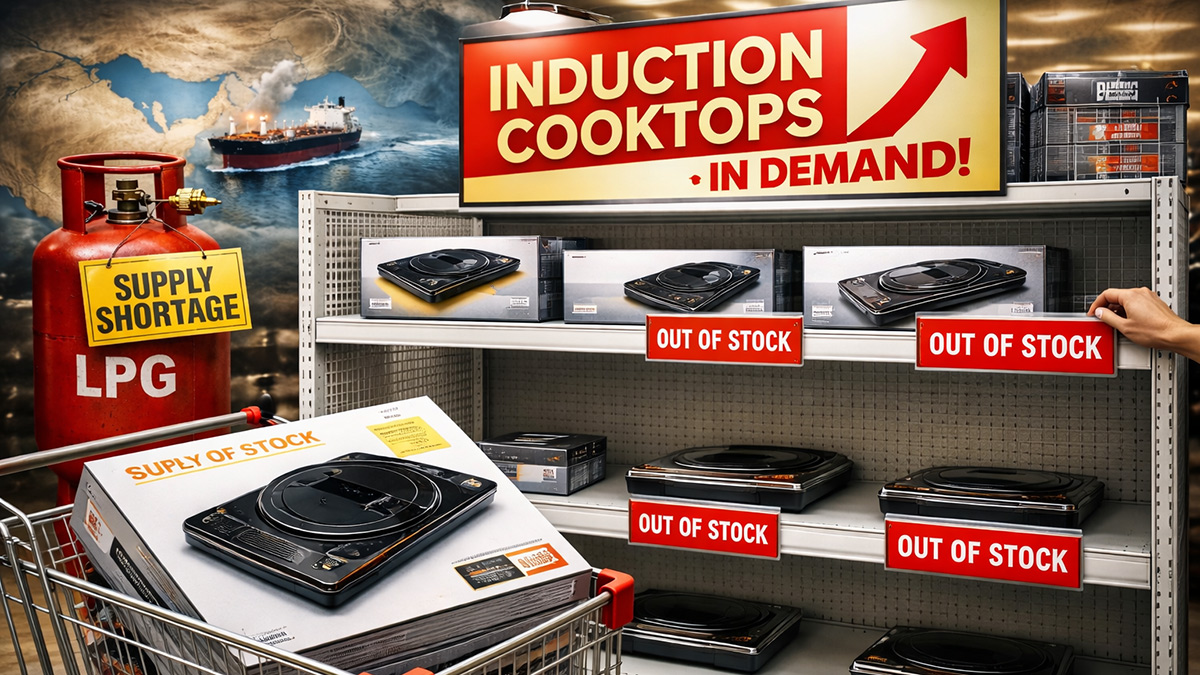
MUMBAI: As geopolitical tensions in West Asia ripple through global energy supply chains, the familiar blue flame in Indian kitchens is facing an unexpected challenger: electricity.
What began as concerns over the availability of liquefied petroleum gas (LPG) has quickly evolved into a technology-driven shift in cooking habits. Households across India are increasingly turning to induction cooktops and other electric appliances, initially as a backup but now, for many, a necessity.
A sudden surge in demand
Recent data from quick-commerce and grocery platform BigBasket highlights the scale of the shift. According to Seshu Kumar Tirumala, the company’s chief buying and merchandising officer, demand for induction cooktops has risen dramatically.
“Induction cooktops have seen a significant surge in demand, recording a fivefold jump on 10 March and a thirtyfold spike on 11 March,” Tirumala said.
The increase stands out sharply when compared with broader kitchen appliance trends. Most appliance categories are growing within 10 per cent of their typical demand levels, while induction cooktops have witnessed explosive growth as households rush to secure an alternative cooking option.
Major e-commerce platforms including Amazon and Flipkart have reported rising searches and orders for induction stoves. Quick-commerce apps such as Blinkit and Zepto have also witnessed stock shortages in major metropolitan areas including Delhi, Mumbai and Bengaluru.
What was once considered a convenient appliance for hostels, small kitchens or occasional use has suddenly become an essential addition in many homes.
A crisis thousands of miles away
The trigger for this shift lies far beyond India’s kitchens.
Escalating conflict in the Middle East has disrupted shipping routes through the Strait of Hormuz, one of the world’s most critical energy corridors. Nearly 85 to 90 per cent of India’s LPG imports pass through this narrow waterway, making the country particularly vulnerable to supply disruptions.
The ripple effects have been swift.
India currently meets roughly 60 per cent of its LPG demand through imports, and tightening global supply has already begun to affect domestic availability and prices.
Earlier this month, the price of domestic LPG cylinders increased by Rs 60, while commercial cylinders rose by more than Rs 114.
To discourage panic buying and hoarding, the government has also extended the mandatory waiting period between domestic refill bookings from 21 days to 25 days.
Restaurants feel the pressure
The strain is not limited to households. Restaurants, hotels and roadside eateries are also grappling with supply constraints as commercial LPG availability tightens under restrictions imposed through the Essential Commodities Act.
In cities such as Bengaluru and Chennai, restaurant associations report that commercial LPG availability has dropped by as much as 75 per cent, forcing many establishments to rethink their kitchen operations.
Some restaurants have reduced menu offerings, while others are rapidly installing high-efficiency induction systems, creating hybrid kitchens where electricity now shares the workload with gas.
For smaller eateries and roadside dhabas, the shift is less about sustainability and more about survival.
A potential structural shift
The government has maintained that there is no nationwide LPG crisis and has directed refineries to increase production to stabilise supply.
Nevertheless, the developments of March 2026 may already be triggering a longer-term behavioural shift.
For decades, LPG has been the backbone of cooking in Indian households. However, recent disruptions have highlighted the risks of relying on a single fuel source.
Increasingly, households appear to be hedging against uncertainty by adopting electric cooking options to guard against price volatility and delivery delays.
If the current trend continues, the induction cooktop, once viewed as a niche appliance, could emerge as a quiet symbol of India’s evolving kitchen economy.