News Headline
“More Media, Less Space”

Reading media interviews on three media websites – this one, agencyfaqs.com, and exchange4media.com -makes one thing very clear. Issues beyond the market, the advertiser, the seller, the buyer, simply do not figure. Not only do industry figures dominate the discourse, their discourse doesn’t go beyond industry issues either. And you have to wonder: media is this constantly growing, powerful arena, an expensively created public space that binds one billion people. Does it not have any concerns beyond who is watching my channel, how can I maximise that, how do I increase the prime time band, how many shows do I have in the top ten, top twenty, top forty, or how much of the 15 per cent revenue increase that the television industry as a whole saw in 2002, came to me? Is there no one raising his vision a few inches higher than the bottom line or looking forward at where we are headed, rather than sideways at the competition?.’
“Maintaining a roving, wide-ranging perspective is not something the media does as a matter of course. In the past year, it preferred to be led by the big story”
People watched a lot of television in the year just gone by. TV penetration grew, the numbers of channels available increased, yet I suspect they watched less variety than ever before. The more media you have, the less it covers. More cricket, more news, more serials on more general entertainment channels. If print is an indication, a few sports events, a few films, and a few personalities dominated the space available in the public sphere, be it newsprint or TV time. Amitabh Bachchan’s sixtieth birthday became a mega-event following a frenetic build up. Devdas so consumed the media that you’d have thought it was a major national achievement. An actress called Antara Mali in a movie called Road, also ate up acres of newsprint. Even a newspaper like the Hindu vastly expanded the space it gave to films, and actresses like Kareena Kapoor. Sachin Tendulkar playing his 100th test match became another major media milestone. Between the exertions of a rapidly growing PR industry and audience-maximising marketeers, older stars were perpetuated, new ones created, and non-stars simply shut out.
The news channels have developed their own logic, refined in 2002. Go for the big story and stick with it. (Which is an euphemism for flog it.) If you were to do an audit you would probably find no more than 20 political figures occupying 70 per cent of the news space all year round. The same 20 spilled over into the entertainment arena with programmes like Jeena Isi Ka Naam Hai. In a country with more than 25 states and Union territories and goodness knows how many political parties. The more political discussion slots you have on television, the more they feature the same politicians, anchors, panelists. It’s the page three syndrome, and it is based on the assumption that only a few personalities sell.
Perhaps there is a logic to it, nothing moves the people of this country as much as the movies, cricket and politics and the big names in all three. But it also stands to figure, if an over-exposed few dominate the canvas, who and what is getting left out? If revenue from television and maximum value to the advertiser are the singular issues that move media executives, who is supposed to watch out for what effect the media has as an institution? Or care about whether the public arena is shrinking rather than expanding? And what that does for the public weal?
“News and regional channels gained revenue share in 2002. That is a slightly hopeful sign: both vehicles help to expand the public arena more than ratings-focussed general entertainment channels do.”

In this respect, newspapers, at least are different from television, and the news channels different from the rest of the TV channels. In both, people are less revenue obsessed, less self-obsessed as media vehicles, and more conscious of public space and their role in mediating it. But they focus narrowly too: Gujarat consumed public debate in 2002. It deserved to, but surely not to the extent of forgetting that there was a nation beyond. Hindu Muslim relations may have improved or deteriorated elsewhere in the country but maintaining a roving, wide-ranging perspective is not something the media does as a matter of course. In the past year, it preferred to be led by the big story.
If the Economic Times television survey is to be believed, news and regional channels gained revenue share in 2002. That is a slightly hopeful sign: both vehicles help to expand the public arena more than ratings-focussed general entertainment channels do. They admit into public consciousness income groups, ethnic groups, and age groups beyond the revenue-maximising, culturally homogenising construct of Hindi-speaking middle India that dominates the most-viewed TV serials.
In the year to come, it might be too much to expect that executives in the commercial media will expand their focus from the consumer to the citizen. But can they at least credit the consumer with a slightly wider range of interest than the precarious eyeballs business assumes? For all the crores spent on television, can we move beyond films to dance and music that does not originate in the movies? Can we move beyond saas bahu themes for stories? Can we move outside family settings for serials to professional and public settings? And from glossy urban to rural? Or is that asking for altogether too much?
(The author is a veteran journalist of national repute. The ideas expressed here are her personal ones and indiantelevision.com need not necessarily endorse them.)




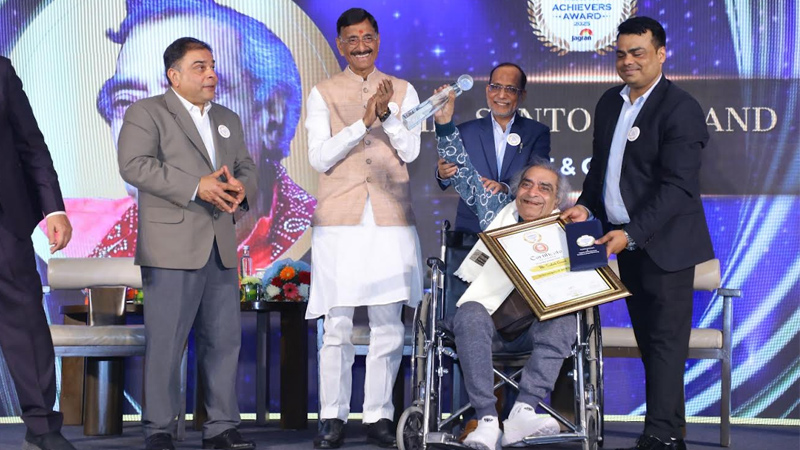
NEW DELHI: Hamdard Laboratories gathered a cross-section of India’s achievers in New Delhi on Friday, handing out the Hakeem Abdul Hameed Excellence Awards to figures who have left their mark across healthcare, education, sport, public service and the arts.
The ceremony, attended by minister of state for defence Sanjay Seth and senior officials from the ministry of Ayush, celebrated individuals whose work blends professional success with a sense of public purpose. It was as much a roll call of achievement as it was a reminder that influence is not measured only in profits or podiums, but in people reached and lives improved.
Among the headline awardees was Alakh Pandey, founder and chief executive of PhysicsWallah, recognised for turning affordable digital learning into a mass movement. On the sporting front, Arjuna Awardee and kabaddi player Sakshi Puniya was honoured for her contribution to the game and for pushing women’s participation onto bigger stages.
The cultural spotlight fell on veteran lyricist and poet Santosh Anand, whose songs have echoed across generations of Hindi cinema. At 97, Anand accepted the honour with characteristic humility, reflecting on a life shaped by perseverance and hope.
Healthcare honours spanned both modern and traditional systems. Manoj N. Nesari was recognised for strengthening Ayurveda’s place in national and global health frameworks. Padma shri Mohammed Abdul Waheed was honoured for his research-backed work in Unani medicine, while padma shri Mohsin Wali received recognition for his long-standing contribution to patient-centred care.
Education and social development also featured prominently. Padma shri Zahir Ishaq Kazi was honoured for decades of work in education, while former Meghalaya superintendent of Police T. C. Chacko was recognised for public service. Goonj founder Anshu Gupta received an award for his dignity-centred rural development initiatives, and the Hunar Shakti Foundation was honoured for empowering women and young girls through skill development.
The Lifetime Achievement Award went to former IAS officer Shailaja Chandra for her long career in public healthcare and governance, particularly in the traditional systems under Ayush.
Speaking at the event, Hamdard chairman Abdul Majeed said the awards were a tribute to those who combine excellence with empathy. “These awardees reflect Hakeem Sahib’s belief that healthcare, education and public service must ultimately serve humanity,” he said.
Minister Seth struck a forward-looking note, saying India’s young population gives the country a unique opportunity to become a global destination for learning, health and wellness by 2047.
The ceremony also featured the trailer launch of Unani Ki Kahaani, an upcoming documentary starring actor Jim Sarbh, set to premiere on Discovery on 11 February.
Instituted in memory of Unani scholar and educationist Hakeem Abdul Hameed, the awards have grown into a national platform that celebrates those building a more inclusive and resilient India. For one evening at least, the spotlight was not just on success, but on service with substance.








