I&B Ministry
MIB grants 30 provisional MSO licences on 1 January to push DAS Phase III

NEW DELHI: Even as almost six states now have received two months’ extension from their respective High Courts to implement Phase III of Digital Addressable System (DAS), the Ministry of Information and Broadcasting granted provisional licences to as many as 30 multi-system operators (MSOs) on New Year’s Day (1 January) in a bid to push cable TV digitisation.
With the new licenses granted, the total number MSOs holding provisional licenses has jumped from 382 to 412 in a single day.

An earlier list had put the figure at 382 provisional licensees on 31 December, the day the analogue signals were to be switched off in Phase III that covers all urban areas in the country, showing 45 new MSOs had been added in the last fortnight of 2015.
Adding to the 230, who have 10-year permanent licences, the total number of registered MSOs now goes up to 642.
The Information and Broadcasting Ministry website did not display the number of permanent licensees, indicating that the number remains at 230 as it has remained since 20 November.
But this slow pace is in direct contradiction to the fact that the Ministry of Home Affairs (MHA) had nearly seven months earlier announced that it was aiming to do away with security clearances for MSOs.
The new licensees covering 11 states include two MSOs namely Hashmee Cable Network and Vaadi Television, who have got provisional licences in Jammu and Kashmir.
The other MSOs are from states like Andhra Pradesh, Telangana, Maharashtra, and Tamil Nadu where the implementation of DAS Phase III has been extended by varying periods. These are: Yuvaraj Cable and Anantha City Digital Comm. Network from AP; Hi – Tech Communication Network from Telangana; Rainbow Digitech, Sangli Media Communication, World Vision Cable Network, Chikhali Cable Network, Shah Cable Network, Shree Balaji Cable Network, TK Cable Network, Alone Cable Network, Amarnath Cable Network and Creative Cable Network from Maharashtra; and Tiruvannamalai Cable Network and Amoga Digital Netcom from Tamil Nadu.
MSOs who have received licenses from the state of Uttar Pradesh are: Netvision Elegant Networks, V.B Distribution Cable Network, Welcome Cable Network and Jagjeet Cable TV Network; from Rajasthan are: Shekhawati Cable Networks, Om Cable Network, Kankroli Digital Network and Jaisal Cable Vision; and from Chhattisgarh are: CCN Digital Network and Vande Mahamaya Cable Network.
Additionally, one MSO each from MP, Haryana and Karnataka namely Yash Cable Network, ABC News Palwal and RST Digital Media Services respectively received the provisional licenses.
The number of MSOs was 612 on 31 December, 567 in mid-December, 553 by 24 November and 470 earlier in November, but this increase was merely in those who have provisional licences.
Sources said many MSOs holding provisional licences had not completed certain formalities relating to shareholders and so on.





I&B Ministry
CBFC speeds up film certification; average approval time cut to 22 days
Over 71,900 films cleared in five years as digital system shortens approval timelines
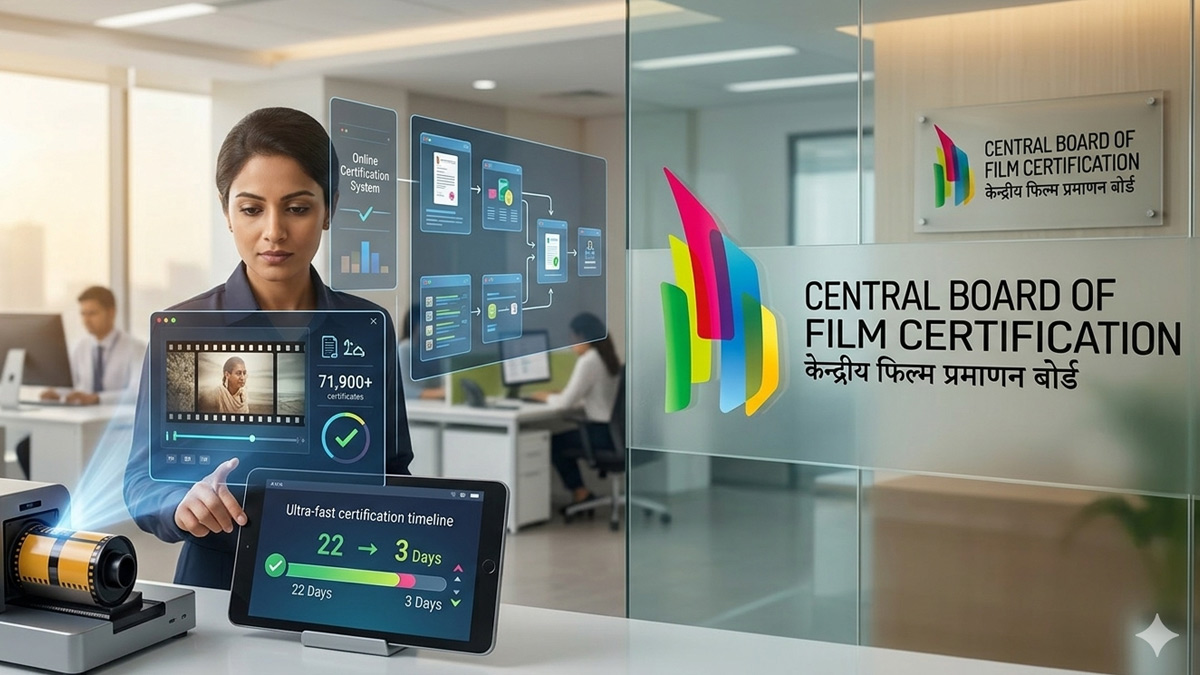
MUMBAI: The Central Board of Film Certification (CBFC) has significantly reduced the time taken to certify films, with the average approval timeline now down to 22 working days for feature films and just three days for short films.
Operating under the Ministry of Information and Broadcasting, the statutory body certifies films for public exhibition in line with the Cinematograph Act, 1952 and the Cinematograph (Certification) Rules, 2024. The rules prescribe a maximum certification period of 48 working days, though the adoption of the Online Certification System has sharply accelerated the process.
Over the past five years, from 2020-21 to 2024-25, the board certified a total of 71,963 films across formats. Of these, the majority fell under the U category with 41,817 titles, followed by UA with 28,268 films and A with 1,878 films. No films were certified under the S category during the period.
Film approvals have also steadily risen in recent years. The CBFC cleared 8,299 films in 2020-21, a figure that peaked at 18,070 in 2022-23 before settling at 15,444 films in 2024-25. During the same period, 11,064 films were certified with cuts or modifications.
Despite the high volume of certifications, outright refusals remain rare. Only three films were denied certification over the last five years, with one refusal recorded in 2022-23 and two in 2024-25.
The board may recommend cuts or modifications if a film violates statutory parameters relating to the sovereignty and integrity of India, security of the state, friendly relations with foreign states, public order, decency or morality, defamation, contempt of court or incitement to an offence.
Filmmakers can challenge CBFC decisions in court. Data shows that such disputes remain limited but have seen some fluctuation. Between 2021 and 2025, a total of 21 certification decisions were challenged before High Courts, with the number rising to 10 cases in 2025.
Responding to a question in the Rajya Sabha, minister of state for information and broadcasting L. Murugan shared the data. The question was raised by Mallikarjun Kharge.
With faster timelines and a largely digital workflow, the certification process appears to be moving at a far brisker pace, signalling a shift towards quicker clearances for India’s growing film output.