News Headline
MIB directive on PwD-friendly programming leaves broadcasters sceptical

MUMBAI: Though laudable, a new government directive on making all TV shows on all channels specially-abled people friendly has left the broadcasting industry sceptical as it would be difficult to implement the directive across all genres of programming 24×7.
A senior executive of a major TV company on condition of anonymity told Indiantelevision.com, “It’s impossible to execute this for the entire 24-hour programming cycle. This issue should be discussed with industry bodies like the News Broadcasters Association (NBA) and others before the TV channels figure out what to do. Anyway, most channel screens are already so cluttered and doing what the government wants us to do will also increase the programming cost.”
The Ministry of Information and Broadcasting (MIB) issued a letter dated 7 February 2019 regarding the concerns raised by the Department of Empowerment of Persons with Disabilities (DoEPwD) in the past. The concerns were raised for the formulation of Accessible India Campaign (Sugamya Bharat Abhiyan) for achieving universal accessibility for persons with disabilities (PwDs) which had stressed that access to TV programmes for many persons with disabilities is denied due to lack of assistive technology.

The ministry requested all TV channels, News Broadcasters Association (NBA), Indian Broadcasting Foundation (IBF) and Association of Regional Television Broadcasters of India (ARTBI) to carry the same language captions and audio description along with the programmes and news reports by TV channels for accessing by differently abled people, vide advisory dated 13 June 2016.
Concurring with the above sentiment, another TV executive, while dubbing the directive "unimaginative", said with the TV channels presently grappling with a new tariff regime and squeezed bottomlines, implementing the diktat of the government will put additional financial pressure on industry players.
Another media executive of a regional news channel said, “Language captions are not that easy to place on a screen. You need expertise to reconstruct or translate it properly. For a news channel it is always live and to describe anything in a sign language you have to be very punctual. Manpower will also increase and lead to an increase in programming cost. The intention is very good; I’m in complete support of MIB. The implementation part is a bit difficult. The language caption will damage the look and feel of the channel.”
The advisory stated that the media has always been in the forefront of taking up important issues/causes including those for the welfare of the disadvantaged sections of the society and in the recent past, Republic Day Parade with commentary/Independence Day Ceremony was carried with sign language interpretation for the benefit of differently abled people.
MIB requested all the private satellite TV channels to carry TV programs with sign language interpretation for accessing by differently able people.
NBA and Indian Broadcasting Foundation could not be contacted for comments.
With an aim to make communications and TV services more accessible to people with disabilities (PWDs), the Telecom Regulatory Authority of India had come out with a series of recommendations last year, including a confusing one suggesting that 50 per cent TV channels to be developed in PWD-friendly and accessible format over the next five years. TRAI suggested that manufacturers maintain accessibility standards for set top boxes (STBs), mobile phones and landlines. Box makers were given till 2020 to make or import at least one model in different variants in an accessible format.





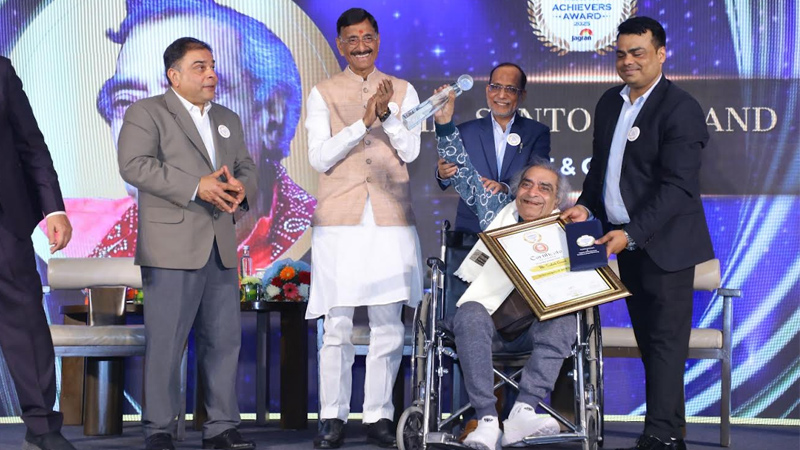
NEW DELHI: Hamdard Laboratories gathered a cross-section of India’s achievers in New Delhi on Friday, handing out the Hakeem Abdul Hameed Excellence Awards to figures who have left their mark across healthcare, education, sport, public service and the arts.
The ceremony, attended by minister of state for defence Sanjay Seth and senior officials from the ministry of Ayush, celebrated individuals whose work blends professional success with a sense of public purpose. It was as much a roll call of achievement as it was a reminder that influence is not measured only in profits or podiums, but in people reached and lives improved.
Among the headline awardees was Alakh Pandey, founder and chief executive of PhysicsWallah, recognised for turning affordable digital learning into a mass movement. On the sporting front, Arjuna Awardee and kabaddi player Sakshi Puniya was honoured for her contribution to the game and for pushing women’s participation onto bigger stages.
The cultural spotlight fell on veteran lyricist and poet Santosh Anand, whose songs have echoed across generations of Hindi cinema. At 97, Anand accepted the honour with characteristic humility, reflecting on a life shaped by perseverance and hope.
Healthcare honours spanned both modern and traditional systems. Manoj N. Nesari was recognised for strengthening Ayurveda’s place in national and global health frameworks. Padma shri Mohammed Abdul Waheed was honoured for his research-backed work in Unani medicine, while padma shri Mohsin Wali received recognition for his long-standing contribution to patient-centred care.
Education and social development also featured prominently. Padma shri Zahir Ishaq Kazi was honoured for decades of work in education, while former Meghalaya superintendent of Police T. C. Chacko was recognised for public service. Goonj founder Anshu Gupta received an award for his dignity-centred rural development initiatives, and the Hunar Shakti Foundation was honoured for empowering women and young girls through skill development.
The Lifetime Achievement Award went to former IAS officer Shailaja Chandra for her long career in public healthcare and governance, particularly in the traditional systems under Ayush.
Speaking at the event, Hamdard chairman Abdul Majeed said the awards were a tribute to those who combine excellence with empathy. “These awardees reflect Hakeem Sahib’s belief that healthcare, education and public service must ultimately serve humanity,” he said.
Minister Seth struck a forward-looking note, saying India’s young population gives the country a unique opportunity to become a global destination for learning, health and wellness by 2047.
The ceremony also featured the trailer launch of Unani Ki Kahaani, an upcoming documentary starring actor Jim Sarbh, set to premiere on Discovery on 11 February.
Instituted in memory of Unani scholar and educationist Hakeem Abdul Hameed, the awards have grown into a national platform that celebrates those building a more inclusive and resilient India. For one evening at least, the spotlight was not just on success, but on service with substance.








