Hardware
Meet the brains behind Caavo, India-designed unique STB

MUMBAI: Meet the brains who founded the unique Caavo, a device that delivers a unified TV experience where devices and services come together to offer ultimate control. Caavo TV box serves as a universal control system for cord cutters that have multiple streaming boxes. The device is equipped with voice recognition, and can find specific content requested across your TV sets and your cable box.
Ashish Aggarwal is one of the co-founders of Caavo who is working on this successful project since June 2015. Before founding Caavo, Aggarwal, an MS and PhD (electrical engineering) from University of California, Santa Barbara, was employed by Violet3D between May 2009 and June 2015 in Bangalore, prior to which he worked with Harman International for over an year as the director of advanced technology in Los Angeles.
The other co-founder is Vinod Gopinath who started working on Caavo in March 2015. Before Caavo happened, Gopinath, a post-graduate from XLRI Jamshedpur, was employed as Snap Networks COO since September 2012 in India before which he served on the board of directors of shufflr.tv (althea systems).

Caavo delivers a unified TV experience. Rather than attempting to consolidate into one box, Caavo connects all of the pieces: pay TV, streaming, and gaming, then unites the experience. The power of Caavo lies in its ability to combine fragmented entertainment devices and the vast, yet ever changing content across all of them into something magical. Caavo’s HDMI output can be connected either directly to a TV or through an [AV Receiver]. Caavo supports Dolby and DTS pass thru from source to the AVR.
By interconnecting pay TV, streaming, and gaming, Caavo brings together your devices, services and control. They work together seamlessly, making it easy to find and play all of TV.
Also Read
http://www.indiantelevision.com/dth/dth-services/dth-stbs-interoperability-to-be-ensured-with-meity-bis-help-170210
http://www.indiantelevision.com/dth/dth-services/dish-tv-ali-tie-up-chipset-tech-vital-for-secure-vas-enriched-viewing-170211
http://www.indiantelevision.com/iworld/telecom/mobitv-powers-jio-live-receives-us-21m-for-ip-based-video-sans-stb-170222




Hardware
India clears Rs 1.6 lakh crore semiconductor projects under Semicon India
Ten projects cleared as production begins and design ecosystem gathers pace
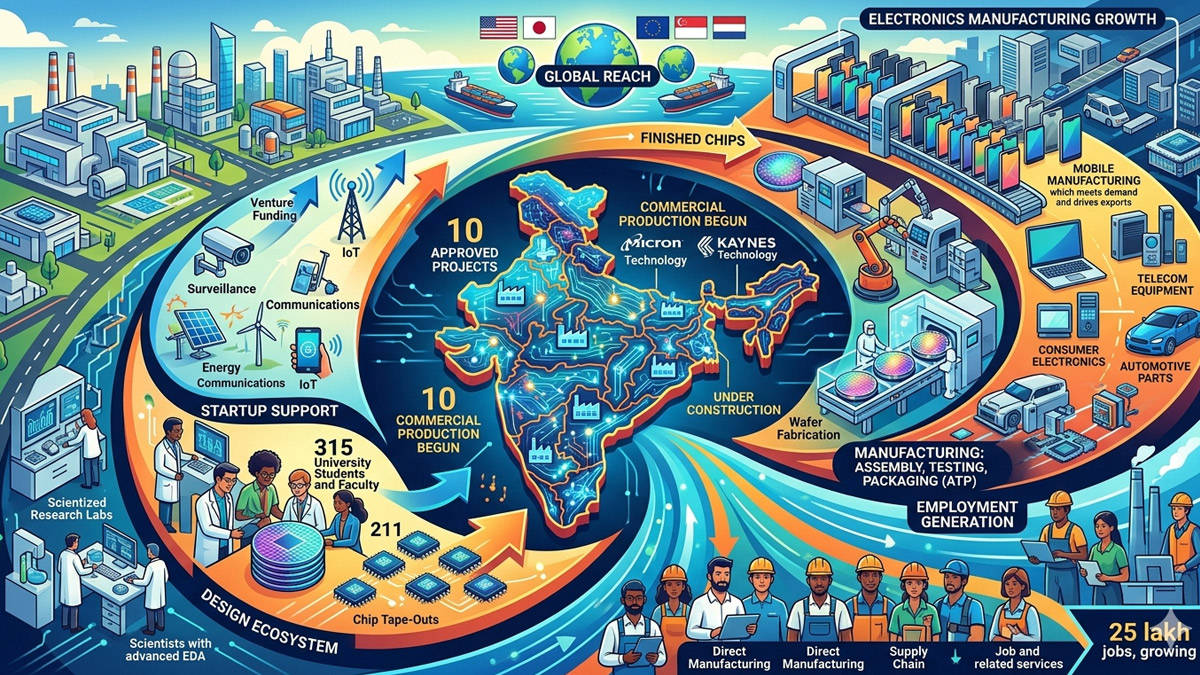
NEW DELHI: India’s push to become a global electronics powerhouse is gaining momentum, with the Semicon India Programme driving the creation of a full-fledged semiconductor ecosystem from design to manufacturing.
Launched in 2022, the programme aims to build capabilities across the entire value chain, including chip design, fabrication, assembly, testing and packaging. In just four years, the government has approved 10 semiconductor projects with a combined investment commitment of around Rs 1.6 lakh crore.
Two of these facilities have already begun commercial production, including units led by Micron Technology Inc. and Kaynes Technology India Limited. Two more plants are expected to go live later this year, signalling that India’s chip ambitions are moving from blueprint to factory floor.
The broader electronics manufacturing story has also seen sharp growth over the past decade. Production has jumped from roughly Rs 1.9 lakh crore in 2014-15 to about Rs 12 lakh crore in 2024-25, while exports have surged nearly eightfold. Mobile phone manufacturing, once heavily import-dependent, now meets almost all domestic demand and has become a major export driver.
Alongside manufacturing, the government is investing heavily in design capabilities. Through access to advanced chip design tools provided free to 315 universities, students and researchers have clocked over 200 lakh hours of usage. This effort has already resulted in 211 chip tape-outs from 75 institutions.
Support for startups is also picking up pace. Twenty-four chip design projects have been approved, targeting sectors such as surveillance, energy, communications and IoT. Of these, 14 companies have collectively raised over Rs 650 crore in venture funding, while several designs have progressed to fabrication, including at advanced nodes.
To strengthen supply chains, India has also signed semiconductor cooperation agreements with countries including the United States, Japan, the European Union, Singapore and the Netherlands. These partnerships aim to reduce global dependencies while boosting domestic capabilities.
The employment impact is equally significant. The electronics sector now supports an estimated 25 lakh jobs, with mobile manufacturing alone accounting for nearly half. As more semiconductor units come online under the India Semiconductor Mission, indirect job creation across supply chains is expected to rise further.
Sharing these updates in Parliament, Ministry of Electronics and Information Technology minister of state Jitin Prasada underscored the government’s focus on building a resilient, end-to-end semiconductor ecosystem.
With factories taking shape, designs moving to silicon and investments flowing in, India’s semiconductor story is steadily shifting gears from ambition to execution.






