News Broadcasting
Media sector feels isolated by budget


NEW DELHI: The media and entertainment industry is feeling a bit left out from Jaswant Singh’s first Budget. Though the finer print is yet to be read and interpreted, the industry, in general, is feeling `what a shame, we’re not there’!
A head of a media company, on condition of anonymity, admitted that the FM has left them out in the cold. “It is quite disappointing that we as an industry have got lost amidst sectors like infrastructure, health and what have you,” he said, adding, “At least the duties on various equipment meant for broadcasting could have been rationalised or brought at par with the IT sector that has, again, got huge sops. All this, at a time when the I&B minister has declared that he would like to push the media and entertainment industry.”
A senior executive of Siti Cable pointed out that the hike in the service tax has come as “quite a blow.” Though Siti Cable as an MSO doesn’t pay a service tax on the cable service as it is the cable operators who are taxed, an MSO has to pay service tax on the ads that are carried on their video channel.

Quite disappointed that there is “nothing apparent” on the reduction or rationalisation of duties on components for STBs or even on import of STBs in the semi-knocked down kits, the Siti cable executive admitted, “It may mean that the consumers would have to bear part of the costs of the STBs as their prices are unlikely to come down.”
Can the government do a mid-course correction as far as STBs are concerned, especially when CAS rollout is being pushed through aggressively? Yes, the finance ministry can bring out orders before the finance bill is passed— that means full okay of the Budgetary proposals — but the various official procedures would be time consuming. Something that the cable industry doesn’t have much of.
But National Cable & Telecom Association president Vicky Chowdhry was more critical of the lack of attention to the industry by the government in the budget.
Chowdhry said, “They have proposed to increase the service tax, good. The consumers will pay. These are such measures where if the industry gets more strident, the politicians would back track. Remember, how last year Yashwant Sinha had to rollback quite a few budgetary proposals after the industry and then his party men termed those consumer-unfriendly.”
TV18 MD Raghav Bahl who spent most of the morning and afternoon questioning people on the budget on the business and finance channel CNBC India did admit to us that the “media industry seems to have got a bit isolated.”
“Any move on the STB front (rationalisation or cut in duties on components)would have been pro-consumer. No mention must be a disappointment for the CAS stakeholders,” he said, pointing out that the increase in service tax did not take him by surprise. “The increase has come for everybody and not singularly for the broadcasting industry,” he explained.






News Broadcasting
News18 India launches Command Centre war explainer with Arya
New show shifts from debates to decoding global conflicts and impacts
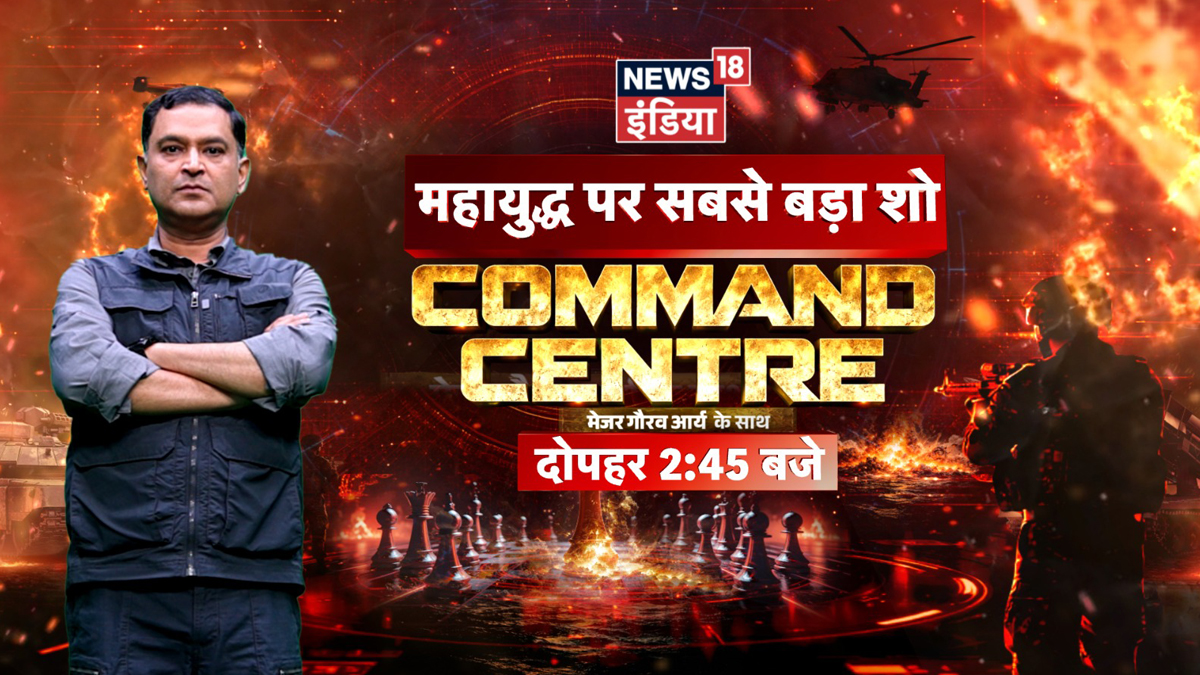
MUMBAI: News18 India has rolled out a new war-focused programme, Command Centre, featuring Gaurav Arya, as it looks to offer viewers a sharper, more grounded take on global conflicts amid rising tensions in West Asia.
Positioned as an “insider war room”, the show moves away from conventional panel debates and instead focuses on explaining military developments, decoding strategy and connecting global events to their everyday impact, from fuel prices to economic shifts.
The format leans heavily on visuals and data. The studio has been designed like a command hub, complete with large LED war maps, real-time graphics and an alert system to track developments as they unfold.
At the centre of it all is Arya, who brings his military background to simplify complex war strategies for viewers. His signature line, “Seedhi baat samjhiye”, anchors the show’s promise of clarity over noise.
News18 India managing editor Jyoti Kamal said, “Command Centre, featuring Major Gaurav Arya is designed to deliver accurate insights and a clear perspective on how evolving conflicts impact everyday life, from household budgets to national security. With expert voices analysing every development in real time, the show goes beyond headlines to decode what’s happening now, what it means, and what could come next.”
Echoing the intent, Gaurav Arya added, “In times of war, confusion is the biggest threat. With News18 India’s Command Centre, we are bringing viewers inside the war room, decoding strategies, tracking every escalation, and explaining, in the simplest terms, what it means for India and for every household. Seedhi baat samjhiye, this is where you understand not just what is happening, but what happens next.”
The weekday show will air in the afternoon slot and will also feature Gaurav Shukla, adding to its editorial depth.
With its mix of analysis, visuals and a clear focus on impact, the show reflects a broader shift in news consumption. Viewers are no longer just watching events unfold, they are looking to understand what those events mean for them.







