News Broadcasting
Media firms straddling various segments; government worried

MUMBAI: Indian media companies are heading towards vertical models, spread across television and print businesses.
A case in point: Sun Network snapping up Dinakaran, marking an entry into the newspaper market. And, Zee Telefilms chairman Subhash Chandra is in the process of launching DNA English daily in Mumbai, with Dainik Bhaskar as the joint venture partner.
It really is a two-way traffic. Print media companies are getting into television ventures as much as there is movement the other way. The Times of India Group has already launched Zoom and its news channel will soon start beaming. ABP Group, which owns Anand Bazar Patrika, Telegraph and Businessworld publications, has a joint venture with Star Group to run Star News and Star Ananda, while drawing up plans to launch new channels.

Why are media companies heading going in for diversified businesses within the segment? Perhaps, the stage is being set for mega companies to emerge, while the space for smaller players is getting increasingly choked. It is no longer safe to rest as a significant player in a particular territory. The Delhi-headquartered Hindustan Times (HT) and Bangalore-based Deccan Herald will vouch for the fact. No more can you afford to crawl in this business.
The trend was started by Hindi dailies like Dainik Bhaskar and Jagran that started sniffing in neighbouring territories, apart from foraying into TV with a news channel. Multiple editions helped them increase their readership base in towns that were emerging as new growth centres.
In English print news segment it was The Times of India that set the pace, taking the battle to HT in Delhi. Next it attacked Deccan Herald in Bangalore, disturbing the earlier contours of influence among newspaper organizations, which were rooted to single metro cities without attempting to spread tentacles outside – Times in Mumbai, HT in Delhi and Hindu in Chennai.
However, now the contours of the media market are undergoing cataclysmic changes. So now you see a new game played by newspaper barons. Deccan Chronicle, for instance, has expanded into Chennai to get strong presence in the big markets of Andhra Pradesh and Tamil Nadu in the southern region. Bangalore could be the next destination with Deccan Herald in a fluid market situation. In the non-South markets, The Asian Age will be put as a warrior brand, which is why the group recently bought out the stake of other partners.
The success of Dainik Bhaskar in multiple editions even outside the Hindi language belt goes to prove how print organisations have to create their empires and be ready for future combat in an era of consolidation. While an intensified rivalry is going on among print publications, TV media barons have realised the advantage they would have in cross-holding platforms. Sun Group’ CMD Kalanithi Maran’s interest lies in the southern language market where he already dominates the television space.
An aggressive player, Maran is planning to relaunch Dinakaran soon and move it up the ladder from the third spot to leadership position in Tamil Nadu. He has to contend with market leader Daily Thanthi and Dina Malar, a tough task as they have a strong, loyal readership.
But don’t miss the moot point: Maran has shown how television and FM radio platforms can be effectively used to grow print presence. Kungumam, owned by the Maran family, has become the top Tamil weekly magazine, toppling the leading Tamil weeklies Kumudham and Anandha Vikadan.
In Andhra Pradesh, Ramoji Rao has extended his print business to television channels even outside southern languages. He, in fact, has a movie studio model with television as logical extensions. If Maran decides to set foot here, he will have to contest with the Eenadu Group and also Deccan Chronicle, which, however, has no TV presence yet. While Maran already has established Gemini TV as the leading channel in the state.
At a time when so many players are crossing borders, Chandra, as the promoter of the country’s largest vertically integrated media company, has also realised the importance of having a stake in the print medium. Earlier, Chandra had made feeble attempts in 1999 when he hired Deepak Shourie, having a print background in India Today and HT, but these were in fringe areas like launching a film magazine called Premiere. He quickly abandoned these plans. Reviving his dream, he has now zeroed down on an English daily that would take Times head on in Mumbai.
Where will all these wars lead to? We will have media magnates owning television, print and radio businesses. And, that is something that’s worrying the government. No wonder, the policy-makers, not used to giving up power and control, are now thinking of curbing the growing influence of media companies and monopolies that might be created through cross-media restrictions.







News Broadcasting
UDF poised to return to power in Kerala, says Manorama-CVoter survey
Massive opinion poll projects shift in Kerala politics ahead of 2026 Assembly elections.
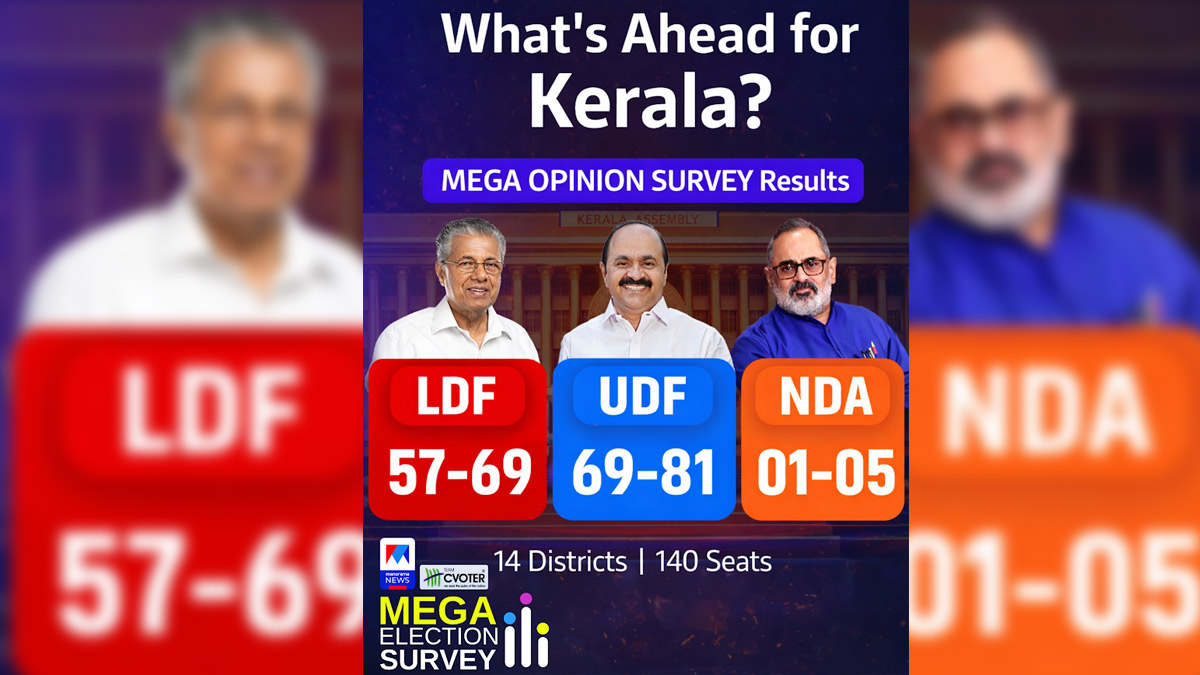
MUMBAI: The winds of change appear to be blowing through Kerala’s political landscape and this time, they seem to favour the United Democratic Front. A comprehensive mega opinion survey conducted by Manorama News in partnership with CVoter projects a potential comeback for the UDF in the upcoming Kerala Legislative Assembly Elections 2026. The survey, covering all 140 constituencies with a massive sample size of nearly 90,000 respondents, predicts the UDF could win between 69 and 81 seats.
The ruling Left Democratic Front (LDF) is expected to secure 57 to 69 seats, a significant drop from the 99 seats it won in the 2021 elections. This would mean the LDF losing 30 to 42 of its sitting seats. Meanwhile, the National Democratic Alliance (NDA), which drew a blank in 2021, is projected to open its account with 1 to 5 seats.
Region-wise, the UDF is expected to make strong gains in Malabar, winning 25 to 34 out of 48 seats, and in Central Kerala, where it could bag 29 to 33 out of 53 seats. In South Kerala, the LDF is likely to retain an edge with 21 to 25 seats, while the UDF may improve to 12 to 16 seats. The NDA could pick up 1 to 3 seats in the southern region.
The survey was conducted between 14 and 26 March 2026, with additional tracker and snap polls carried out from December 2025 to March 2026. A total of 89,693 respondents participated, ensuring representation across all demographics and social segments.
Manorama News has a strong track record of accuracy, with its previous projections closely matching the actual results of the 2019 and 2024 Lok Sabha elections as well as the 2021 Kerala Assembly polls.
In Kerala’s famously fierce political battles, this survey suggests the pendulum may be swinging back. Whether the final verdict matches these numbers or throws up another surprise, one thing is clear, the 2026 Assembly elections are shaping up to be one of the most keenly watched contests in the state’s history.






