I&B Ministry
Mass Comm courses in regional languages significant: Naidu

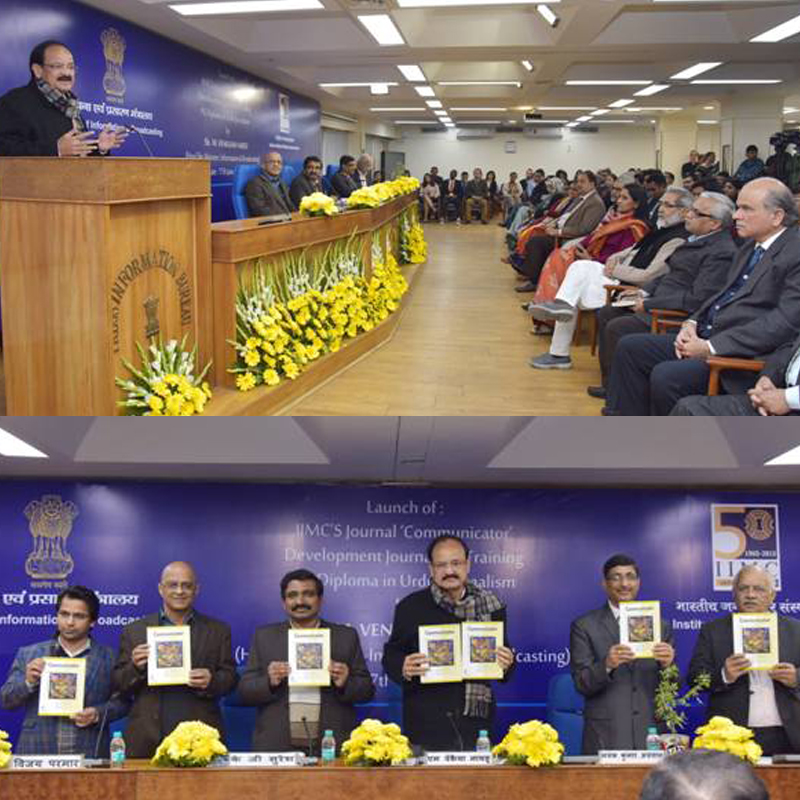
NEW DELHI: Information and Broadcasting Minister M Venkaiah Naidu has stressed the vast need of skilled personnel in the media and entertainment sector in the country as the sector was expanding rapidly.
The Minister referred to the prominent role being played by the Government’s Skill India Initiative for upgrading skills under multiple disciplines. He added that the vision of this Government was to bring Transformational changes in all sectors.
Speaking about the changing paradigm in communication, the Minister said Social Media has broken the boundaries of time and space in communication. It is a pre-requisite for budding journalists to be social media savvy and to have a watchful eye about the public perception on issues of local and international importance.

He advised students aspiring to become journalists in future to ensure that news and views are not mixed and be objective. Every budding young journalist should have an open mind to acquire maximum knowledge to present the perspective in an objective manner. He urged students to keep abreast with the latest developments, new technology and new modes of communication and should inculcate a habit of reading to remain relevant and effective.
He also called upon the Indian Institute of Mass Communications to strive for journalism courses in all Indian languages to cater to the communication needs of the citizens all across the country.
The Minister was speaking after inaugurating the First PG Diploma course in Urdu Journalism, the 67th Diploma course in Development Journalism, and the launch of the IIMC Journal “Communicator” at Shastri Bhawan.
Emphasizing on the training methodology, Naidu said it was important in the current scenario to include Case studies and practical exposure as a part of curriculum for learning, practising and applying new concepts. He also stressed the need for imparting an outlook that is rooted in strong ethical values among budding journalists and communicators.
Naidu said Urdu journalism was an important and integral part of media and communication landscape of our country which had played an important role in the Freedom Struggle.
Inaugurating the 67th Development Journalism course, the Minister said India is today regaining the lost glory of being the Knowledge hub of the world. The Development Journalism course provided a great opportunity for understanding and appreciating each other’s culture, and developing bonds of friendship.
He added that journalist scholars from various Developing Countries were unofficial Ambassadors of India who shall provide a link of brotherhood among different cultures through their writings. The 67th batch of Development Journalism course at IIMC has 23 scholars (12 females and 11 males) from 19 different countries.







I&B Ministry
India tightens anti-piracy law, blocks sites and Telegram channels
New rules bring jail terms, fines and faster takedowns of illegal content

NEW DELHI: The Government of India has stepped up its fight against film piracy, invoking stricter provisions under the Cinematograph Amendment Act 2023 to crack down on unauthorised recording and distribution.
The law now imposes tougher penalties, including jail terms ranging from three months to three years and fines starting at Rs. 3 lakh, which can go up to 5 per cent of a film’s production cost. The provisions target both illegal recording in cinemas and unauthorised online transmission.
In a fresh enforcement push, authorities have notified the Telegram platform to act against piracy, leading to the identification of 3,142 channels allegedly distributing copyrighted content without permission. In parallel, access to around 800 piracy websites has been blocked through internet service providers.
The action has been taken under the Information Technology Act 2000, which empowers the government to direct intermediaries to remove unlawful content. The framework is further reinforced by the Information Technology Rules 2021, requiring platforms to act swiftly when notified of violations.
An institutional mechanism is also in place, allowing copyright holders and authorised representatives to file complaints through designated nodal officers. Once verified, these complaints trigger takedown notices to intermediaries for disabling access to infringing content.
The update was shared in Parliament by Government of India minister of state information and broadcasting l murugan in response to a query from Parimal Nathwani.
The government’s latest move signals a sharper, more coordinated approach to tackling piracy across both physical and digital channels. For the film industry, it is a step towards protecting revenues, while for viewers, it reinforces the shift towards legitimate content consumption.








