eNews
Maharashtra governor Ramesh Bias to inaugurate Bharat Rang Mahotsav 2024

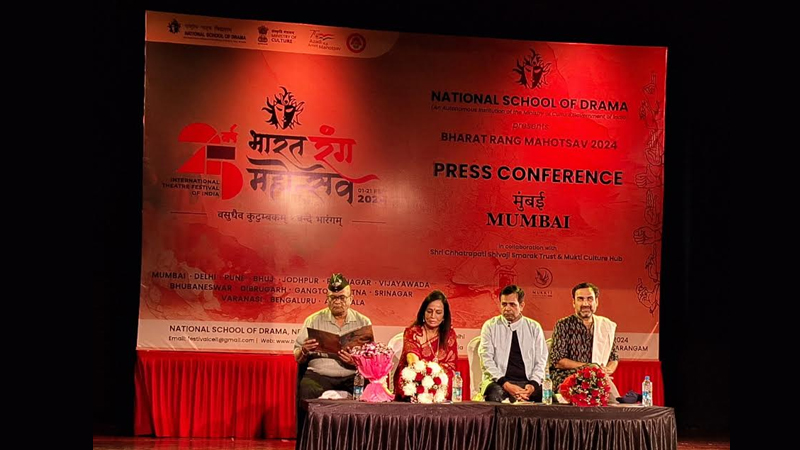
Mumbai: The National School of Drama (NSD) has announced the forthcoming Bharat Rang Mahotsav (BRM 2024), the world’s largest theatre festival. BRM will kick off with a splendid inaugural ceremony at the National Centre for the Performing Arts (NCPA) in Mumbai on 1 February 2024. His excellency governor of Maharashtra Ramesh Bais, accompanied by NSD chairperson Paresh Rawal, will officially open the festival with a special ceremony.
The event is scheduled to take place from 1 February to 21 February, 2024. Spanning across 15 cities in the country, this 21-day theatre festival will feature over 150 performances, and numerous workshops, discussions, and master classes, providing a rich tapestry of Indian and global theatre traditions. Additionally, this year will commemorate the 25-year-anniversary of the inception of Bharat Rang Mahotsav.
The Mumbai press conference was addressed by NSD director Chittaranjan Tripathy, NSD Society chairperson Paresh Rawal, BRM ambassador (Rang Doot) Pankaj Tripathi, Mukti Foundation founder & chairperson Smitha Thackeray, Shri Chattrapati Shivaji Smarak Mandal (Trust) chairman Brigadier Sudhir Sawant and other prominent members of NSD were present at the press conference.

To promote theatre in Mumbai, Mukti Cultural Hub has partnered with Bharat Rang Mahotsav. Mukti Foundation chairperson Smita Thackeray has provided crucial support, enabling Mukti Cultural Hub to host three days festival from 4 to 6 February. Additionally, Shivaji Natya Mandir has generously supported the festival, hosting two days festival in their theatre auditorium on 2 and 3 February.
This year’s festival revolves around the theme Vasudhaiva Kutumbakam, Vande Bharangam, fostering global unity among thespians and artists. Emphasizing social harmony, it seeks to create a sense of a shared world – the entire world one large family, bringing diverse cultures together through the powerful medium of the performing arts for a truly enriching experience.
NSD director Chittaranjan Tripathy expressed profound enthusiasm for the impending festival, stating, “As we embark on the 25th year of the Bharat Rang Mahotsav, it is truly a momentous occasion that reflects our enduring commitment to artistic excellence and cultural diversity. Over the post quarter-century, this festival has served as a guiding light, illuminating the rich tapestry of global theatre traditions. The upcoming edition promises to be a grand celebration, showcasing not only the extraordinary creativity within the theatrical realm but also emphasizing the beauty of collaboration. We are dedicated to fostering the magic of theatre, providing a platform for diverse voices and narratives to thrive. This year’s festivities will not only mark a milestone but also reaffirm our steadfast belief in the transformative power of the performing arts.”
In Mumbai, this cultural extravaganza, set to enchant audiences for six exhilarating days from 1 to 6 February 2024, will culminate with a grand closing ceremony on 6 February at Mukti Cultural Hub. It will feature a total of six captivating plays, each a masterpiece in its own right, spanning various genres and languages. It will commence with the compelling play Humare Ram, featuring renowned actor and NSD alumnus Ashutosh Rana, produced by Felicity Theatre, Delhi, followed by a diverse array of productions, including ‘GAJAB TICHI ADA’ by Rangpeeth Theatre, Mumbai, ‘BABUJI’ by NSD Repertory Company, New Delhi, ‘THE ZOO STORY’ by Panchkosi, Delhi, ‘TODI MILL FANTASY’ by Theatre Flamingo, Goa, and ‘SWAHA’ by Darpan, Lucknow.
The 25th year of this festival holds special significance as it brings together diverse theatrical voices in a celebration of the magic of theatre. Audiences can expect a captivating array of theatrical forms, including international productions, folk and traditional plays, modern dramas, graduate showcases, and collegiate street plays. The festival will unfold in parallel venues across Mumbai, Pune, Bhuj, Vijayawada, Jodhpur, Dibrugarh, Bhubaneswar, Patna, Ramnagar, and Srinagar, ensuring a nationwide celebration of the transformative power of theatre.
In an innovative move, this year NSD also introduces Rang Heat, an annual initiative aimed at establishing Asia’s inaugural global theatre market and nurturing international collaborations. in the theatrical domain. Rong Hoat will unite theatre artists, programmers, patrons, and supporters, fostering the discovery of hidden talent, showcasing international projects, and facilitating both creative and financial partnerships. Participants will gain exposure to a broader audience, fostering potential collaborative ventures and injecting dynamism into the global theatre landscape.
The BRM extends beyond the stage, offering a plethora of enriching experiences. Parallel exhibitions, director-audience dialogues, discussions, and seminars will explore various facets of theatre, sparking stimulating conversations and insights. Attendees can engage in masterclasses with veteran thesplans, immerse themselves in the vibrant Rang Haat, and explore the diverse offerings at the Food Bazaar, letting the spirit of theatre truly captivate them.






eNews
Paisabazaar launches Credit Premier League 2.0
Nationwide campaign rewards highest credit scores with Rs 1 lakh top prize.

MUMBAI: When credit scores become a national league, even your CIBIL report starts feeling like it’s playing in the IPL and Paisabazaar has just kicked off the second season. Paisabazaar, India’s leading marketplace for financial products and the country’s largest free credit score platform, has announced the return of the Credit Premier League (CPL) 2.0, a fun, nationwide initiative to recognise and reward individuals with the highest credit scores.
Building on the success of the first edition, CPL 2.0 introduces higher rewards and broader participation. The individual(s) with the highest credit score in the country will win Rs 1 lakh, while state champions will each receive Rs 10,000. Additionally, all participants from the winning state, the one with the highest average credit score will also be rewarded.
All winnings will be credited directly to winners’ PB Wallet, allowing them to pay credit card bills, recharge mobiles, or settle utility bills seamlessly on the Paisabazaar platform.
Paisabazaar CEO Santosh Agarwal said the campaign aims to make credit awareness more engaging and mainstream. “With CPL, we are bringing together engagement, gamification and rewards to make conversations around credit scores more mainstream,” he noted. “Our focus remains on building a financially aware and credit-healthy Bharat.”
The first edition of CPL saw over 5.5 million participants, with the highest individual score touching 861. Delhi recorded the highest average credit score of 746.
Consumers can participate simply by checking their free credit score on the Paisabazaar platform or app. The CPL leaderboard and rankings will be available exclusively on the Paisabazaar App.
In a country where financial dreams are serious business, Paisabazaar has found a smart way to turn credit scores into an exciting game – because when your financial health gets rewarded, everyone wants to play.






