English Entertainment
Looking for a digital high


MUMBAI: With the number of netizens increasing day by day in the country, for a brand to create conversation with the target audience on the digital platform has become an utmost priority.
And following this mantra are English movie and entertainment channels, who are eagerly trying to tap into the virtual space, where their target audience spends most of the time.

According to Zee Studio and Zee Café content and marketing head Sharlton Menezes social media enables channels to create relationships with their viewers and at the same time raise awareness around their offerings. “It also makes us more accessible to viewers for feedback and queries they may have,” he says.
Agreeing with the point, Pix VP marketing Neville Bastawalla adds, “Great programming for digital is key which will provide great entertainment, which will in return drive great organic engagement.”
For another prominent player in the fragmented space, HBO, a major reason for encouraging digital engagement is to have their ‘ear on the ground’, so they get a pulse of what the audience likes, dislikes, expects, accepts and rejects. “The higher the interaction with the audience on a specific film, the greater the probability of this involvement being translated into tune-ins for that film,” feels HBO India South Asia managing director Monica Tata.
English movie channels have a legion of followers on social media. On Facebook for example, Star Movies has 3,877884 likes, Pix has 21,68,570, HBO has 34,17,539, Zee Studio has 14,55,263 while Movies Now has 4,421,487 likes. On twitter, Pix has 49.2 K followers, Movies Now has 133 K, Zee Studio has 63. 4 K , Star Movies has 96.7 K while HBO India has 55.4 K followers.
Social media has been a pivotal stage ahead of movie premieres and campaigns for the channels. For instance, Movies Now’s second season of 100 Mania campaign, starting 7 December, will see viewers stand a chance to win prizes like cars, international holidays, iPhone among others by only giving a missed call on the number flashed during 9 pm movie. The 100 Mania season one witnessed an increase in channel viewership and phenomenal viewer participation. The channel saw 25 per cent increase in the GVTs and close to one million missed calls. In addition to that, over 50,000 fans were added to the Facebook page of the channel and the number of Twitter followers shot up from 31,000 to 100,000 in a period of 100 days, claims the channel.
Similarly, Pix’s recently launched campaign ‘Pix School of Bonding’ initiates a live chat between the face of the campaign, Sania Mirza and the fans. The channel has a micro property called Notty Pixy, who is a gossip reporter and provides hollywood news first in India on the social media.
HBO, this year, launched a digital campaign #SteelTheDay, for the movie ‘Man of Steel.’ The buzz started with the famous line ‘It’s a bird, it’s a plan…It’s Superman’, with supported creative’s. Through this campaign, the channel was able to reach three lakh fans generating approximately two lakh interactions on Facebook. On Twitter, within five hours, #SteelTheDay campaign reached 50K accounts generating one lakh plus tweet impressions at an interaction rate of 25 tweets/minute.
Zee Studio, which refreshed the brand this year, had a digital activation running for 15 days starting 3 October where the channel hosted a ‘See it All’ contest on Twitter for its viewers to tune-in to the 9 pm movie and win goodies through contests.
While some of the online content is managed by the in-house teams of the channels, digital agencies are also hired to take it a notch up. HBO’s social media pages are handled by the digital agency OMLogic, who has been working with them since the past five years. Zee café and Zee Studios digital pages are manned by Interactive Avenues, who have been with the channel for the last two years while Tonic Media handles Pix.
The channels claim strong and continuous posts and interactions help them drive strong engagement rate. Bastawalla claims they currently have a 12 per cent engagement rate on social media versus the nearest rival which has a five per cent engagement rate. On the other hand, Tata quoting Sprout Social report from 1 January to 21 September 2014 says that HBO has an engagement rate of 100 per cent. She further says, “As per the Klout report, HBO India has the most influential Twitter account among all the competitors.”
According to Maxus managing partner north and east region Navin Khemka, the matrix is changing as brands today are willing to associate with properties which have a high digital success rate. “Even if a channel is not getting the ratings, but has a high digital engagement rate, the brands are willing to ignore the ratings and continue as partners. So the matrix for evaluation from a brands point of view is also changing,” he concludes.





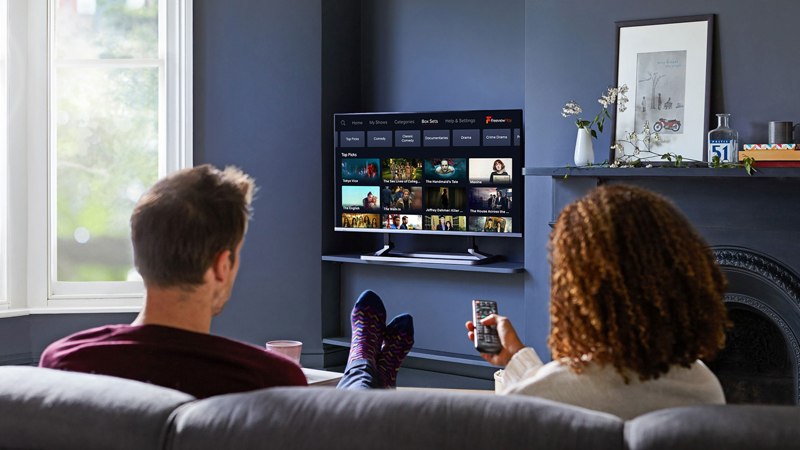
UK: The aerial is losing its grip. As broadband becomes the default way Britons watch television, the UK is edging towards a decisive, and divisive, question: should Freeview be switched off by 2034? The issue, highlighted in reporting by The Guardian, has exposed deep fault lines over access, affordability and the future of public service broadcasting.
For nearly 25 years, Freeview has delivered free-to-air television from the BBC, ITV, Channel 4 and Channel 5 to almost every corner of the country. Even now, it remains the UK’s largest TV platform, used in more than 16m homes and on around 10m main household sets. Yet the same broadcasters that built it are now pressing for its closure within eight years.
Their case rests on a structural shift in viewing. Smart TVs, superfast broadband and the Netflix-led streaming boom have pulled audiences online. Advertising economics have followed. By 2034, the number of homes using Freeview as their main TV set is forecast to fall from a peak of almost 12m in 2012 to fewer than 2m, making digital terrestrial television, or DTT, increasingly costly to sustain.
But critics say the rush to switch off risks abandoning those least able, or least willing, to move online.
“I don’t want to be choosing apps and making new accounts,” says Lynette, 80, from Kent. “It is time-consuming and irritating trying to work out where I want to be, to remember the sequence of clicks, with hieroglyphics instead of words. If I make a mistake I have to start again.”
Lynette is among nearly 100,000 people who have signed a “save Freeview” petition launched by campaign group Silver Voices. She fears the government is about to “take [Freeview] away from me and others who either don’t like, can’t afford, or can’t use online versions”.
Official figures underline the fault lines. A report commissioned by the Department for Culture, Media and Sport estimates that by 2035, 1.8m homes will still depend on Freeview. Ofcom’s analysis shows those households are more likely to be disabled, older, living alone, female, and based in the north of England, Wales, Scotland and Northern Ireland.
Freeview is owned by the public service broadcasters through Everyone TV, which also operates Freesat and the newer streaming platform Freely. After two years of review, DCMS is expected to set out its position soon, drawing on three options proposed by Ofcom: a costly upgrade of Freeview’s ageing technology; maintaining a bare-bones service with only core PSB channels; or a full switch-off during the 2030s.
The broadcasters have rallied behind the third option. They argue that 2034 is the logical cut-off, when transmission contracts with network operator Arqiva expire. By then, they say, the cost of broadcasting to a dwindling audience will far outweigh the returns from TV advertising.
Ofcom agrees a crunch point is approaching. In July, the regulator warned of a “tipping point” within the next few years, after which it will no longer be commercially viable for broadcasters to carry the costs of DTT.
Others see risks beyond economics. Questions remain over whether internet TV can reliably deliver emergency broadcasts, such as the daily Covid updates, in the way that universally available DTT can. The UK radio industry has also warned that an internet-only future for TV could push up distribution costs and force some radio stations off air if PSBs no longer share Arqiva’s mast network.
“It is a political hot potato,” says Dennis Reed, founder of Silver Voices, who says he has “dissociated” his organisation from the government’s stakeholder forum, which he believes is “heavily biased” towards streaming.
The Future TV Taskforce, representing the PSBs, counters that moving online could “close the digital divide once and for all”. “We want to be able to plan to ensure that no one is left behind,” a spokesperson says, adding that rising DTT costs could otherwise mean cuts to programme budgets.
The numbers show the scale of the challenge. Of the 1.8m Freeview-dependent homes projected for 2035, around 1.1m are expected to have broadband but not use it for TV. The remaining 700,000 are forecast to lack a broadband connection altogether.
Veterans of the analogue switch-off, completed in 2012 after 76 years, recall similar fears of “TV blackout chaos”. Around 6 per cent of households were labelled “digital refuseniks”, yet a targeted help scheme and a national campaign, fronted by a robot called Digit Al voiced by Matt Lucas, delivered a largely smooth transition.
This time, the BBC is less keen to foot the bill. Tim Davie, the outgoing director general, has said the corporation should not fund a comparable support programme for a Freeview switch-off.
Research for Sky by Oliver & Ohlbaum suggests that with early awareness campaigns and digital inclusion measures, only about 330,000 households would ultimately need hands-on help ahead of a 2034 shutdown.
Meanwhile, viewing habits continue to fragment. Audience body Barb says 7 per cent of UK households no longer own a TV set, choosing to watch on other devices. In December, YouTube overtook the BBC’s combined channels in total UK viewing across TVs, smartphones and tablets, albeit measured at a minimum of three minutes.
That shift may accelerate. YouTube has recently blocked Barb and its partner Kantar from accessing viewing session data, limiting transparency just as online platforms consolidate power.
“When the government chose British Satellite Broadcasting as the ‘winner’ in satellite TV it was Rupert Murdoch’s Sky instead that came out on top,” says a senior TV executive quoted by The Guardian. “There already is such an outsider ready to be the winner in the transition to internet TV; it is YouTube.”
Freeview’s future now hangs on a familiar British dilemma: modernise fast and risk exclusion, or protect universality and pay the price. Either way, the aerial’s days as king of the living room look numbered.






