iWorld
Local language content drives higher audience engagement: Netflix’ Patrick Fleming


Mumbai: Southeast Asia users consume two times more Netflix content than the global average, and India leads the charts, said Netflix, director of product innovation, Patrick Fleming at the ongoing virtual APOS summit on media, telecoms, and entertainment.
The streaming giant currently has over 209 million paid subscribers globally out of which 27 million subscribers are from APAC markets. While that is a fraction of the total user base, it should be noted that two-third of its paid subscriber growth was driven by the APAC market in 2020. “We know that a substantial part of future subscriber growth is going to come from outside of the US,” said Fleming.
Talking about the mobile-only plan, Fleming said, it has not been a success in all markets. The plan was first launched in India followed by Malaysia, Indonesia, Philippines, and Thailand, followed by markets across Asia and Africa. “We introduced the mobile plan in markets only after experimenting with the right entry price and discerning the demand for video content on mobile,” he added.

Fleming said, “It is important for Netflix to speak more languages to cater to the APAC market. We now offer our content along with subs and dubs across 30 languages, so that a great show may travel anywhere in the world. For example, Thailand prefers dubbed content while South Korea prefers subs.”
While a show like “Money Heist”, “Bridgerton” and “Emily in Paris” has done well in markets like India and Southeast Asia, local language content consistently outperforms in terms of audience engagement, he observed. In India, that means local language films and, in South Korea and Japan that means K-dramas and anime. Launching more payment modes has also increased adoption. Netflix recently enabled autopay via unified payments interface (UPI) in India and GoPay in Indonesia.
The streaming giant has introduced a slew of nifty features that individually may seem like marginal improvements but are incredibly important to a mobile customer. The ideas first came in India and were then tested globally, noted Fleming.
These features include a native brightness, playback speed and lock screen functionality. Currently, the OTT giant is experimenting with a function that plays a short vertical video clip when the user hovers above a title. “The idea is to capture the shorter moments of consumption on mobile devices. The user may not sample the content immediately but may put it in his watch list for later consumption,” said Fleming.
Not just mobile, Netflix can be streamed across 1700 devices and Android and iOS operating systems (OS). Coding efficiency is vital when it comes to mobile customer experience. It was important that the Netflix mobile app was always in a ‘ready to watch’ mode, emphasised Fleming. Features like ‘smart downloads’ and ‘downloads for you’ were introduced to minimize memory usage and ensure that customers transitioned to the next piece of content seamlessly.
Netflix has also partnered with over thousand local internet service providers (ISPs) to join their open connect network so that it may deliver a high-quality video viewing experience. It has purpose-built boxes called open connect appliances that have been deployed at interconnection locations to localise substantial amounts of traffic by ISPs.
“Technology has come a long way in ten years,” said Fleming. “A decade ago you could transmit 1.5 hours of content with 1 Gb of data, in 2015 you could transmit 2.5 hours of content or an entire movie in 1 Gb, today you can transmit 6.5 hours of content or the entire first season of “Stranger Things” in the same amount. The same quality, fewer bits.”
In terms of product innovation, Fleming is bullish about interactivity and branching narratives. “Audiences have loved our interactive content like “Puss in Book” and “Black Mirror: Bandersnatch”. We’re working on an interactive mindfulness series with Headspace and there is the expansion into gaming” noted Fleming.
Netflix has launched two mobile games based on the “Stranger Things” franchise in Poland.
“Mobile audiences are wonderfully impatient,” remarked Fleming when speaking about the need to deliver top notch customer experience on mobile. “We’re not just competing with other long form content platforms but any platform that offers a unique mobile experience.”






Gaming
India’s broadcasters say no to Fifa World Cup 2026
Fifa has slashed its asking price by 65 per cent but India’s broadcasters are still not buying

MUMBAI: The world’s biggest sporting event cannot find a single taker in the world’s most sports-mad nation. Fifa’s television rights for the 2026 World Cup remain unsold in India, and the clock is ticking loudly.
To shift the property, world football’s governing body has already swallowed hard and cut its asking price from $100m to $35m, bundling in the 2030 edition as a sweetener. It has not worked. Indian broadcasters have looked at the offer, done the sums and quietly walked away.
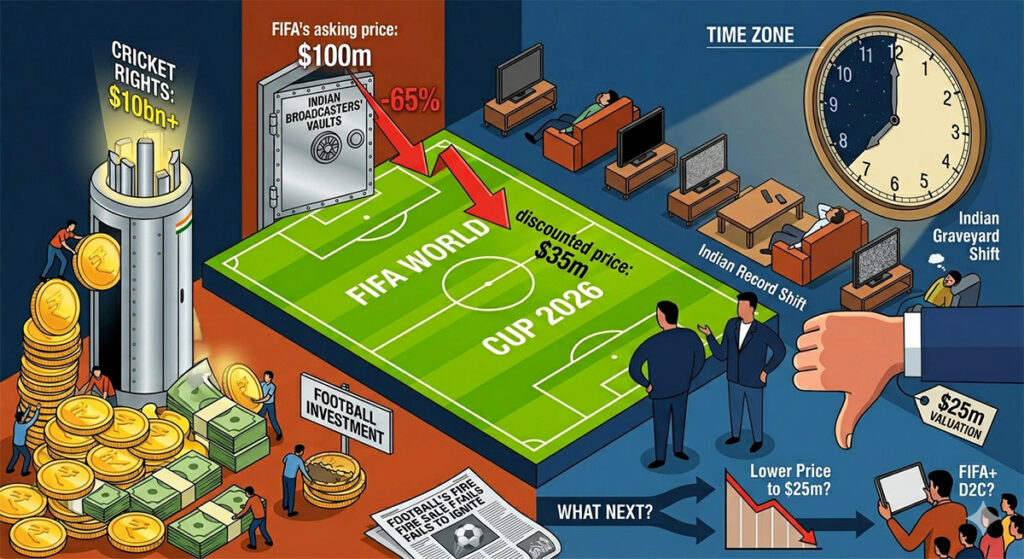
The reasons are brutally simple. The 2026 tournament, co-hosted by the United States, Canada and Mexico, kicks off in a time zone that turns India’s primetime into a graveyard shift. Most matches will air between midnight and 7am IST, a scheduling catastrophe for advertisers chasing mass reach. The 2022 Qatar edition was a gift by comparison, with matches dropping neatly into Indian evenings. North America offers no such luxury.
The market itself has also changed beyond recognition. The merger of Star India and Viacom18 into JioStar has gutted the competitive tension that once sent sports rights prices soaring. Where rival bidders once slugged it out, there is now a single dominant buyer, and it is in no hurry. JioStar has valued the rights at roughly $25m, a full $10m below Fifa’s already-discounted floor price. That gap has so far proved unbridgeable.
Broadcasters are also nursing a ferocious cricket hangover. Between 2022 and 2023, Indian media houses committed well over $10bn to cricket rights alone, covering IPL, ICC events and BCCI domestic fixtures combined. After a binge of that scale, appetite for a football package that delivers a fraction of the ratings, in the dead of night, is close to zero.
The economics of football broadcasting make the maths even harder. Cricket, with its natural breaks every few overs, is an advertiser’s paradise. Football offers a 15-minute halftime and precious little else. Recovering a nine-figure rights fee from a single half-hour ad window is a stretch at the best of times. These are not the best of times: the Indian government’s tightening grip on real-money gaming and gambling advertising has vaporised a category that once underwrote the economics of big sporting events.
Nor is the World Cup an anomaly. Indian Super League valuations have cratered. English Premier League rights have softened across successive cycles. The cooling of football as a broadcast commodity in India is structural, not cyclical.
With the tournament opening on 11th June, Fifa is running out of road. It may yet blink and meet JioStar at $25m. Or it may go direct, streaming the entire tournament on its own platform, Fifa+, or cutting a digital deal with YouTube, and hoping that a generation of Indian football fans finds its way there without a broadcaster to guide them.
Either way, the beautiful game’s Indian chapter is looking decidedly ugly.






