News Broadcasting
Local brands would hold their own


NEW DELHI: With increasing number of international brands entering the Indian market, one aspect of worry is the survival of local brands in a market where competitive prices and quality products hold top priority.
However with this, local brands will definitely up their ante to survive, learn from the competitors and prosper, which is a good thing, pointed out Espirit Asia regional director Peter Hammond at the KSA Retail Summit here yesterday (Thursday).
Hammond said that India has the largest single country retail opportunity in the next decade as the local market has rapidly developed western tastes.

“India is the second largest country to achieve global growth at 8.2 per cent in 2003. The median age of people here is 24 years, wherein 400 million people are between the age of 20-49 years and the country is expected to double its GDP in the next 10 years. Apart from that, credit cards holders are expected to triple by 2008. However, the challenge is that the retail sector is highly disorganized in India and the import duties are restrictive. Also the middle market price points are 50 per cent lower than that of Europe,” he said.
Drawing parallels between the Indian and Chinese markets, he said that 10 years ago China’s retail sector too was unorganized with few shopping malls and high import restrictions. The middle class was also minimal wherein only 1 million people out of 1 billion were able to afford Espirit.
According to Hammond, the two countries are similar in the following areas:
1. Population
2. Actively embracing globalization
3. 100+ cities
4. Extensive local brand presence
5. Change in government direction towards economic growth
6. Extraordinary plans for retail infrastructure development
7. Restrictive local tax system
8. Conflict and stable economies for the last 50 years
The differences between the two countries can be outlined as
|
China
|
India
|
| Communist embracing capitalism controls for brands | Democratic and capitalistic so restrictions to growth is minimal |
| Began from a ‘culturally natural’ position | Large and diverse segment of middle class population but low average income |
| Very few Chinese traveled abroad prior to the 1990s | Many Indians live abroad and have also come back to the country |
China India
Communist embracing capitalism controls for brands Democratic and capitalistic so restrictions to growth is minimal
Began from a ‘culturally natural’ position Large and diverse segment of middle class population but low average income
Very few Chinese traveled abroad prior to the 1990s Many Indians live abroad and have also come back to the country
Looking at the above table, it is obvious that India has more potential than China to grow if the opportunity is tapped properly.
“At Esprit, our strategy is to look at the consumer of tomorrow and not the consumer of today and therefore focus on our brands and not on sales. If we have a good brand, sales will follow,” Hammond said.
Cautioning companies who are looking to enter an international market, he said that companies should never localize their brands to suit the market that they were looking to enter.
“Don’t compromise your international success recipe and don’t build footfalls by compromising the price factor,” he warned.
In a geographically large markets like India and China, where one part of the country may be really cold and the other may be warm, companies should keep in mind the seasonality and accordingly place their brands.
“Don’t compromise on your international portfolio for short term sales. Also, don’t decide for your customer, let the customer decide for himself,” he said.
Hammond said that Espirit’s advertising and promotional campaign was the same in all the markets that it had a presence in. “Our mission statement is that we are an international youthful lifestyle brand offering smart luxury, bringing newness and style to life,” he said.







News Broadcasting
India Today Group sweeps top honours at Ramnath Goenka Awards
Journalists recognised for fearless investigative and civic reporting.
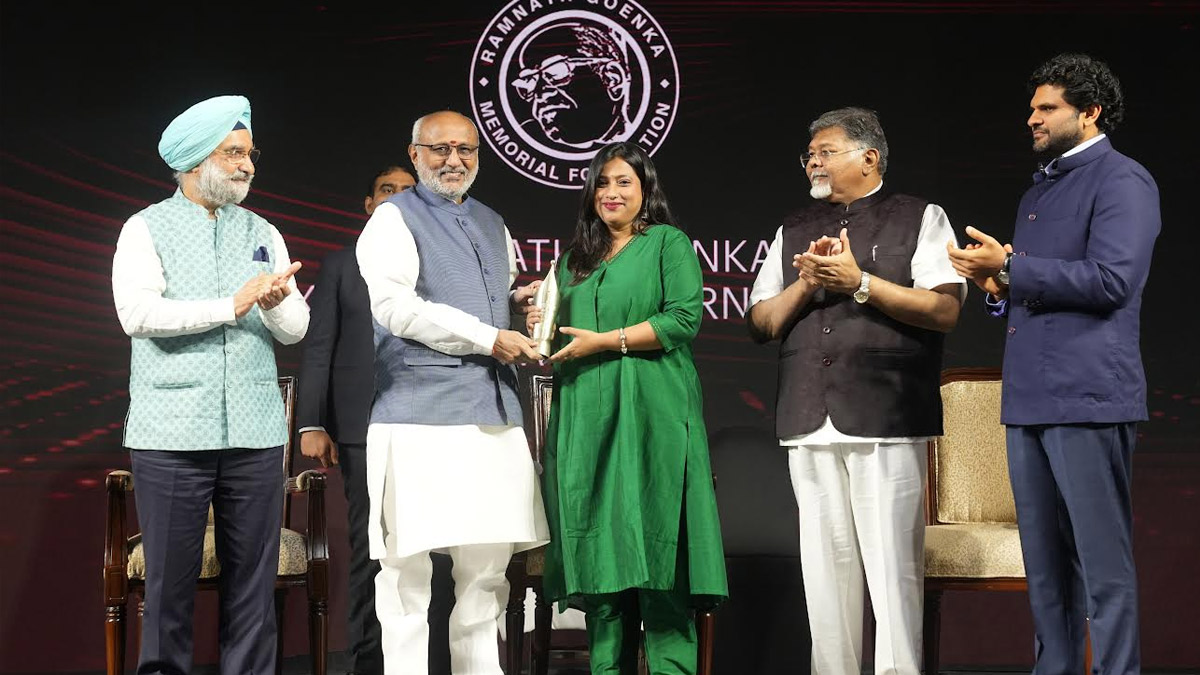
MUMBAI: India Today Group just turned the Ramnath Goenka Awards into its own trophy cabinet because when your reporters dig this deep, even the judges have to award a clean sweep. India Today Group journalists have secured multiple top honours at the latest edition of the prestigious Ramnath Goenka Excellence in Journalism Awards, reinforcing the network’s legacy as the gold standard of Indian journalism. The awards were conferred by vice president C. P. Radhakrishnan at a ceremony held on 27 March 2026.
Sreya Chatterjee won in the ‘Investigative Reporting – Broadcast’ category for her powerful India Today TV report ‘Operation Illegals: The Alarming Rise in Bangladeshi Infiltration Across India’s Fragile Eastern Frontier’. The investigation stood out for its depth, on-ground rigour and national relevance.
In the ‘Civic Journalism – Print/Digital’ category, Sreya Chatterjee along with Arvind Ojha were honoured for their indiatoday.in report on unregulated water extraction and the ‘Tanker Mafia’ in Delhi’s Bawana Industrial Area. The story exposed critical systemic gaps and environmental challenges affecting daily life.
Additionally, aajtak.in was recognised in the ‘Investigative Reporting – Print/Digital’ category for its hard-hitting exposé ‘The Surrogate Mother Market’, which highlighted the human, legal and ethical dimensions of the surrogacy ecosystem.
India Today Group emerged as the only network honoured in Investigative Journalism across both Print/Digital and Broadcast categories. The wins reflect the strength of its multi-platform newsroom and its unwavering commitment to credible, high-impact reporting that informs public discourse and drives accountability.
In an era when speed often trumps substance, these awards remind us that the most powerful stories are still the ones dug out with courage, told with clarity, and delivered with conscience, one fearless byline at a time.








