Applications
Kore.ai plugs into Inception to power AI surge across UAE and the global south

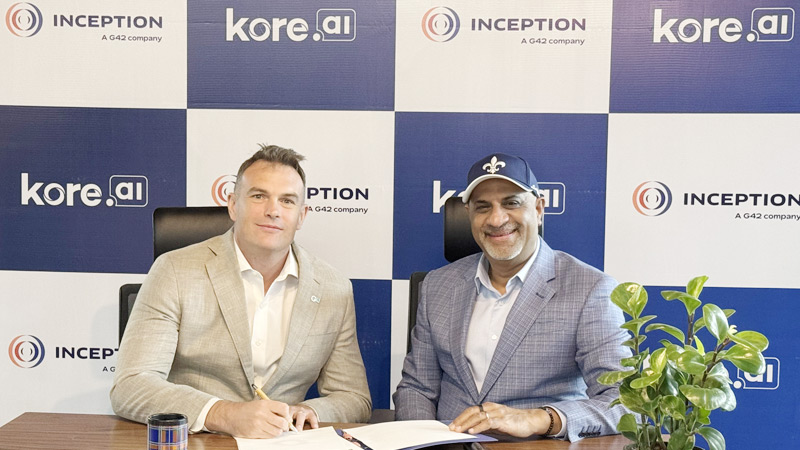
MUMBAI: When the AI gold rush kicks off in the Gulf, you don’t show up with a shovel. You show up with a full-blown intelligent automation arsenal—which is exactly what Kore.ai just did.
The Hyderabad-headquartered enterprise AI giant has inked a partnership with Inception, a G42 company based in Abu Dhabi, to co-develop and deploy a suite of AI-native applications for enterprise customers across the UAE and beyond. The deal is as strategic as it gets—aligning Kore.ai’s conversational AI clout and global distribution muscle with Inception’s model-building firepower and deep regional ties.
“Our collaboration with Inception represents a significant opportunity to accelerate AI adoption across global markets in alignment with our vision to help businesses drive tangible value through AI,” said Kore.ai CEO & founder Raj Koneru. “By combining our industry-leading AI platforms/solutions and broad market reach with Inception’s deep expertise in AI models and product development and domain-specific solutions, we deliver AI-powered solutions that will transform business operations.”

The UAE has gone all in on AI, with a national plan to become a top-tier global AI player by 2031. Abu Dhabi alone is dropping $13 billion on digital transformation—and the big names are circling.
Microsoft.
NVIDIA.
Now Kore.ai.
Under the new partnership, the companies will co-develop apps on Inception’s AI platform using Kore.ai’s technology, targeting sectors like government, finance, energy, healthcare, retail, and telecom. Kore.ai will also open the global floodgates, pushing these apps through its sprawling partner ecosystem and customer base.
Inception will take the reins on go-to-market execution in the UAE, while also deploying these AI solutions across G42’s enterprise portfolio. Think of it as AI with GPS coordinates: precise, strategic, and hardwired into local infrastructure.
“Partnering with Kore.ai aligns perfectly with our mission to develop AI-powered solutions that drive real business value to the customers in UAE and rest of the world,” said Inception CEO Andrew Jackson. “Our joint expertise will allow us to accelerate the AI adoption, deployment of AI-powered solutions and address critical business challenges, enhance decision-making, and drive real business outcomes for the companies in the region.”
The endgame?
Serious ROI for clients via cost savings, sharper decision-making, and customer experiences that actually feel intelligent. Whether it’s streamlining procurement, automating processes, or making chatbots sound like they’ve read a book, this collab is setting a new bar for enterprise AI in emerging markets.




Applications
With 57 per cent single new users, Ashley Madison rebrands as discreet dating platform
Platform says majority of new members now identify as single

INDIA: Ashley Madison is shedding the “married-dating” label that defined it for two decades, repositioning itself as a platform for discreet dating in what it calls the post-social media age.
The rebrand, unveiled in India on 27 February, 2026, marks a structural shift in business model and identity. Once synonymous with married dating, the company now describes itself as the “premier destination for discreet dating” under a new tagline: Where Desire Meets Discretion.
The pivot is data-driven. Internal figures show that 57 per cent of global sign-ups between 1 January and 31 December, 2025 identified as single: a notable departure from the platform’s married core. The company argues that its community has already evolved beyond its original positioning.
“In an age where our lives have been constantly put on public display, privacy has become the new luxury,” said Ashley Madison chief strategy officer Paul Keable. He framed the platform’s offering as “ethical discretion” for singles, separated, divorced and non-monogamous users seeking private connections.
The shift also taps into wider digital fatigue. A global survey conducted by YouGov for Ashley Madison, covering 13,071 adults across Australia, Brazil, Canada, Germany, India, Italy, Mexico, Spain, Switzerland, the UK and the US, found mounting discomfort with hyper-public online lives.
Among dating app users, 30 per cent cited constant swiping and messaging as a source of fatigue, while 24 per cent pointed to pressure to curate public-facing profiles and early personal disclosure. Some 27 per cent said fears of screenshots or information being shared contributed to exhaustion; an equal share cited unwanted attention.
The retreat from oversharing appears broader. According to the survey, 46 per cent of adults actively try to keep most aspects of their life private online. Only 8 per cent feel comfortable sharing most aspects publicly, while 35 per cent say they are becoming more selective about what they disclose.
Ashley Madison is betting that this cultural recalibration towards controlled visibility can be monetised. By doubling down on privacy infrastructure and reframing itself around discretion rather than infidelity, the company is attempting to convert reputational baggage into a premium proposition.






