News Headline
KEO satellite targets end 2003 launch


MUMBAI : The KEO satellite scheduled to orbit around 1800 kilometers above earth for 50,000 years will be launched at the end of next year.
The announcement was made on Tuesday at a media briefing organised by the French Embassy in Mumbai. The winged satellite will be a secondary passenger on an Ariane rocket and will carry billions of messages from all parts of the globe free of cost. These will consist of what we wish to tell our descendants about our lives and our hopes for the future. As of now, the cut off date for sending messages is the end of the year.
The project has over 30 companies working and collaborating for free. They include Arianespace, Intespace which is providing flight conformity and wing deployment tests, International Space University, Carre Noir who created the KEO logo, Radio France Internationale, Sokatel, Air Franceand Lingway which provides solutions in language processing.

There will also be a glass disk containing a mosaic of faces representing diverse ethnic groups on Earth. So far, KEO claims to have received thousands of messages from over 60 languages. Though the bulk are from the US, Canada and Europe the company is trying to reach out to the developing regions and India marks a starts towards that endeavour. The creator of KEO Jean Marc Phillipe says UNESCO has elected it as the project of the 21st century. “We chose the name KEO as it reflects the spirit of sharing. This is not simply another satellite orbiting into space. This is a humanitarian concept which gives people from different cultures, races a chance to bury their differences and come together in order to collectively express themselves. 50,000 years is the mirror date to a milestone in the evolution of our species. 50,000 years represents only one per cent of the evolution of the human species that appeared on earth five million years ago.”
For orbit KEO has two choices. Since its mass was recently lightened, it may be injected into an elliptical orbit or into a circular one with a range of several thousand kilometres. For symbolic reasons, KEO has been adorned with two wings. Folded in the cap of the rocket during the launch, the wings will function once the satellite is in orbit due to the sublimation of the small naphthalene spheres under the Earth’s shadow and its exposure to the sun’s rays. To allow the wings to flutter KEO is using a technology called shape memory alloys. The metallic alloys are able to assume different shapes according to different temperature ranges. After a couple of years, the unprotected wings will be shed leaving the core sphere to continue its journey alone in space.
The main risk for KEO is the possibility of a collision with micrometeorites or space debris of human origin. This is why the core of KEO is protected by several layers of shields made from aluminium, titanium and tungsten separated by a vacuum. KEO does not have its own energy. Once injected into orbit, it is only subject to the laws of nature such as ballistic forces, lunar and planetary attraction. Film personality and MP Shabhana Azmi who was present on the occasion said it was important to take the project into rural areas so that illiterate people could have their say. Information technology could be used in this regard, she said. KEO is also looking for a partner to distribute its educational kits across schools in the country.
An official release informs that when the satellite has 20 minutes to go before returning to our planet it will announce its arrival to the future generation in the form of a shooting star emitting sparks of radiant light far brighter than those of the natural star. Two minutes before landing its titanium and tungsten shields will disintegrate under the effect of the heat accumulated during its passage across layers of dense atmosphere. Our descendents will see a small titanium sphere engraved with an image of our planet in its current state. This will spread the message that the object is for them. Besides messages enclosed in glass disks the descendants will find a diamond with four inclusions made of tiny spheres of gold. The first sphere will have a drop of water from the oceans, the second will have a pinch of fertile soil and the third will contain a sample of air from our current environment. The fourth sphere will protect a small drop of human blood.
In 2000 it was determined that the glass disks would be able to resist a temperature of 480 degrees Celsius. Finally in 2001 in order to be compatible with the new data that led to a reduction in KEOs mass engineers of CNES, EADS, Arainespace and SupAero needed to redefine the new technical dimensions of KEO.
For further details on the project and how to send a message log on to www.keo.org

NEW DELHI: Hamdard Laboratories gathered a cross-section of India’s achievers in New Delhi on Friday, handing out the Hakeem Abdul Hameed Excellence Awards to figures who have left their mark across healthcare, education, sport, public service and the arts.
The ceremony, attended by minister of state for defence Sanjay Seth and senior officials from the ministry of Ayush, celebrated individuals whose work blends professional success with a sense of public purpose. It was as much a roll call of achievement as it was a reminder that influence is not measured only in profits or podiums, but in people reached and lives improved.
Among the headline awardees was Alakh Pandey, founder and chief executive of PhysicsWallah, recognised for turning affordable digital learning into a mass movement. On the sporting front, Arjuna Awardee and kabaddi player Sakshi Puniya was honoured for her contribution to the game and for pushing women’s participation onto bigger stages.
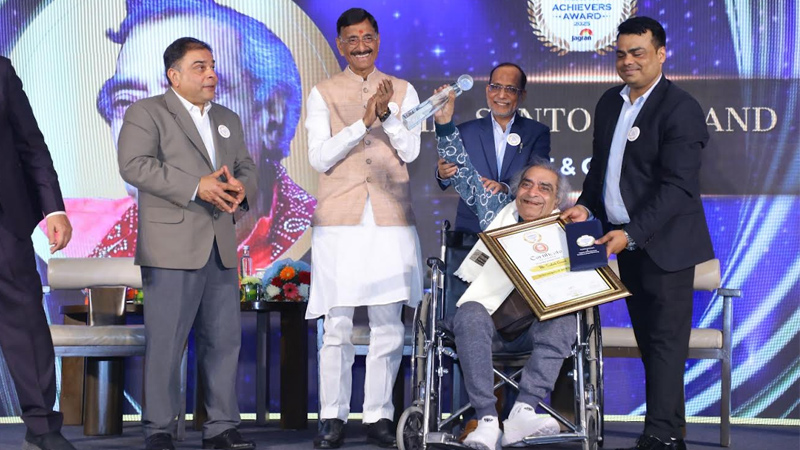
The cultural spotlight fell on veteran lyricist and poet Santosh Anand, whose songs have echoed across generations of Hindi cinema. At 97, Anand accepted the honour with characteristic humility, reflecting on a life shaped by perseverance and hope.
Healthcare honours spanned both modern and traditional systems. Manoj N. Nesari was recognised for strengthening Ayurveda’s place in national and global health frameworks. Padma shri Mohammed Abdul Waheed was honoured for his research-backed work in Unani medicine, while padma shri Mohsin Wali received recognition for his long-standing contribution to patient-centred care.
Education and social development also featured prominently. Padma shri Zahir Ishaq Kazi was honoured for decades of work in education, while former Meghalaya superintendent of Police T. C. Chacko was recognised for public service. Goonj founder Anshu Gupta received an award for his dignity-centred rural development initiatives, and the Hunar Shakti Foundation was honoured for empowering women and young girls through skill development.
The Lifetime Achievement Award went to former IAS officer Shailaja Chandra for her long career in public healthcare and governance, particularly in the traditional systems under Ayush.
Speaking at the event, Hamdard chairman Abdul Majeed said the awards were a tribute to those who combine excellence with empathy. “These awardees reflect Hakeem Sahib’s belief that healthcare, education and public service must ultimately serve humanity,” he said.
Minister Seth struck a forward-looking note, saying India’s young population gives the country a unique opportunity to become a global destination for learning, health and wellness by 2047.
The ceremony also featured the trailer launch of Unani Ki Kahaani, an upcoming documentary starring actor Jim Sarbh, set to premiere on Discovery on 11 February.
Instituted in memory of Unani scholar and educationist Hakeem Abdul Hameed, the awards have grown into a national platform that celebrates those building a more inclusive and resilient India. For one evening at least, the spotlight was not just on success, but on service with substance.