Movies
Karnataka film producers association plans protest rally

BANGALORE: Karnataka Film Producers Association (KFPA) has called for a rally on 9 August, protesting the government’s decision to reduce entertainment tax from 70 per cent to 40 per cent for non-Kannada films.
The association had also been demanding that the government should extend subsidy to all the Kannada films produced in the state, with the exception of remakes and sex and violence-dominated films.
Though KFPA has asked prominent Kannada actors to participate in the rally, their confirmation is still awaited. Hence, till the time of filing of this report, industry sources were unsure whether the rally would be held or not.
Fresh Kannada films have a benefit of no entertainment tax at all being levied on them, while remakes are taxed at a reduced rate of 30 per cent. A section of the producers would like this 30 per cent entertainment tax also to be waived, while some others would like it to continue.

On an average, Karanataka film industry has been producing 80 to 90 movies annually. But for Karnataka, which has the maximum number of cinema halls in the South, this is not at all a sufficient figure. Also, some producers are often reluctant to release their movies in certain theaters in the state. In such a scenario, theater owners cannot do away with non-Kannada films.
The Karnataka Theater Owners Association (KTOA) has approved the deputy chief minister’s decision to bring down the entertainment tax. They would also like the government to re-introduce the service tax of Rs1.50 per ticket, which could be utilised for improving the theatre conditions.
Some industry sources feel that reduction of entertainment tax would improve compliance and the tax collections and make more exhibitors to come forward and declare correct ticket sales figures. But another section feels that lower tax declarations and collections would force the government to reverse its decision to bring down entertainment tax.







Movies
Green Gold Animation creates CG character for Telugu film Rākāsā
Chhota Bheem studio expands into mainstream VFX with dialogue-free digital lead.
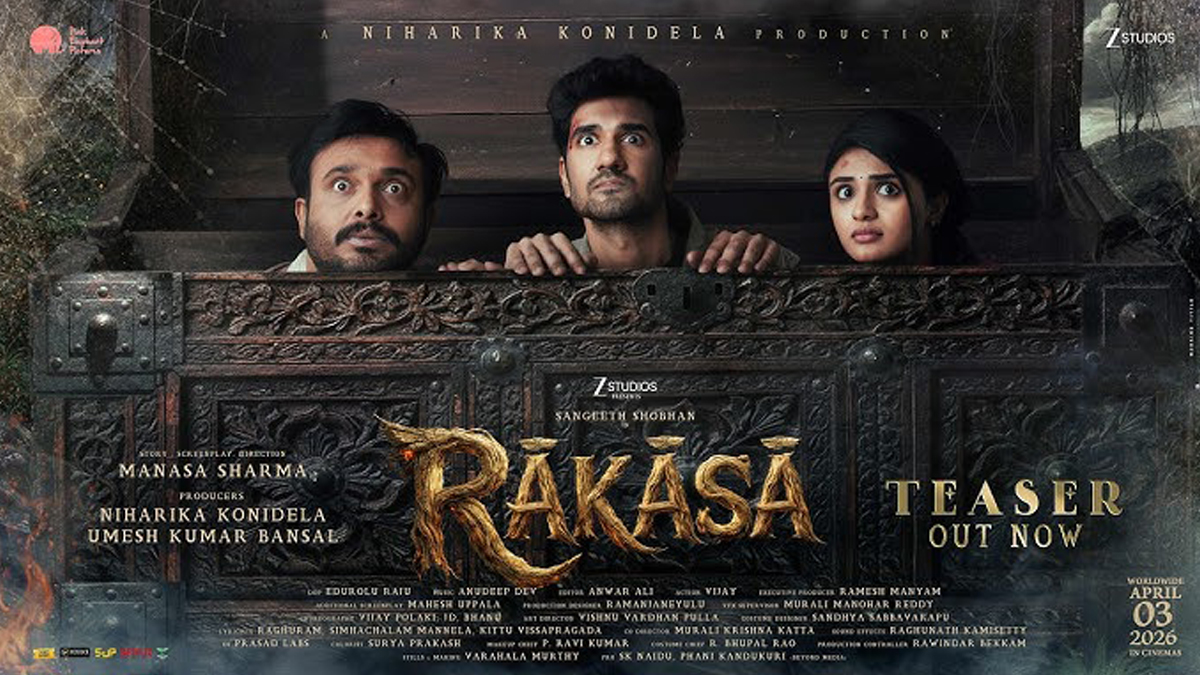
MUMBAI: Green Gold Animation, the house that gave India Chhota Bheem, is now stepping out of the kids’ zone and into the big screen with a rather silent but powerful performer. The Hyderabad-based studio’s VFX division has delivered a fully computer-generated character for the upcoming Telugu-language comedy-fantasy thriller Rākāsā, set for theatrical release on 3 April 2026. Directed by Manasa Sharma and produced by Niharika Konidela under Pink Elephant Pictures in collaboration with Zee Studios, the film marks a notable move for Green Gold into complex, character-driven work for mainstream cinema.
What makes the project stand out is its ambitious central character, a completely digital creation that does not speak a single line. Instead, the character relies entirely on animation, movement, facial expressions and body language to convey emotion and connect with audiences. This is a relatively unexplored approach in Telugu cinema at this scale.
Green Gold’s VFX team was involved from early pre-production through to final delivery, completing over 750 CG shots with a team of more than 100 artists. The work included detailed character animation, performance design and fluid simulations, all executed within tight timelines and practical budgets through strong planning and close collaboration.
Green Gold Animation founder & CEO Rajiv Chilaka said the project pushed the team to approach character creation differently. “Building a fully digital character where every emotion had to come through performance and detailing was very meaningful,” he noted.
Green Gold VFX supervisor and VFX creative director Murali Manohar Reddy added that the emotional depth had to be communicated entirely through visual performance. “This wasn’t about reinventing technology, but about using our tools and processes with precision to serve the story,” he said.
Producer Niharika Konidela praised the collaboration, saying the Green Gold VFX team understood the vision and brought strong detail and emotion to the character while working within practical constraints.
The film blends humour, action and mythological elements, following an NRI protagonist on a chaotic and magical adventure. It stars Sangeet Shobhan, Nayan Sarika, Vennela Kishore, Brahmaji and Ashish Vidyarthi, with music by Anudeep Dev.
For a studio best known for colourful kids’ animation, delivering a silent, emotionally expressive CG lead for a mainstream theatrical release is quite the plot twist. With Rākāsā, Green Gold Animation is quietly proving it can speak volumes even without dialogue.






