News Broadcasting
Kainthola takes over as executive director in LS TV


NEW DELHI: Indian Information Service officer Bhupendra Kainthola has taken over as the new executive director (programmes) of Lok Sabha Television, filling the vacancy created in January after the termination of services of Sudhir Tandon, without ascribing reason.
Kainthola has been posted to LS TV on deputation for three years. He is an IIS officer of the 1989 batch.
His last posting was as the deputy general manager (media) for the National Highways Authority of India (NHAI) for the past two years, but he has earlier worked for several years in Doordarshan News in the Mumbai and Delhi kendras. He also functioned in the Press Information Bureau for one year.

The post of the ED (P) has been held as an additional charge first by the executive producer Vartika Nanda-Sahai, and then by the executive director (marketing), Sunit Tandon, who is in the channel on deputation from the National Films Development Corporation.
Sudhir Tandon had retired as deputy director general in August 2005 from the charge of Director of the Delhi Kendra of Doordarshan before joining LS TV. He had received a termination order in late December ending his three-year contract (in just over a year), without assigning any reasons.
The LS TV was first conceived by the Lok Sabha Speaker Somnath Chatterjee and offered to Doordarshan.
However, the public broadcaster had demanded financial support for a minimum of 250 employees. Bhaskar Ghose – a former Director General of Doordarshan and also Secretary in the Information and Broadcasting Ministry – was then given the task of running the channel with a strength of less than 80 people.
He was appointed with the designation of media adivsor to the speaker and chief executive of the channel. LS TV was formally launched as a 24×7 channel from July 24, 2006 when the Monsoon session commenced.
Commencing with the Budget session, the channel is now in charge of transmitting the signals to the Doordarshan tower from where these are uplinked. Earlier, this work was being handled by DD staff.
Furthermore, two more studios are coming up to augment the facilities, but sources in the channel told indiatelevision.com that there was no corresponding increase in staff strength which was now just over 100.
The channel still does not have any funds of its own and has to depend on the Audio Visual Unit of the Lok Sabha Secretariat for its expenses and infrastructure.







News Broadcasting
Network18 channels lead YouTube news viewership in March 2026
CNN-News18, News18 India and CNBC channels top categories with record views
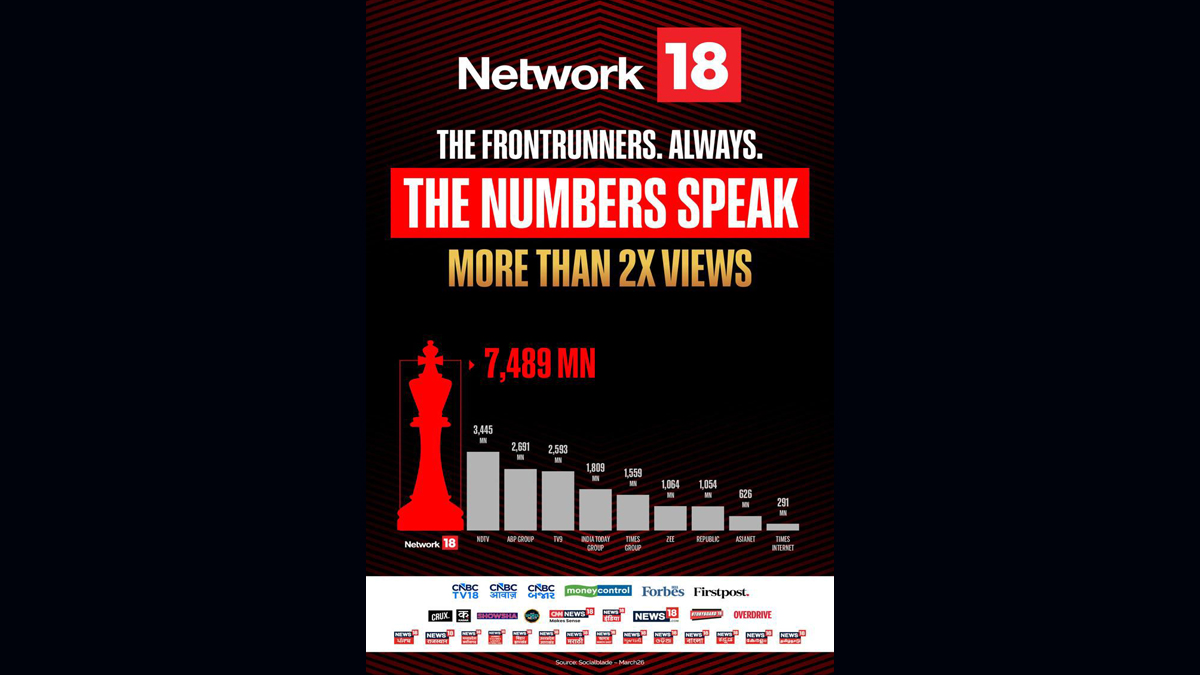
MUMBAI: When the world hit refresh on breaking news, Network18’s channels were already streaming ahead. As geopolitical tensions and war-driven headlines fuelled a surge in global news consumption, the network’s digital playbook delivered big clocking record Youtube viewership across English, Hindi and business news categories in March 2026.
At the forefront was CNN-News18, which emerged as the clear leader in the English news segment with 130 million live and video-on-demand views. The channel edged past competitors such as Times of India (126.5 million), Times Now (101.1 million), India Today (88.2 million) and NDTV (77.5 million), according to Databeings data for March.
In the Hindi news arena, News18 India delivered a commanding performance, racking up a staggering 3,297 million views on YouTube. The channel comfortably outpaced NDTV India, which recorded 3,119 million views, underlining its deep reach and consistent engagement with mass audiences, as per Playboard data.
The network’s dominance wasn’t confined to general news. In the Hindi business segment, CNBC Awaaz topped the charts with 92 million views, narrowly ahead of Zee Business (90 million) and well ahead of ET Now Swadesh (57 million). Meanwhile, its English counterpart CNBC-TV18 posted a strong 58 million views, reinforcing the network’s cross-category strength.
The spike in viewership reflects a broader shift in audience behaviour, with viewers increasingly turning to digital platforms particularly Youtube for real-time updates and in-depth coverage during high-intensity news cycles. For Network18, the numbers signal more than just scale; they underline the effectiveness of a multi-platform strategy that blends speed, credibility and continuous coverage.
In a month where the news never paused, it seems viewers chose to stay tuned where the stream never stopped.






