Broadband
JioGigaFiber: all you need to know

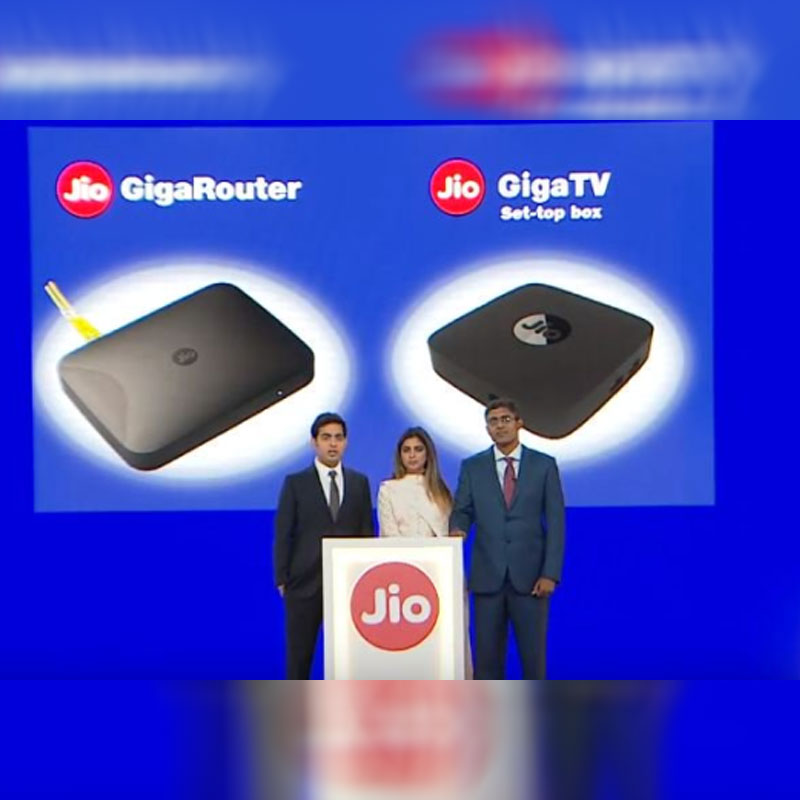
MUMBAI: With the launch of Jio back in 2016, business tycoon Mukesh Ambani reshaped the telecom business in India by disrupting the tariff charges. Riding on the popularity of his telecom venture, the Reliance Industry Limited (RIL) chairman now looks set to set off yet another price war. Addressing his shareholders at the company’s 41st Annual General Meeting, Ambani announced the launch of its fiber-to-the-home (FTTH) fixed line broadband service – Jio Giga Fiber, the registration for which will begin on 15 August through the MyJio app and the Jio website.
“JioGigaFiber will be the largest greenfield fixed-line broadband rollout anywhere in the world,” said Ambani.
• The initial roll out of the service will start from areas with maximum registrations. The company plans to target 1,100 cities.

• Jio Giga Fiber service will be activated through a Jio Giga Router
• Besides the basic internet service, Jio Giga Fiber will be bundles with a Jio Giga TV set top box, offering more than 600 TV channels as well as over 1000 movies with enabled voice command feature for TV
• Another interesting feature is that of video calling through TV. Users can call any other TV connected through JioGigaFiber
• Other amenities include multi-party video conferencing from the living room, voice activated virtual assistants, virtual reality gaming and digital shopping and smart-home solutions
“Gone are the days of Mbps, now it will be about Gbps,” said Isha Ambani at the AGM.
The company has rolled out a trial service offering of unlimited internet at 100 mbps for 90 days along with a monthly data quota of 100 GB for a security deposit of Rs 4,500 for the Optical Network Termination (ONT) device. Those opting to disconnect the service will get a refund of the amount.
Anticipating another disruptive set of services from Jio, market leader Airtel has also set in motion the revamp its existing wired broadband connection solutions.
For the upcoming war with Jio, the telco has set aside Rs 24,000 crore for the financial year.
From current 89 cities, it wants to expand its service to 100 key cities targeting big data consumption zones. To cope up with competition, Bharti Airtel is also expected to bombard consumers with great offers.
Also Read:
It’s official! JioGigaFiber is Mukesh Ambani’s next big bet
Jio & Hathway continue to lead wireless and wired Internet subs growth in 2018







Broadband
Zoff Foods extends Shilpa Shetty partnership into ninth year
Spice brand reinforces trust-led positioning amid growth and funding push.

MUMBAI: Nine years, one flavour and the recipe clearly still works. Zoff Foods has extended its long-running association with Shilpa Shetty, marking nine consecutive years of her as brand ambassador as the company scales its presence across Indian households. What began as a digital-first collaboration has gradually evolved into a defining element of the brand’s identity. Over nearly a decade, the partnership has mirrored Zoff’s own journey from an emerging challenger to a fast-growing FMCG player with a widening footprint across e-commerce, quick commerce and offline retail channels.
The logic behind the continuity is straightforward. In a category where trust and familiarity drive purchase decisions, particularly in spices and ready-to-cook segments, long-term associations tend to carry more weight than short bursts of visibility. Shetty’s positioning as a fitness-conscious, health-aware public figure aligns with the brand’s emphasis on purity and quality factors that are increasingly shaping consumer choices in modern Indian kitchens.
The extension also comes at a time when Zoff Foods is entering a more aggressive growth phase. The company recently raised $2 million in a Pre-Series B funding round led by JM Financial Private Equity, with participation from Aman Gupta, signalling a push towards expanding distribution, product innovation and market reach.
Company executives have positioned the continued partnership as a strategic anchor amid this expansion, reinforcing brand recall while entering new markets. For Shetty, the association remains rooted in shared values around authenticity and ingredient integrity attributes that resonate strongly with increasingly mindful consumers.
In a market crowded with new-age brands and shifting loyalties, Zoff’s approach suggests a different playbook: build slowly, stay consistent, and let familiarity do the heavy lifting. Because sometimes, in both branding and cooking, it’s not about reinventing the dish, it’s about perfecting it over time.







