News Broadcasting
It is Arnab’s Republic now


NEW DELHI/MUMBAI: It’s not the nation now, it’s republic. And, true to his flamboyant style, Arnab Goswami’s new venture, believed to be on the cutting edge of technology — and news — would be christened Republic.
Though not much details are available, Goswami, when contacted by indiantelevision.com on Thursday, confirmed that his new independent venture would be called Republic.
Goswami was mum on the nature of the project or the investors funding it or when the venture would be launched. Industry sources, however, opined that it may be up and running (as a news channel) on 27 January 2017. Goswami, reportedly, has offers dangling for many of his former colleagues in Times TV Network. According to company sources, quite a few may also join their former editorial boss’ new venture.

After about a fortnight’s speculation, the news about Goswami exiting Times group as the editor-in-chief of Times Now and ET Now became official in the first week of November 2016. Some media reports, which indiantelevision.com could not confirm independently, had indicated that the departure was not on as much a friendly terms as the celebrity news anchor had expected.
Before his departure from Times group’s TV news venture, in at least a couple of media conferences and events, Goswami had said that there were no reasons why India could not have a media organisation as professional or credible as BBC or CNN and also straddle the digital (news) world with equal ease, hinting at his future assignments and challenges.
Over the last several years, Goswami had become the face of Times Now news channel with his aggressive brand of TV journalism and signature news show called the `News Hour’, which actually ran over 60 minutes debating two to three big news developments of the day.
It is ironical — some may call it coincidental — that Goswami chose to make public to select media outlets about his new venture `Republic’ on a day when his former employer, Times TV Network, formally announced his successor at Times Now in Rahul Shivshankar for whom this would be his second stint at Times.
ALSO READ
Arnab Goswami quits as editor-in-chief of Times Television Network
The after-effect of Arnab Goswami’s exit
‘King’ content will take over monopolistic media entities, says Arnab Goswami







News Broadcasting
News18 India launches Command Centre war explainer with Arya
New show shifts from debates to decoding global conflicts and impacts
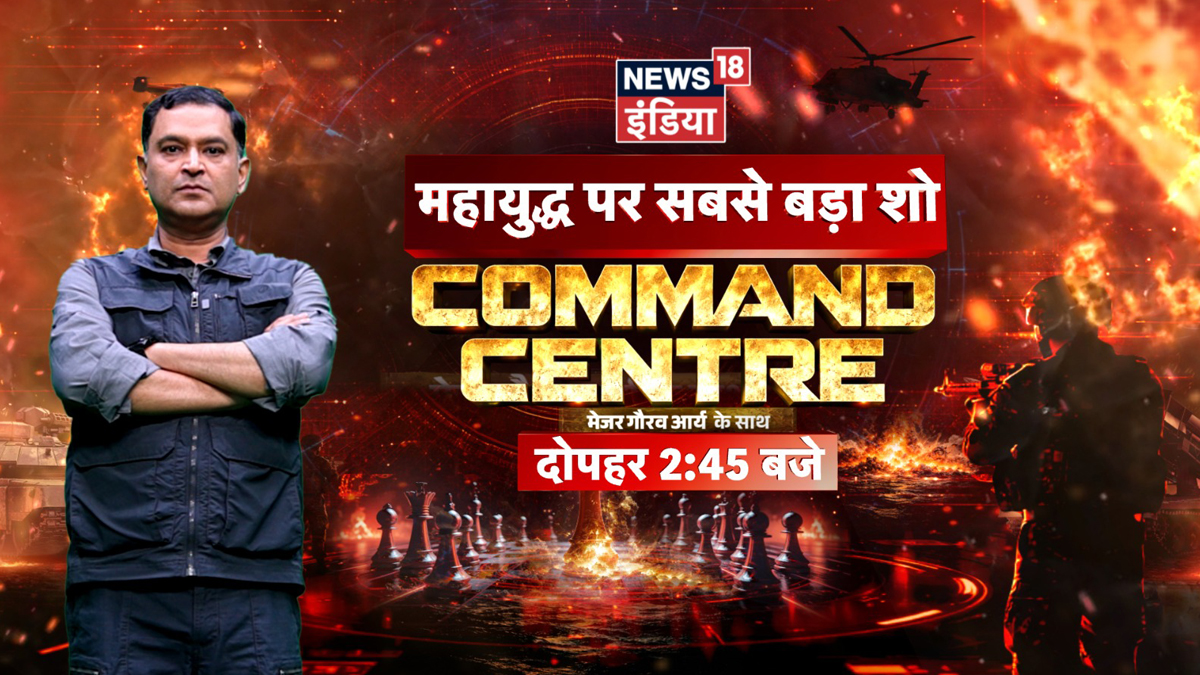
MUMBAI: News18 India has rolled out a new war-focused programme, Command Centre, featuring Gaurav Arya, as it looks to offer viewers a sharper, more grounded take on global conflicts amid rising tensions in West Asia.
Positioned as an “insider war room”, the show moves away from conventional panel debates and instead focuses on explaining military developments, decoding strategy and connecting global events to their everyday impact, from fuel prices to economic shifts.
The format leans heavily on visuals and data. The studio has been designed like a command hub, complete with large LED war maps, real-time graphics and an alert system to track developments as they unfold.
At the centre of it all is Arya, who brings his military background to simplify complex war strategies for viewers. His signature line, “Seedhi baat samjhiye”, anchors the show’s promise of clarity over noise.
News18 India managing editor Jyoti Kamal said, “Command Centre, featuring Major Gaurav Arya is designed to deliver accurate insights and a clear perspective on how evolving conflicts impact everyday life, from household budgets to national security. With expert voices analysing every development in real time, the show goes beyond headlines to decode what’s happening now, what it means, and what could come next.”
Echoing the intent, Gaurav Arya added, “In times of war, confusion is the biggest threat. With News18 India’s Command Centre, we are bringing viewers inside the war room, decoding strategies, tracking every escalation, and explaining, in the simplest terms, what it means for India and for every household. Seedhi baat samjhiye, this is where you understand not just what is happening, but what happens next.”
The weekday show will air in the afternoon slot and will also feature Gaurav Shukla, adding to its editorial depth.
With its mix of analysis, visuals and a clear focus on impact, the show reflects a broader shift in news consumption. Viewers are no longer just watching events unfold, they are looking to understand what those events mean for them.






