Gaming
Infinix Levels Up with True Rippers for a Power-Packed BGMI Partnership

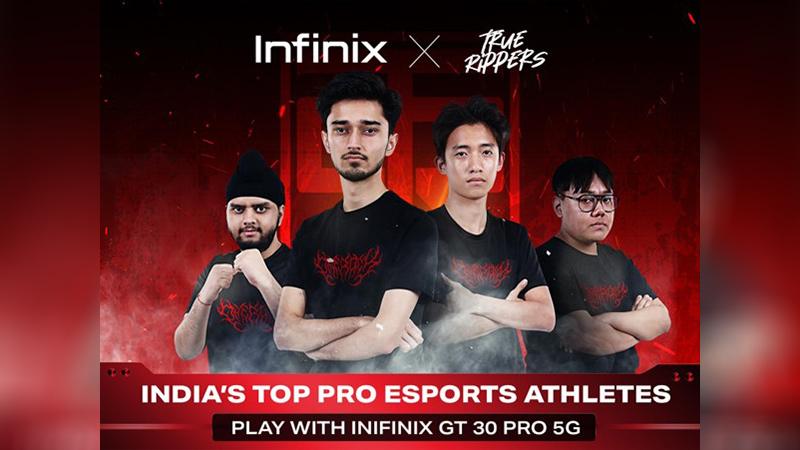
MUMBAI: It’s game on in the world of mobile Esports and Infinix just hit a headshot with this one. In a move that fuses silicon with swagger, smartphone brand Infinix India has teamed up with one of the country’s top BGMI (Battlegrounds Mobile India) outfits, True Rippers. The team will now compete under the newly minted moniker Infinix True Rippers, marking Infinix’s maiden foray into the Esports arena and its first-ever global Esports team collaboration.
This strategic alliance comes ahead of Infinix’s June 3 launch of the GT 30 Pro, a gaming-ready smartphone with 120 FPS BGMI certification and dual gaming shoulder triggers an Indian segment-first. With this hardware-meets-hustle partnership, Infinix is aiming squarely at India’s Gen Z gaming cohort, where play isn’t just pastime, it’s purpose.
“At Infinix, we’re not just witnessing the gaming revolution, we’re driving it,” said Infinix India CEO Anish Kapoor. “Teams like True Rippers are the driving force behind India’s growing Esports culture. Our collaboration is rooted in a shared belief that gaming in India is more than just play; it’s a powerful aspiration for the youth… Together, we’re setting the stage towards strengthening the Indian Esports ecosystem.”

Currently, Infinix True Rippers is battling it out in BMPS 2025, an invite-only Krafton-hosted tournament that wraps with a finale in New Delhi next month. The team’s form is impressive, having placed sixth at the BGIS in Kolkata just weeks ago.
The roster includes:
1 Gunjan Thakur aka Jelly
2 Swaraj Singh aka KioLmao
3 Ngurang Takar aka Ninzae
4 Samuel Nabam aka SAM
But this partnership isn’t just about trophies, it’s about storytelling. True Rippers will co-create content with Infinix, plugging directly into the lifestyle and aspirations of Indian gamers.
“We’re thrilled to partner with Infinix, a brand that shares our vision for trendy storytelling and performance excellence,” said True Rippers CEO Yashwanth AR. “This carefully curated collaboration is a step towards redefining how brand narratives can go beyond conventional naming rights deals.”
With 454 million gamers in India in 2023 (expected to hit 730 million by 2028), and BGMI contributing heavily to this boom, the Infinix–True Rippers union couldn’t have come at a better time.
Earlier this year, BGIS 2025 notched a peak concurrent viewership of 485,132 and over 9.4 million watch hours, according to Esports Charts. It’s proof that this isn’t just about games, it’s about culture, community, and carving out a space in a booming economy of attention.
With GT 30 Pro on deck and True Rippers on fire, this duo is ready to take the leaderboard and Indian gaming to the next level.







Gaming
Dream Sports sees 100 plus exits after gaming ban forces overhaul
Company splits into eight units as real money gaming law hits revenue.

MUMBAI: For a company built on fantasy leagues, reality has suddenly rewritten the rulebook. More than 100 employees have exited Dream Sports, the parent of Dream11, after the company reorganised its operations following India’s ban on real money online gaming. The shake up came after the Promotion and Regulation of Online Gaming Act, 2025 came into force in August 2025, prohibiting games where users deposit money expecting winnings. The regulation struck at the heart of the fantasy gaming industry and dramatically affected Dream Sports’ core business, wiping out about 95 percent of its revenue and all of its profits.
In response, the Mumbai based company shifted into what chief executive officer Harsh Jain described as “startup mode”, splitting its operations into eight independent business units in December.
Around 700 employees were reassigned across these newly formed ventures based on their experience and interests. However, roughly 15 percent opted to leave the company.
A spokesperson for Dream Sports said many of those who exited were experienced professionals accustomed to running scaled businesses rather than early stage ventures.
“Since some of these employees were experienced with running high scale businesses and not startups, around 15 percent chose to leave and join other scaled companies or start ventures of their own,” the spokesperson said.
Despite the departures, the company noted that the attrition rate is only slightly higher than its earlier level of around 10 percent before the ban. Dream Sports now has close to 950 employees and is not currently hiring, choosing instead to focus on stabilising its existing workforce.
The restructuring has transformed Dream Sports from a fantasy gaming company into a broader sports entertainment platform. The eight units now operate independently, each focusing on different segments of the sports and technology ecosystem.
These include Dream11, sports streaming platform Fancode, sports travel service DreamSetGo, mobile game Dream Cricket and artificial intelligence initiative Dream Sports AI, which includes sports analytics platform Dream Play.
Other ventures include fintech product Dream Money, open source initiative Dream Horizon and the philanthropic arm Dream Sports Foundation.
As part of cost saving efforts, Dream Sports also relocated its headquarters from Bandra Kurla Complex to Worli earlier this year. The new office, called Dream Sports Stadium, brings teams from its various brands together under one roof to improve collaboration and operational efficiency.
Jain had earlier said the company removed bonus lock in timelines for employees hired in recent years, allowing those who wished to leave to exit with pro rata payouts.
“We want people who are fully into the startup mode and willing to work for it, and we will share that reward if it comes,” he said.
Founded in 2008 by Harsh Jain and Bhavit Sheth, Dream Sports was last valued at 8 billion dollars after raising 840 million dollars in 2021 from investors including Falcon Edge Capital, DST Global, D1 Capital Partners, RedBird Capital Partners, Tiger Global Management, TPG and Footpath Ventures.
The new gaming law has forced several companies in the fantasy gaming sector to either shut down or pivot their business models, signalling a significant reset for one of India’s fastest growing digital entertainment industries.