Hindi
Indifference of movie-goers

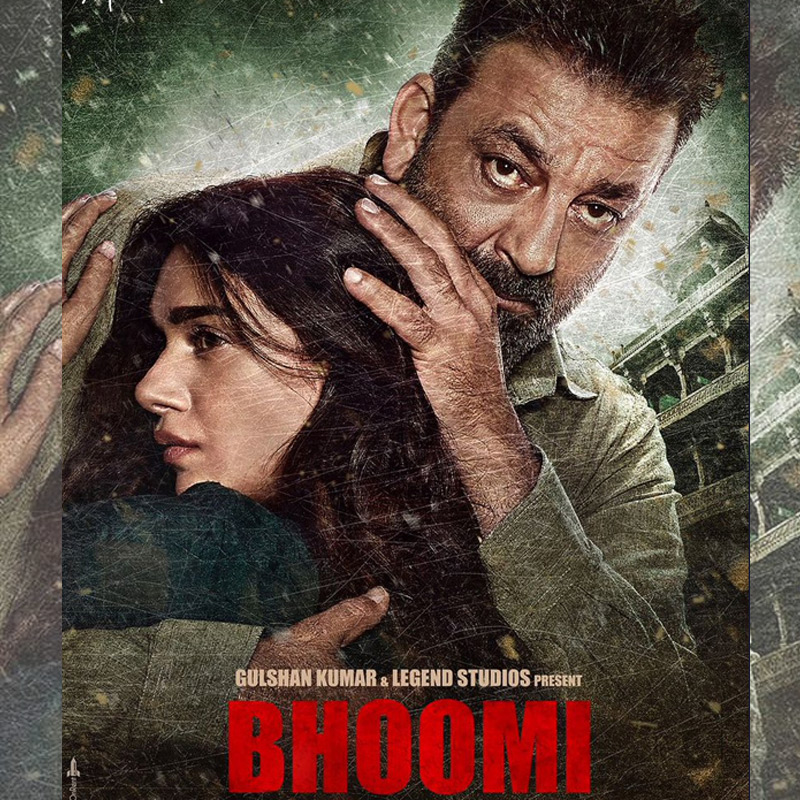
*Bhoomi was chosen to be the re-launch vehicle of Sanjay Dutt on his return from serving a jail sentence. The subject could not have been a romance considering his age and the receding hairline. And, Munnabhai scripts are not something you picked off the shelf!
Omung Kumar earned fame with his direction of Mary Kom and, one must say, that very little of it he merited for his contribution to the film, most of it was media gifted which is to say, he has been overrated.
Omung’s next was Sarbjit, which he also produced, which was a rank bad film. It seemed have been made with the intent of encashing Aishwarya Rai’s face forgetting most of the time about Sarbjit.

But, for the sake of Sunjay Dutt, the idea of Bhoomi, a father daughter story worked.
Considering all things, the director, Omung Kumar, made partly right decision, to cast Dutt according to his age, as the father of a girl of marriageable age. But, the rest of the decision was disastrous. That was to fall back on old-fashioned 1980s films churned out from South where the ‘izzat’ of wife, sister, bhabhi was compromised by the villains. The true hero was then expected to save his family honour.
It made simple thrill seeking audience happy. Movie going has come a long way since.
Bhoomi has turned out to be bad film with the opening response showing indifference of movie goer. The opening day was poor at about Rs 20 million with the Saturday and Sunday remaining stagnant as the film closed its opening weekend with Rs 66 million.
*Worse choice for a maker was to opt for Haseena Parker. This shows a total lack of imagination let alone creativity. When creativity is nil, one looks for such short cuts just to stay afloat in the industry. After all, a film is made for the all India audience! And, how would they identify with a South Mumbai small lane woman who cashed in on the name of her brother, Dawood Ibrahim? Not many earlier and not now after the film.
Shraddha Kapoor mouthing Urdu dialogue with a stuffed mouth comes across as a comedy! The film opened with poor collections of Rs 11 million, failing to improve much over the weekend and collecting Rs 41 million.
Newton, an odd film about an honest officer wanting to conduct free and fair elections in a Naxal affected area, as expected, has an indifferent opening, but the release of the film coincided with the film’s selection as India’s choice for entry at the Oscars. And, that boosts the footfall for the film over the weekend with big leaps. The film, which opened at Rs 9 billion on Friday, had a huge jump in collections on Saturday of Rs 25 million and Rs 32 million on Sunday giving it a decent weekend of Rs 66 million.
*Lucknow Central, a poor idea poorly executed, fails miserably. With a poor opening weekend of Rs 72.5 million, the film could manage to add just three crore for the next four days to end its first week with a total of Rs 103 million.
*Simran, counting on yet another one-woman show from Kangana Ranaut, like Queen, had just about everything going wrong for it. From the script, to the characterisation of Kangana, to direction, just about everything.
The film let the Kangana fans down as it ended its first week with a tally of Rs 145 million. It is another thing that had the film succeeded, it would have given some standing and credibility to the director Hansal Mahta, too.
*Patel Ki Punjabi Shaadi has collected Rs 13 million for its one week. (The film’s weekend collection was Rs 7 million, and not 700 million.)
*Poster Boys collects Rs 15 million for week two taking its two week total to Rs 122.5 million.
*Daddy added Rs 11 million in its week two to take its two week total to Rs 75 million.







Hindi
India’s telecom subscribers cross 1.32 billion in February 2026
Broadband base swells past 1.06 billion as Jio and Airtel tighten grip on the market.
MUMBAI: India’s telecom sector is ringing in steady growth once again adding millions of new connections every month while the race for broadband supremacy continues to heat up like a fiercely contested cricket match. According to the latest data released by the Telecom Regulatory Authority of India (TRAI) on 1 April 2026, the total telephone subscriber base in the country reached 1,321.31 million at the end of February 2026. This marked a net addition of 7.31 million subscribers during the month, translating into a monthly growth rate of 0.56 per cent.
Wireless subscribers (including mobile and Fixed Wireless Access) stood at 1,273.31 million, registering a net addition of 6.97 million and a growth rate of 0.55 per cent. Within this, urban wireless connections grew to 730.75 million (growth 0.70 per cent), while rural wireless subscribers reached 542.56 million (growth 0.35 per cent).
Wireline subscribers, though much smaller in scale, showed slightly faster growth. The total wireline base increased to 47.99 million, with a net addition of 0.34 million and a monthly growth rate of 0.70 per cent. Urban areas continued to dominate wireline connections with a share of 89.41 per cent.
Overall tele-density in India improved to 92.66 per cent. Urban tele-density stood at 150.68 per cent, while rural tele-density edged up to 60.02 per cent.
The broadband subscriber base crossed a significant milestone, reaching 1,059.05 million at the end of February 2026. This reflected a healthy net addition of 6.33 million subscribers and a monthly growth rate of 0.60 per cent from January’s figure of 1,052.72 million.
Segment-wise, mobile wireless access continued to drive the majority of growth with 996.52 million subscribers. Fixed Wireless Access (including 5G FWA) added 16.51 million, while wired broadband stood at 46.02 million.
Reliance Jio Infocomm Ltd. maintained its commanding lead with 519.64 million broadband subscribers. Bharti Airtel Ltd. followed with 364.14 million, Vodafone Idea Ltd. with 129.36 million, Bharat Sanchar Nigam Ltd. with 28.70 million, and Atria Convergence Technologies Ltd. with 2.38 million.
Together, these top five players command a massive 98.60 per cent share of the total broadband market.
In the wireless (mobile) segment, private operators continued to dominate with 92.59 per cent market share, leaving public sector undertakings (BSNL and MTNL) with just 7.41 per cent.
Out of the total 1,257.29 million wireless (mobile) subscribers, 1,177.60 million were active on the peak Visitor Location Register (VLR) date, representing an impressive 93.66 per cent activity rate. Bharti Airtel led in this metric with 99.42 per cent of its subscribers active.
Meanwhile, 14.47 million subscribers submitted requests for Mobile Number Portability (MNP) in February, indicating healthy competition and customer churn across zones.
While urban areas still lead in absolute numbers, rural connectivity is slowly catching up. Rural wireless tele-density stood at 59.46 per cent, compared with the much higher urban figure of 142.32 per cent.
Fixed Wireless Access using 5G technology also showed promising traction, growing to 11.93 million subscribers. Reliance Jio and Bharti Airtel are the primary players driving this segment.
The data paints a picture of a maturing yet still rapidly expanding telecom ecosystem. With total telephone subscribers now well past the 1.32 billion mark and broadband users comfortably above 1.06 billion, India continues to solidify its position as one of the world’s largest and most dynamic digital markets.
From bustling city streets to remote villages, more Indians are staying connected than ever before proving that when it comes to telecom, the country’s appetite for growth shows no signs of hanging up anytime soon.






