News Broadcasting
Indiantelevision.com to host first ever CAS summit on TV ad scenario post CAS


MUMBAI: India’s First ever CAS Summit on the TV Advertising Scenario Post CAS will be held on 4 July at the Hyatt Regency Mumbai.
Hosted by indiantelevision.com, the National CAS Media Summit has over 300 trade professionals scheduled to attend the event that will be a meeting ground for advertisers, media planners/buyers, broadcasters and market researchers. Associate sponsors for the summit so far are Media Reach Research India Pvt Ltd and Broadband Pacenet India Pvt Ltd.
The burning issue of whether advertisers will begin shunning pay channels after the 14 July deadline will be addressed at the summit from the advertisers’ point of view, the media professionals’ angle and the broadcasters’ side too. At the same time, the question of FTA channels benefiting in terms of ad revenue at the cost of the pay channels will also be deliberated upon by all three. The hitherto unexplored option of cable channels and whether they too stand to benefit from the implemention of conditional access systems in the country will also be touched upon.

Meenakshi Madhvani, eminent media professional , Sandip Tarkas, president, Media Planning Group, Sameer Nair, COO, Star India Ltd, Kunal Dasgupta, CEO, SET India, Pranav Barua, Godrej Ltd, Paulomi Dhawan, Raymonds, Amit Ray, VP, Optimum Media (Mudra), Divya Radhakrishnan, VP, The Media Edge, and Ashutosh Shrivastava, GM, planning, Mindshare, are some of the panellists who will speak on the issues touched upon.
While audience measurement for television has thus far been the preserve of ratings like TAM, CAS is poised to usher in an era that will force us to look beyond ratings. A panel comprising experts like TAM India CEO LV Krishnan, media expert Raj Nayak, ETC Networks business head Jagjit Singh Kohli and Media Research marketing VP Kapil Anand will attempt to unravel the logistics involved.
CAS may well be the necessity that will foster a series of innovations on the part of all players connected to the television industry. Sam Balsara, chairman, Madison Communications Ltd, Ravi Kiran GM south & west, Starcom Worldwide, Vikram Sakhuja, managing director, Mindshare Fulcrum South Asia, M Suku, national director, Broadmind , Jasmin Sohrabji Grey Worldwide and a senior representative from Pacenet will attempt predictions based on their vast experience to envision what kind of innovations the morrow will bring.
Pacenet, Hathway, Siticable and In Cablenet, the major players in the STB arena, will demonstrate their products and their respective merits at the summit.
The moderators of the various sessions at the summit will be Anil Wanvari, founder and CEO, Indian Television Dot Com, Thomas Abraham, managing editor, indiantelevision.com and Samir Kale, president, CMCG.





News Broadcasting
UDF poised to return to power in Kerala, says Manorama-CVoter survey
Massive opinion poll projects shift in Kerala politics ahead of 2026 Assembly elections.
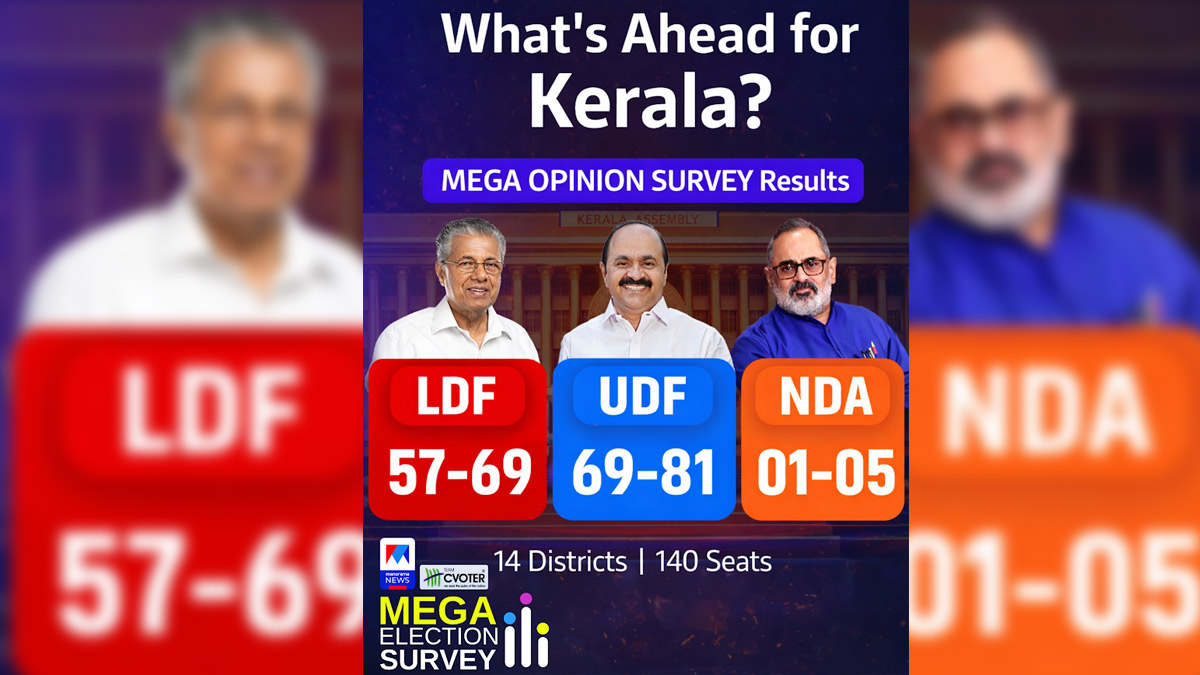
MUMBAI: The winds of change appear to be blowing through Kerala’s political landscape and this time, they seem to favour the United Democratic Front. A comprehensive mega opinion survey conducted by Manorama News in partnership with CVoter projects a potential comeback for the UDF in the upcoming Kerala Legislative Assembly Elections 2026. The survey, covering all 140 constituencies with a massive sample size of nearly 90,000 respondents, predicts the UDF could win between 69 and 81 seats.
The ruling Left Democratic Front (LDF) is expected to secure 57 to 69 seats, a significant drop from the 99 seats it won in the 2021 elections. This would mean the LDF losing 30 to 42 of its sitting seats. Meanwhile, the National Democratic Alliance (NDA), which drew a blank in 2021, is projected to open its account with 1 to 5 seats.
Region-wise, the UDF is expected to make strong gains in Malabar, winning 25 to 34 out of 48 seats, and in Central Kerala, where it could bag 29 to 33 out of 53 seats. In South Kerala, the LDF is likely to retain an edge with 21 to 25 seats, while the UDF may improve to 12 to 16 seats. The NDA could pick up 1 to 3 seats in the southern region.
The survey was conducted between 14 and 26 March 2026, with additional tracker and snap polls carried out from December 2025 to March 2026. A total of 89,693 respondents participated, ensuring representation across all demographics and social segments.
Manorama News has a strong track record of accuracy, with its previous projections closely matching the actual results of the 2019 and 2024 Lok Sabha elections as well as the 2021 Kerala Assembly polls.
In Kerala’s famously fierce political battles, this survey suggests the pendulum may be swinging back. Whether the final verdict matches these numbers or throws up another surprise, one thing is clear, the 2026 Assembly elections are shaping up to be one of the most keenly watched contests in the state’s history.






