Cable TV
Indian pay-TV expanding by 10.6 pc, 77 pc to be digitised, ARPUs to rise by ’22: MPA

MUMBAI: Pay-TV players in Asia-Pacific region are girding up their loins to integrate online video into their service bouquets and recalibrate owing to broadband growth while concentrating and scaling up their investment on premium content as they stare at competition
Indian pay-TV revenue, according to the new Media Partners Asia (MPA) report, is set to expand by 10.6 per cent this year. The annual ‘Asia Pacific Pay-TV Distribution 2017’ report covering 17 markets includes analysis of 80 pay-TV and broadband operators with KPIs and P&L.
Pay-TV industry revenues in India are on track to pass the US$-10 billion mark this year, MPA states. Industry revenues are set to expand by 10.6 per cent this year, picking up the pace again after a 6.3 per cent growth rate in 2016.

Cable, the dominant platform in Indian pay-TV with 59 per cent of subscription revenue and 67 per cent of subscribers, will expand by 7.0 per cent this year to exceed US$ 3.6 billion, according to MPA forecasts. Revenues for DTH satellite meanwhile will grow by 13.6 per cent to reach approximately US$ 2.6 billion. Pay-TV advertising, meanwhile, is set to contribute just over US $3.8 billion.
Media Partners Asia president – India Mihir Shah said: “India’s pay-TV market has been shaken and stirred by macro-economic developments, from demonetisation to tax reform, as well as structural shifts in the marketplace, notably TV ratings for rural areas as well as proposals for a new tariff regime from the regulator. That said, the market continues to offer scale and opportunities for monetisation. India’s pay-TV industry will add five million net new customers this year, lifting the base to 155 million homes. By 2022, this base will have grown to 173 million homes.”
“Although average revenue per user or ARPU is relatively low at US$ 3.4, this will rise to US$ 3.8 by 2022,” Shah added.
“Digitalisation offers a major opportunity, not only to incumbent cable and DTH operators, but also to new platforms such as DD FreeDish. By the end of this year, there will still be 44 million analogue cable homes in India that need to be upgraded to digital networks. We expect 77 per cent of India’s pay-TV base to be digitalised by 2022. On-ground enforcement of the government’s cable digitalisation programme, together with more foreign direct investment as well as healthy primary and secondary capital markets, will also help drive digital subscriber growth.”
India’s pay-TV market is poised to be the fastest growing in Asia Pacific over the next five years, as revenues increase by a 7.1 per cent annual growth rate between 2017 and 2022, according to MPA forecasts. Analysts projected pay-TV industry revenues in India to pass the US$ 14-billion mark in 2022.
Revenue from pay-TV advertising will grow by a 10.5 per cent annual growth rate over this time-frame, increasing its share of the pay-TV pie from 38 per cent in 2017 to 45 per cent in 2022. Pay-TV subscription revenue will grow by a 4.8 per cent annual growth rate, with its share of the pie set to fall from 62 per cent in 2017 to 55 per cent in 2022.
India is the second largest pay-TV market in Asia-Pacific, after China, which is expected to generate US$ 21.0 billion in revenue this year, according to MPA. Japan, a US$ 6.5 billion pay-TV market, is third. Korea sits in the fourth place, at US$ 5.5 billion, while Australia lies fifth at US$ 2.8 billion.







Cable TV
Hathway Cable appoints Gurjeev Singh Kapoor as CEO
Leadership change comes as cable TV faces shrinking subscriber base and modest earnings pressure
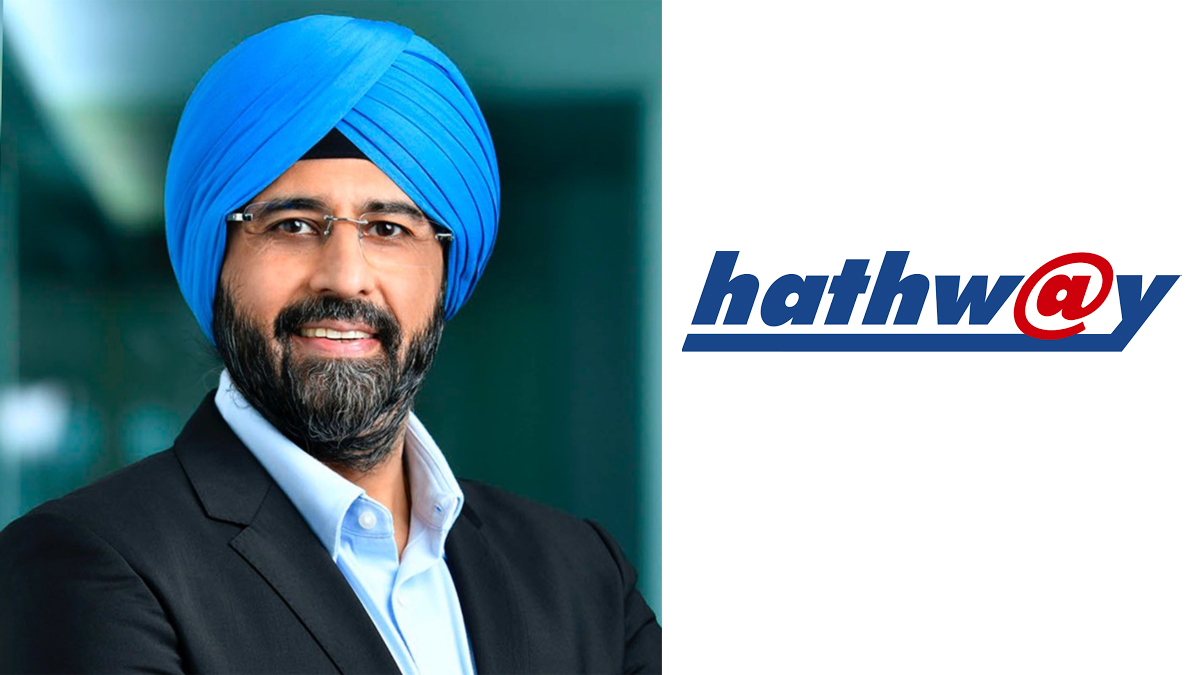
MUMBAI: Hathway Cable and Datacom has tapped industry veteran Gurjeev Singh Kapoor as chief executive officer, marking a leadership pivot at a time when India’s cable television business is under mounting strain.
Kapoor will take over from Tavinderjit Singh Panesar, who is set to retire in August after a long innings with the company. Panesar, chief executive since 2023, has held multiple leadership roles at Hathway, including his latest stint beginning in 2022.
Kapoor brings more than three decades of experience in media and entertainment. He most recently led distribution at The Walt Disney Company’s Star India business, now part of JioStar. His career spans television distribution and affiliate partnerships, with stints at Sony Pictures Networks India, Discovery Communications and Zee Entertainment.
Panesar, with over three decades in the industry, has worked across strategic planning, distribution and business development in media, broadcasting and manufacturing. His past associations include ESPN Star Sports, Star India, Apollo Tyres and JK Industries.
The transition lands as the cable sector grapples with structural disruption. Traditional operators are losing ground to streaming platforms, while telecom and broadband players tighten the squeeze with bundled offerings.
An EY report estimates India’s pay-TV base could shrink by a further 30 to 40 million households by 2030, taking the total down to 71 to 81 million. The slide follows a loss of nearly 40 million homes between 2018 and 2024, a contraction that has already wiped out more than 37,000 jobs in the local cable operator ecosystem.
Hathway’s numbers reflect the strain. The company reported a consolidated net profit of Rs 93 crore for FY25, down from Rs 99 crore a year earlier. Revenue inched up to Rs 2,040 crore from Rs 1,981 crore. As of December 2025, it had about 4.7 million cable TV subscribers and roughly 1.02 million broadband users.
Kapoor steps in with a familiar brief but a shrinking playbook. In a market where viewers are cutting cords faster than companies can reinvent them, the new chief executive inherits a business fighting to stay plugged in.







