News Broadcasting
Indian news industry needs mid-course correction: Zee News’ Sudhir Chaudhary

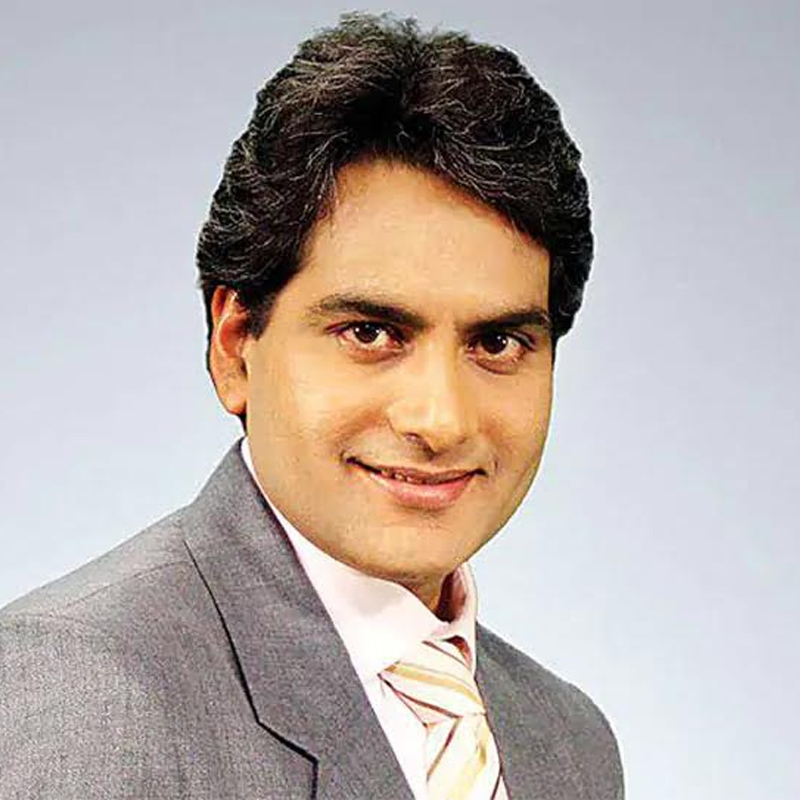
NEW DELHI:, Zee News CEO and editor-in-chief Sudhir Chaudhary expressed his discontent towards BARC ratings and the news channels flaunting them on a weekly basis during a virtual fireside chat with Indiantelevision.com founder, CEO, and editor-in-chief Anil Wanvari on the concluding day of News Television Awards Summit 2020.
“I think the main problem with BARC ratings is that the sample size is so small. Statistically speaking, we are a 32,000 crore industry and BARC has its meter in just 44,000 homes. As we traditionally say that of the overall sample size only 10 per cent watch news, we are left with just 4,400 boxes, which is very less for a huge market like India,” he elaborated.
He added that it is probably the reason why the Indian news industry is failing to grow and getting monotonous in its programming too.

“You see each GEC has a different programming structure, each channel has a distinct identity. Similar is the case with every other genre, be it kids or sports. But in news, you see all the news channels have a similar programming line-up. They have a bank of 10-20 similar issues that they cover. BARC ratings confuse the editors so much that sometimes I question if an editor is really the editor or a producer, and for that matter, if the anchors are really actors,” Chaudhary commented.
The Daily News and Analysis host also blasted the news channels that flash BARC data every Thursday in a bid to lure advertisers and viewers. “As per BARC Guidelines, no channel is allowed to declare themselves number one based on only a week’s data. One needs to have at least four weeks of data to call themselves number one. But which channel is following this guideline? BARC data was never meant for the audience but the news channels are using that to influence them.”
He further stated that to move past this, advertisers will themselves have to make their own investments in time, efforts, and technology. “I agree that no single technology will be acceptable to everyone. We may start using some tools for measurement but my clients or advertisers might not agree to that. Therefore, it is important to agree on a uniform tech tool for measurement.”
Chaudhary emphasised that the whole news industry needs a mid-course correction otherwise the audience will start taking news channels as entertainment channels.
On being asked by Wanvari if the break on TRP ratings of news channels implemented by BARC in the wake of the recent TRP manipulation scam will change the industry, Chaudhary replied, “If I look at my own experience, I still feel nothing is going to change. But as an optimistic person, we are trying to change the programming of our own channels.”
He continued, “When this break was announced, I told my teams that this is a constructive window of three months and we can use that to our advantage. I also asked my viewers what sort of content they want to see from us and got thousands of responses. The top suggestions we got were news on employment, education, healthcare, and local heroes. So, as an experiment, we have already started a special programme that talks all about job opportunities, hiring, skill development, etc.”
Chaudhary went on to reveal that Zee News earned a 100 per cent increase in its digital audience during the Covid-2019 period.
“I cannot clearly talk about the numbers on the broadcast side because there is not much clarity but we have seen a hundred per cent spike on our digital platforms. Even if we come down from here (in post-pandemic times), we will still retain 70-80 per cent of our new audience,” he said.
But what the news space needs the most right now is good, solid editorialised content, insisted Chaudhary. News channels really need to buck up when it comes to creating valuable news content, and establish their own distinct identity.







News Broadcasting
News18 India launches Command Centre war explainer with Arya
New show shifts from debates to decoding global conflicts and impacts

MUMBAI: News18 India has rolled out a new war-focused programme, Command Centre, featuring Gaurav Arya, as it looks to offer viewers a sharper, more grounded take on global conflicts amid rising tensions in West Asia.
Positioned as an “insider war room”, the show moves away from conventional panel debates and instead focuses on explaining military developments, decoding strategy and connecting global events to their everyday impact, from fuel prices to economic shifts.
The format leans heavily on visuals and data. The studio has been designed like a command hub, complete with large LED war maps, real-time graphics and an alert system to track developments as they unfold.
At the centre of it all is Arya, who brings his military background to simplify complex war strategies for viewers. His signature line, “Seedhi baat samjhiye”, anchors the show’s promise of clarity over noise.
News18 India managing editor Jyoti Kamal said, “Command Centre, featuring Major Gaurav Arya is designed to deliver accurate insights and a clear perspective on how evolving conflicts impact everyday life, from household budgets to national security. With expert voices analysing every development in real time, the show goes beyond headlines to decode what’s happening now, what it means, and what could come next.”
Echoing the intent, Gaurav Arya added, “In times of war, confusion is the biggest threat. With News18 India’s Command Centre, we are bringing viewers inside the war room, decoding strategies, tracking every escalation, and explaining, in the simplest terms, what it means for India and for every household. Seedhi baat samjhiye, this is where you understand not just what is happening, but what happens next.”
The weekday show will air in the afternoon slot and will also feature Gaurav Shukla, adding to its editorial depth.
With its mix of analysis, visuals and a clear focus on impact, the show reflects a broader shift in news consumption. Viewers are no longer just watching events unfold, they are looking to understand what those events mean for them.






