I&B Ministry
Indian films are carriers of culture across the world: Rajyavardhan Rathore

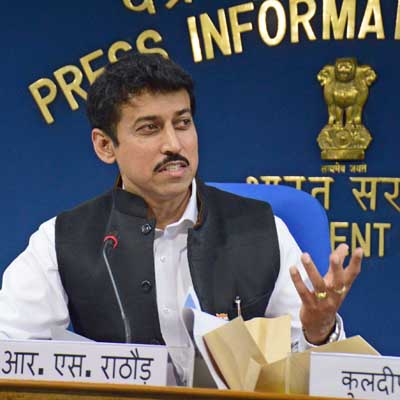
NEW DELHI: Minister of State for Information and Broadcasting Rajyavardhan Rathore said that the Ministry was keen on organising Indian Film festivals all over the world as films are carriers of culture, tradition and values.
Indian films have been a soft medium to reach out to a global audience. More film festivals would be organised in the future and at the same time, there would be enhanced participation in the Film festivals abroad.

Inaugurating the Indian Panaroma film festival and the renovated facilities at the Siri Fort auditorium complex in Delhi, he claimed that the upgraded projection and sound facilities at Siri Fort Auditorium had positioned the venue amongst the top 50 auditoriums within the country that screened films for public viewing.
Organised by Directorate of Film Festivals, Ministry of Information and Broadcasting, the festival would screen 26 Feature Films and 15 Non-Feature Films. The Opening Film of the Festival was Gour Hari Dastaan – The Freedom File directed by Ananth Narayan Mahadevan. The eight day festival would showcase all the films selected in the Indian Panorama section as part of the 45th International Film Festival of India, IFFI 2014. The Director of the opening film and lead actor Vinay Pathak were present on the occasion.
The renovated infrastructure reiterated the vision of the Ministry to establish world class viewing facilities for screening films that incorporated technical brilliance in totality. The Siri Fort auditorium had set high standards which were normally found in the corporate domain. The digital projection and Dolby sound system would enable cinema lovers to enjoy a memorable viewing of movies.
He said the films representing the Indian Panaroma section had a profound impact on the different International Film Festivals abroad. The effort would now focus on mainstreaming the impact of Indian Culture through the medium of Cinema.
I&B secretary Bimal Julka said the Indian Panaroma showcased high quality films abroad. The Panaroma section reiterated the power of Indian regional cinema. Films were the appropriate medium to celebrate India’s unity and diversity. The renovated facilities at Siri Fort had been done keeping in mind the needs of good viewing for cinema lovers.
The Siri Fort Auditorium has lately gone through a complete make-over with state-of-the-art equipments being installed in the complex. In the Plan Scheme 2013-2017, Ministry of Information & Broadcasting has made these efforts to modernize the Projection and Sound System of all the Four Auditoriums here. In Audi-1 & 2, high-end Digital Cinema Projectors of 4K resolution have been installed, while other two small auditoriums (AUDI 3 & 4) now have the latest Digital Cinema Projectors of 2K resolution. Besides projection system, Cinema sound and PA systems have also been upgraded. The Ministry has spent nearly Rs five crore to make this prestigious Auditorium Complex of International standards.
Audi-2 is now equipped with the best digital cinema projection technology along with Silver Screen, 3-D Projection System and Dolby Atmos Sound System. Dolby Atmos is considered to be the best sound effects presently available in the globe and only a few theatres in India have this sound system. Besides, Siri Fort Complex has preserved the traditional 35 mm and 16 mm analogue projection to enjoy the old classics of Indian Cinema which are available in analogue format only. It makes the Complex equipped to project films in both digital and analogue formats.Besides technical upgradation, the security arrangements, auditorium roofs and sanitary fittings have also gone through re-modulling. Aesthetical upgradation of Auditorium –II has been done by providing new chairs, carpet and projection friendly look.


I&B Ministry
AIDCF moves TDSAT over Waves plan to stream linear TV channels
Industry body flags regulatory gap as OTT push sparks broadcast turf war
NEW DELHI: The battle between traditional television distributors and digital platforms has found its way to the courts, with the All India Digital Cable Federation (AIDCF) moving the Telecom Disputes Settlement and Appellate Tribunal (TDSAT) against Prasar Bharati’s latest OTT play.
At the heart of the dispute is Waves, Prasar Bharati’s OTT platform, which has invited applications to onboard linear satellite TV channels. Aidcf, which represents multi-system operators (msos), argues that this move sidesteps existing broadcasting rules and risks tilting the playing field in favour of digital platforms.
The federation’s petition hinges on a key provision in the Uplinking and Downlinking Guidelines, 2022. Clause 11(3)(f) allows broadcasters to downlink channels only if they provide signal decoders to recognised distribution platforms such as MSOS, DTH operators, hits operators and iptv platforms. OTT platforms, aidcf points out, do not feature on that list.
In simple terms, AIDCF’s argument is this: if OTT platforms are not officially recognised distributors, they should not be receiving broadcast signals in the first place. By inviting channels onto Waves, the federation claims, Prasar Bharati is opening a backdoor that lets broadcasters bypass long-standing rules.
The concern goes beyond legal interpretation. Aidcf says OTT platforms currently operate without a clear regulatory framework, allowing them to expand into traditional broadcasting territory without the compliance burden that cable and satellite operators must carry. That, it argues, creates an uneven contest.
There is also a warning for broadcasters. If they provide signal decoders to an OTT platform like Waves, they could risk breaching the very conditions under which their downlinking permissions were granted.
For its part, Prasar Bharati’s Waves initiative is positioned as a step towards wider access and digital reach, bringing linear television into the streaming era. But critics say the move blurs the line between regulated broadcasting and largely unregulated streaming.
The matter is expected to come up before tdsat next week. The outcome could do more than settle a single dispute. It may help define how India regulates the fast-merging worlds of television and OTT, where the lines are getting fuzzier by the day and the stakes, sharper than ever.







