Animation
Indian animation to the fore at NATPE


The animation segment of the Indian television industry is all set to become an international hub if the the fantastic response received by Indian companies at The National Association of Television Program Executives 2001, a premier international television programming convention held recently at Las Vegas, Nevada, is anything to go by.
Held from 22 to 25 January, the 38th NATPE is an annual affair dedicated to facilitate the continued growth and convergence of all content across multiple distribution platforms. “It is a good platform for networking, with quite a few deals taking place,” Amit Khanna, chairman of Reliance Entertainment, said on Tuesday.

“India is fast emerging as an entertainment hub for Asia. The very fact that there was a special session – Adventures in Indian Television – devoted to India proves the point,” Khanna said. Regarding the response to the session held on India, Khanna said: “It was well attended.” The special session was chaired by Bhuvan Lall, executive director of the Indian Broadcasting Foundation, while on the panel were eminent personalities in the Indian entertainment sector. Among them, along with Khanna, were V Chandrasekaran, chairman & CEO, Pentamedia Graphics Ltd., Bill Dennis, president & CEO, Toonz Animation India Ltd, Dheeraj Kapuria, North American Head, Zee TV, Firdaus Kharas, chairman, UTV International LTD, and Ramesh Sharma, chairman & managing director, Moving Picture Company.
Discussions centred around the potential the Indian market held, whether international channels and production companies could take advantage of the developing multi-channel and convergent environment in India, and the kind of programming and formats that were likely to work in the country.
“This time around the animation media got a good business thrust,” said Khanna. In the past two years animation had an export market of $5 million and in this year itself it has a potential of touching $50 million.
In the near future, a lot of original animation programming from Toonz Animation India LTD, Pentamedia Graphics LTD, UTV International LTD, and other such companies from India are likely to make a splash internationally.







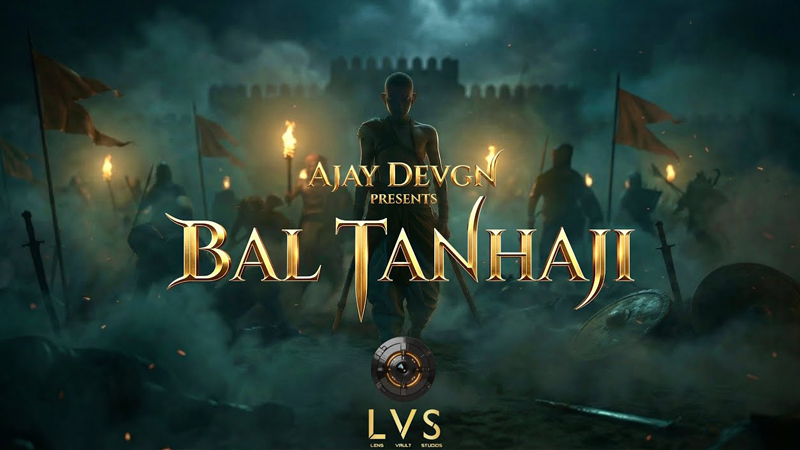
MUMBAI: History is getting a fresh rewrite this time with code, creativity and a longer arc in mind. Lens Vault Studios has announced its first original production, Bal Tanhaji, marking the official entry of the newly launched, tech-driven studio into India’s evolving entertainment landscape.
Arriving six years after the box-office success of Tanhaji: The Unsung Warrior, the new project expands the universe rather than revisiting familiar ground. Bal Tanhaji explores uncharted narrative territory, signalling a clear shift from one-off cinematic spectacles to long-format, world-building storytelling designed for digital-first audiences.
At the heart of this ambition is Prismix Studios, the in-house generative AI and technology arm powering the creative engine behind the show. The studio’s approach blends storytelling with next-generation tools, aiming to reimagine how Indian IPs are created, scaled and sustained beyond theatrical releases.
For Lens Vault Studios chairman Ajay Devgn the new venture represents a deliberate step beyond traditional cinema. The focus is firmly on building long-form intellectual properties across fiction and non-fiction, tailored to changing viewing habits and platform-led consumption. He said the studio intends to explore formats that remain largely untapped, while drawing on the team’s experience with large-scale cinematic storytelling.
Lens Vault Studios founder and CEO Danish Devgn echoed that sentiment, describing Bal Tanhaji as the studio’s first generative-AI-led IP and the starting point of a broader vision. The aim, he noted, is to carry forward the legacy of the Tanhaji universe while connecting with younger audiences through a blend of powerful narratives and emerging technologies.
With Bal Tanhaji, Lens Vault Studios is planting its flag early not just launching a show, but signalling a larger play for cinematic universes that live, grow and evolve across platforms. If this debut is any indication, the future of Indian storytelling may be as much about imagination as it is about innovation.