I&B Ministry
India websites eligible for government advertisements


NEW DELHI: Timing the move with its second anniversary of assumption of office, the government today announced that only websites which are owned and operated by companies that are incorporated in India will be considered for empanelment by Directorate of Advertising & Visual Publicity (DAVP) for government advertisements.
However, websites owned by foreign companies/origin can still be empanelled if such companies have branch offices which are registered and operating in India for at least one year.
In a move aimed at highlighting the government’s flagship programmes and achievements of the past two years, the Information & Broadcasting Ministry has framed guidelines and criteria for Empanelment of suitable agencies and Rate fixation for government advertisements on websites.

The aim of the guidelines is to devise principles and instruments to streamline the release of Government advertisements on websites. The policy stipulates eligibility criteria for websites to get empanelled with DAVP which includes Unique Users (UU) per month data which shall be cross-checked and verified by internationally accepted and credible third party tool that monitors website traffic in India.
The guidelines aim to ensure that the visibility of government advertisements online increased by strategically placing the ads on websites having higher Unique Users per month.
The policy requires that the websites shall run the government ads through a Third Party Ad Server (3-PAS) engaged by DAVP for providing all relevant reports linked with online billing and will be used for verification of bills for payment. The Unique User Data of each empanelled websites will be reviewed in first week of April every year. The guidelines categorises the Unique User per month data of the websites into three categories:

The key features of the policy guidelines include different rates for different ad properties like Standard Banners on Cost per Thousand Impressions (CPTI) basis and a minimum Click-Through Rate (CTR) of 0.30, Video ads per five second videos, Fixed Banner on home page with minimum display size of 300 X 250 pixels in a time frame on six-hour slots (6 am-12 noon, 12 noon to 6 pm, 6 pm to 12 midnight and 12 midnight to 6 am) and Fixed Video ads for 24 hour time slots on home page.
The policy emphasizes that DAVP shall be the nodal agency for all central government ministries / departments for advertising through DAVP empanelled internet websites. However, autonomous bodies/PSUs can directly release advertisements but at DAVP rates and to agencies empanelled with DAVP.




I&B Ministry
India tightens anti-piracy law, blocks sites and Telegram channels
New rules bring jail terms, fines and faster takedowns of illegal content
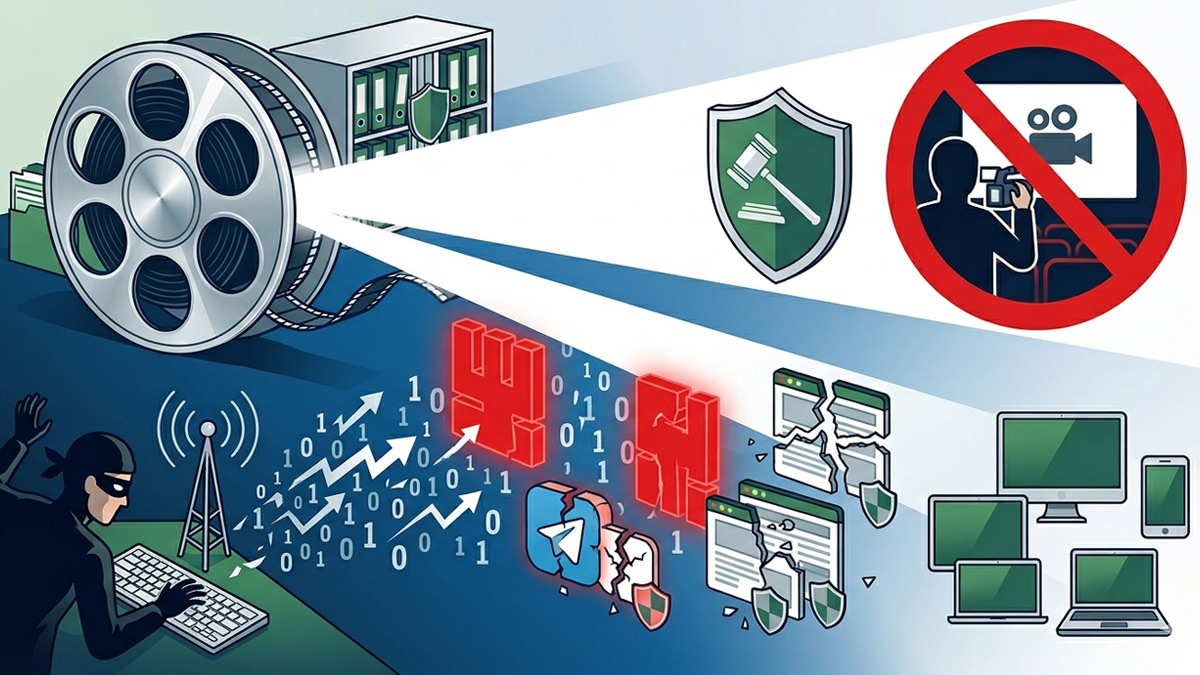
NEW DELHI: The Government of India has stepped up its fight against film piracy, invoking stricter provisions under the Cinematograph Amendment Act 2023 to crack down on unauthorised recording and distribution.
The law now imposes tougher penalties, including jail terms ranging from three months to three years and fines starting at Rs. 3 lakh, which can go up to 5 per cent of a film’s production cost. The provisions target both illegal recording in cinemas and unauthorised online transmission.
In a fresh enforcement push, authorities have notified the Telegram platform to act against piracy, leading to the identification of 3,142 channels allegedly distributing copyrighted content without permission. In parallel, access to around 800 piracy websites has been blocked through internet service providers.
The action has been taken under the Information Technology Act 2000, which empowers the government to direct intermediaries to remove unlawful content. The framework is further reinforced by the Information Technology Rules 2021, requiring platforms to act swiftly when notified of violations.
An institutional mechanism is also in place, allowing copyright holders and authorised representatives to file complaints through designated nodal officers. Once verified, these complaints trigger takedown notices to intermediaries for disabling access to infringing content.
The update was shared in Parliament by Government of India minister of state information and broadcasting l murugan in response to a query from Parimal Nathwani.
The government’s latest move signals a sharper, more coordinated approach to tackling piracy across both physical and digital channels. For the film industry, it is a step towards protecting revenues, while for viewers, it reinforces the shift towards legitimate content consumption.








