News Broadcasting
IBN Lokmat set for launch by March-end


NEW DELHI: IBN Lokmat, the upcoming Marathi news channel from the GBN-Lokmat joint venture company, is all set to launch by March-end.
“We will be officially launching it between 16 March but before 1 April,” editor-in-chief Nikhil Wagle told indiantelevision.com.
Wagle said that the existing 13 bureaux are fully functional and two more are being added. Four OB vans from the four key cities – Mumbai, Pune, Nagpur and Aurangabad – will be used for the most “vibrant live coverage and programming.”

“We are completely ready after the training by the American technological and editorial experts have done their work over the past few months, and this will give us the competitive edge,” Wagle held.
He added that the channel has 13 leased lines from across the state, so that direct and live news content can be shown throughout the day.
However, Wagle refused to disclose any programming or coverage pattern, saying: “Already there are many copycats who are getting half-baked information of the kind of programming we are going to do, and are copying them. I do not want to disclose the content beforehand.”
Asked about the usual repeated show of violence that the Ministry of Information & Broadcasting has been seriously upset with, Wagle said that if there is violence in society, it will be shown, but in a responsible manner, so that further violence is not fomented.
Reminded that most channels had shown old footage of violence against north Indians during the Raj Thackeray arrest on 12 February, but without mentioning that those were old file photos, Wagle asserted that this will not be done in IBN Lokmat.
“I do care for TRPs but I shall not stoop so low for TRPs that it gets away from serious but popular journalism, because that is what I have done in my 20 years of print and the past decade of television journalism. I believe that TRPs will come if one does serious and popular but highly credible journalism,” Wagle clarified.







News Broadcasting
UDF poised to return to power in Kerala, says Manorama-CVoter survey
Massive opinion poll projects shift in Kerala politics ahead of 2026 Assembly elections.
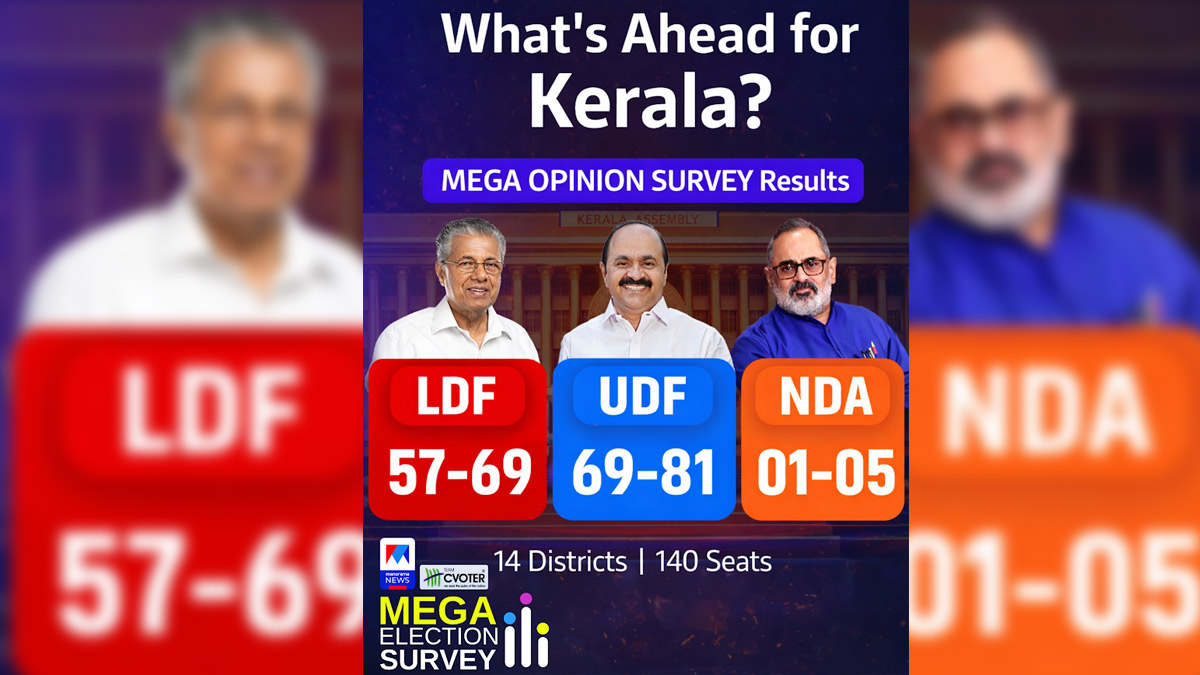
MUMBAI: The winds of change appear to be blowing through Kerala’s political landscape and this time, they seem to favour the United Democratic Front. A comprehensive mega opinion survey conducted by Manorama News in partnership with CVoter projects a potential comeback for the UDF in the upcoming Kerala Legislative Assembly Elections 2026. The survey, covering all 140 constituencies with a massive sample size of nearly 90,000 respondents, predicts the UDF could win between 69 and 81 seats.
The ruling Left Democratic Front (LDF) is expected to secure 57 to 69 seats, a significant drop from the 99 seats it won in the 2021 elections. This would mean the LDF losing 30 to 42 of its sitting seats. Meanwhile, the National Democratic Alliance (NDA), which drew a blank in 2021, is projected to open its account with 1 to 5 seats.
Region-wise, the UDF is expected to make strong gains in Malabar, winning 25 to 34 out of 48 seats, and in Central Kerala, where it could bag 29 to 33 out of 53 seats. In South Kerala, the LDF is likely to retain an edge with 21 to 25 seats, while the UDF may improve to 12 to 16 seats. The NDA could pick up 1 to 3 seats in the southern region.
The survey was conducted between 14 and 26 March 2026, with additional tracker and snap polls carried out from December 2025 to March 2026. A total of 89,693 respondents participated, ensuring representation across all demographics and social segments.
Manorama News has a strong track record of accuracy, with its previous projections closely matching the actual results of the 2019 and 2024 Lok Sabha elections as well as the 2021 Kerala Assembly polls.
In Kerala’s famously fierce political battles, this survey suggests the pendulum may be swinging back. Whether the final verdict matches these numbers or throws up another surprise, one thing is clear, the 2026 Assembly elections are shaping up to be one of the most keenly watched contests in the state’s history.






