GECs
IBF questions need for new tariff order revisions


MUMBAI: The last six months have been rather unsettling for the television sector what with the regulator the Telecom Regulatory Authority of India revising tariff regulations for pay TV at least a couple of times. Indian broadcasting CEOs hence came together under the umbrella of the Indian Broadcasting Foundation (IBF) on 10 January to air their concerns about the latest amendments in the new tariff order. They were more than clear that the latest revision is going to adversly affect their toplines and bottomlines and hence that may leave them no recourse but to consider legal options.
While the new price regime implemented in the last year did not have enough time to settle, the Telecom Regulatory Authority of India (TRAI) once again revised the order recently including reducing the pricing cap to Rs 12 per channel to be included in a bouquet, down from Rs 19 per channel.
“Even as the new regime was settling down, on 1 January 2020, TRAI notified certain amendments to the New Tariff Order and Interconnection Regulations for the broadcast sector. These amendments attempt to make further disruptive changes in an industry already grappling with the paradigm shift to an MRP based pricing regime,” IBF president and Sony Pictures Networks MD & CEO N P Singh expressed.

He also mentioned that while the broadcasting industry is apprehensive about the magnitude of changes, they support bringing in order into the system.
Singh also noted that the collective cost to the broadcasters was well over Rs 1,000 crore in just communicating the changes to the consumers. Moreover, there was an overall loss of 12-15 million subscribers in the process.
Walt Disney Company Asia Pacific president, Star Disney India chairman Uday Shankar also raised the question that if a comprehensive exercise was done last year, then what is the need for the current revision. He also added that if TRAI is so concerned with bringing down the price for the consumer then why, in the name of NCF (network capacity fee), distributors are being allowed to charge as much as Rs 160 for something that DD FreeDish is giving for free.
“The objective of NTO 1 was first – to give choice to consumers, second – to bring transparency and third – to reduce litigation. While only the first two have happened, it's too early to talk about the third. Statistically, overall 94 per cent of Indians are aware of the NTO and the choices they have because of the efforts made by the broadcast industry collectively. The month on month churn in industry shows that people are continuously fine-tuning their choices. The other objective of NTO was transparencey which it has also brought in. The question therefore, is ‘what is the fundamental need to change again?,’" posed Viacom18 Group CEO & MD & IBF vice president Sudhanshu Vats.
"India is a heterogenous country with different choices and abilities to pay. In every sector there is a wide spectrum and that needs to play out more in Indian media as well. This push for consistency shouldn’t come in the way of the industry's and the economy's growth. In the M&E industry there is a lot of dynamism and flux and hence the broadcast sector needs to be able to settle down. If there has to be any change we need to allow for enough time for its implementation and also changes shouldn't be suggested so frequently," he added.
Shankar also emphasised on the problems that long-tail channels will face. He commented that the latest revisions will seriously threaten the existence of smaller channels. He also raised concerns about the quantum of investment in content, which broadcasters have been making.
Zee Entertainment Enterprises Ltd (ZEEL) CEO & MD Punit Goenka also questioned if these changes are in line with the government’s stated intent of improving the ease of doing business. According to him, whether it will really benefit end consumers is also arguable.




GECs
EPIC Company unifies all brands under single EPIC identity
IN10 Media rebrand aligns TV, digital and films into one ecosystem
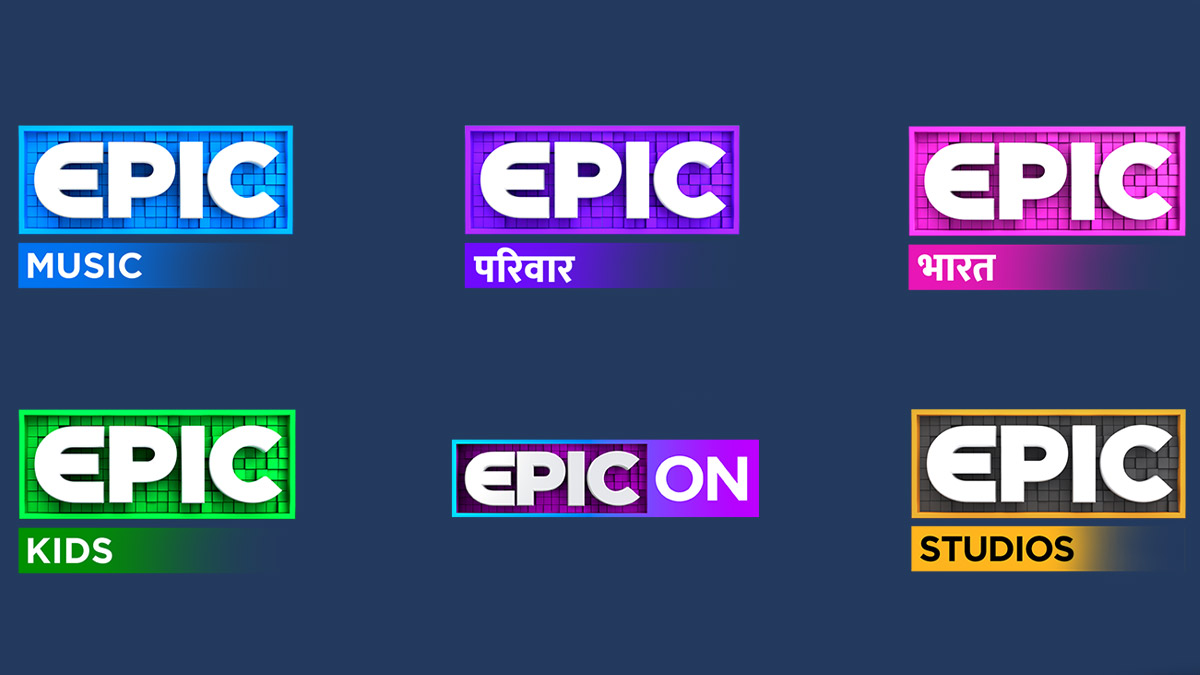
MUMBAI: The EPIC Company, formerly known as IN10 Media Network, has announced a sweeping brand consolidation, bringing its television channels, digital platforms and content IPs under a single identity, EPIC.
The move is aimed at simplifying the company’s structure while creating a more connected content ecosystem spanning television, digital and films. By aligning multiple verticals under one umbrella, the company is looking to present a sharper, more cohesive face to both audiences and partners.
As part of the transition, several channels have been rebranded to align with the EPIC identity. EPIC will now operate as EPIC TV, while Nazara becomes EPIC Bharat, Filamchi is now EPIC Bhojpuri, Gubbare transitions to EPIC Kids, and ShowBox is reintroduced as EPIC Music. Ishara will continue under the identity EPIC Parivaar, maintaining its core positioning.
The company has also refreshed EPICON, its streaming platform, to reflect a more unified and modern brand experience. The overhaul is designed to improve content discovery and create a seamless experience across platforms.
This consolidation follows the recent launch of EPIC Studio, a unified production arm that brings together Juggernaut Productions and MovieVerse Studio, as the company expands its footprint across films, OTT and television.
The EPIC Company managing director Aditya Pittie said, “As our scale has grown, it has become important to simplify how we operate and how we present ourselves to the ecosystem. This consolidation gives us a clearer, more future-ready structure to partner, invest, and build at scale, while ensuring that for viewers, the experience is more seamless and intuitive.”
With the rebrand, The EPIC Company is positioning itself as a platform-agnostic content network, focused on scale, simplicity and integrated storytelling. By bringing everything under one banner, it is aiming to make its content universe easier to navigate and harder to ignore.






