News Broadcasting
IBF meets to implement blacklist on defaulting ad agencies


The toothless tiger is attempting to bare its teeth.
The Indian Broadcasting Foundation – a representative body of a small but powerful interest group of broadcasters – is currently meeting at Sony Entertainment’s offices to reportedly decide on a ban of three agencies – McCann Erickson, HTA (Hindustan Thompson Associates) and HTA Fulcrum (handles the Hindustan Levers account) – for payment defaults.

The attempt is to play a role like that of the INS which blacklists agencies that play truant as far payments to member newspaper organisations are concerned. Once the agency is placed on the blacklist, other INS members are supposed to cooperate and not carry any of their ads.
The three agencies are reportedly in default of upwards of Rs 3000 million accumulated over the last three years.
The IBF is likely to announce the first of the blacklists today. Of course, it will be up to the member broadcasters to comply with the ban.





News Broadcasting
Network18 channels lead YouTube news viewership in March 2026
CNN-News18, News18 India and CNBC channels top categories with record views
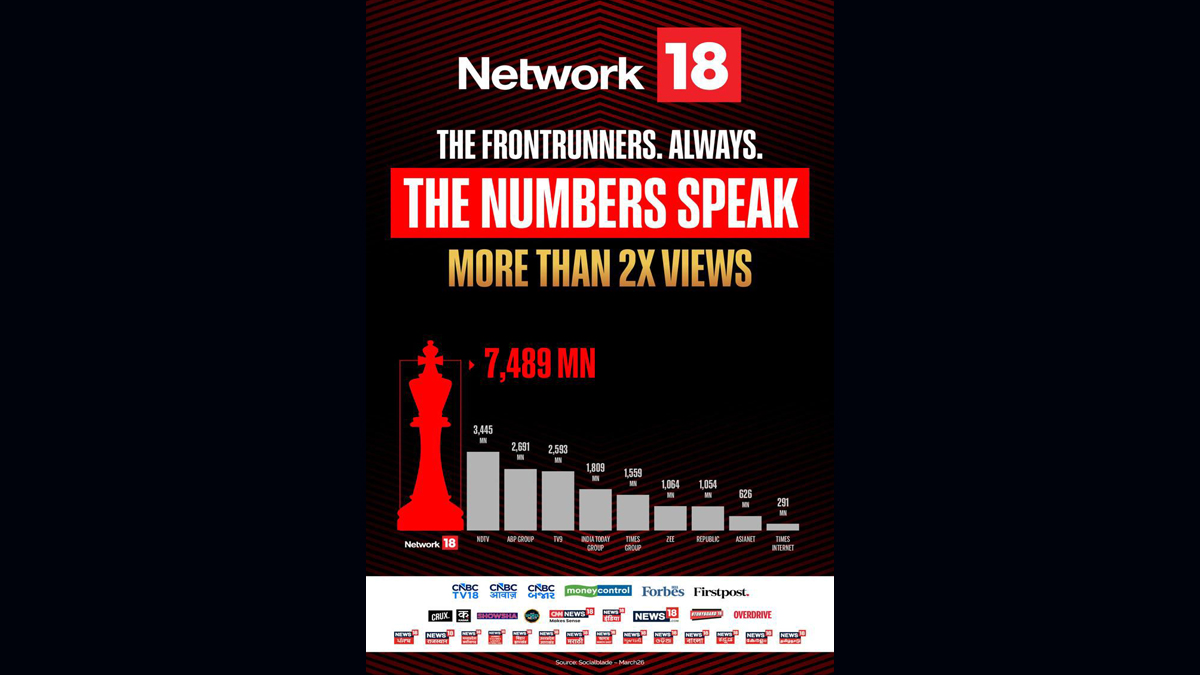
MUMBAI: When the world hit refresh on breaking news, Network18’s channels were already streaming ahead. As geopolitical tensions and war-driven headlines fuelled a surge in global news consumption, the network’s digital playbook delivered big clocking record Youtube viewership across English, Hindi and business news categories in March 2026.
At the forefront was CNN-News18, which emerged as the clear leader in the English news segment with 130 million live and video-on-demand views. The channel edged past competitors such as Times of India (126.5 million), Times Now (101.1 million), India Today (88.2 million) and NDTV (77.5 million), according to Databeings data for March.
In the Hindi news arena, News18 India delivered a commanding performance, racking up a staggering 3,297 million views on YouTube. The channel comfortably outpaced NDTV India, which recorded 3,119 million views, underlining its deep reach and consistent engagement with mass audiences, as per Playboard data.
The network’s dominance wasn’t confined to general news. In the Hindi business segment, CNBC Awaaz topped the charts with 92 million views, narrowly ahead of Zee Business (90 million) and well ahead of ET Now Swadesh (57 million). Meanwhile, its English counterpart CNBC-TV18 posted a strong 58 million views, reinforcing the network’s cross-category strength.
The spike in viewership reflects a broader shift in audience behaviour, with viewers increasingly turning to digital platforms particularly Youtube for real-time updates and in-depth coverage during high-intensity news cycles. For Network18, the numbers signal more than just scale; they underline the effectiveness of a multi-platform strategy that blends speed, credibility and continuous coverage.
In a month where the news never paused, it seems viewers chose to stay tuned where the stream never stopped.






