News Broadcasting
I&B ready to re-examine FTA package costing in CAS

NEW DELHI: Even as broadcasters and cable operators disagreed over pricing of the basic tier of free to air channels in a post-conditional access regime at meeting yesterday (Friday), the government has agreed to revisit an analysis of the probable costing of the basic tier undertaken earlier by the finance ministry that had said the price should be in the region of Rs 50 (exclusive of local taxes) per month.
The government has also suggested that broadcasters, MSOs, cable operators should sit down and sort out differences on issues like piracy, auditing of subscriber base and distribution margins for MSOs.
Though government sources and some panel members insisted that the over three-hour meeting of the task force on CAS was carried out in a friendly atmosphere, a collation of information done by indiantelevision.com suggests that there were several areas of disagreement and the cable operators staunchly opposed any move by broadcasters to keep the price of the basic tier low.

ESPN India’s country head Manu Sawhney, who represented the Indian Broadcasting Foundation (IBF), according to industry sources, suggested in the task force meeting, attended by about 16 people, that the pricing of the basic tier should be around Rs. 25/month/susbcriber. He also said the pricing should be arrived at as soon as possible with the rollout of CAS in non-metro cities being done within three months of the first phase implementation.
While some other members of the task force agreed with some IBF viewpoints, the cable operators strongly opposed the suggestion and alleged that a low price of basic tier would make the business of cable operators unviable and pave the way for closures and takeovers. The meeting was chairted by joint secretary (broadcasting) in the I&B ministry Rakesh Mohan,
Rakesh Dutta of the Cable Networks’ Association and one of the several independent cable op in the task force, told indiantelevision.com today: “We strongly oppose IBF and Sawhney’s posturing and we would start a stir if the basic tier price is below Rs 150/month.”
He added: “I also told him (Sawhney) during the meeting that broadcasters should not try to dictate the business terms to a cable op as the latter does not interfere with the way a broadcaster does its business.”
Another cable operator task force member, Roop Sharma, said, “The cable operators are united on the issue. We want CAS to be implemented soon, but a low price of the basic tier is not acceptable to us. Broadcasters are attempting to make sure that more pay channels can be accommodated by a consumer in his monthly cable subscription outflow if the basic tier is cheap.”
The cable ops’ point of view was that the basic tier should be around Rs 150/month/susbcriber. A memorandum was also submitted to the ministry by cable operators that put across their views on the matter.
The meeting, according to sources, was conducted in strict accordance of the agenda set out, but mini-flare-ups could not be avoided. Dutta is reported to have retorted to Sawhney’s suggestion of a low priced FTA channel package that if the broadcasters were ready to sell air time at the rate of Rs 25/10 seconds on various channels, cable operators would agree to the basic tier price being Rs 25/month.
Adding spice to the lack of consensus on this were the consumer activists. One of the three activists on the panel, Mumbai’s Varsha Raut, observed that at present on an average consumers are getting about 80 channels (both FTA and pay ) for a price between Rs 150 – Rs 200/month. If the total cost of cable television to a consumer exceeded Rs 200/month (inclusive of pay channels), it would not be acceptable to them, Raut is understood to have conveyed to the meeting.
Those who attended yesterday’s meeting included Sawhney, Essel Group’s additional vice-chairman Jawahar Goel, Hathway’s K. Jayaraman, INCableNet’s Rajiv Vyas, RPG’s A Datta, Siti Cable’s Rajeev Khattar, a representative from Sumangali (Sun TV’s parent company), electronic goods manufacturing companies’ apex body CETMA’s Suresh Khanna, and Thomson India’s Sanjiv Kainth, apart from several consumer activists and independent cable operators from Delhi, Mumbai, Calcutta and Chennai.
When MSOs and cable operators were asked whether they had placed orders for set-top boxes (STBs), some of them said this could not be done till a business plan was made and that could only be done when it was clear what would be the composition of the basic tier and the number of channels that would form part of the free to air channels.
The government representative is understood to have conveyed to all that broadcasters should come out with the number of FTA channels within 10-12 days (when the next meeting is likely to take place) in the various bouquets to enable other stakeholders of the industry to firm business plans.
CETMA was of the opinion that both digital and analog set-top boxes can be made available, indigenously manufactured and assembled from SKD (semi-knocked down) kits, within 12-16 months of placing orders. The CETMA representative is also reported to have opined that an analog STB can be had for about Rs 1,500, while digital STBs may cost up to Rs 4,000 (inclusive of various duties) apiece.
The industry has also petitioned the government to waive various duties on import of STB components — an issue, Mohan pointed out, that has been taken up with the finance ministry.
At the meeting it was also suggested — and also agreed upon by most people — that broadcasters should devote some time on their various channels to educate viewers about CAS, pricing of pay channels and other issues involved.
The meeting ended with a warning from Mohan that the implementation of CAS and the deadline fixed would be pursued by the government zealously and soon officials at state-levels would be nominated whose role would be to monitor CAS implementation and take action against errant parties.






News Broadcasting
UDF poised to return to power in Kerala, says Manorama-CVoter survey
Massive opinion poll projects shift in Kerala politics ahead of 2026 Assembly elections.
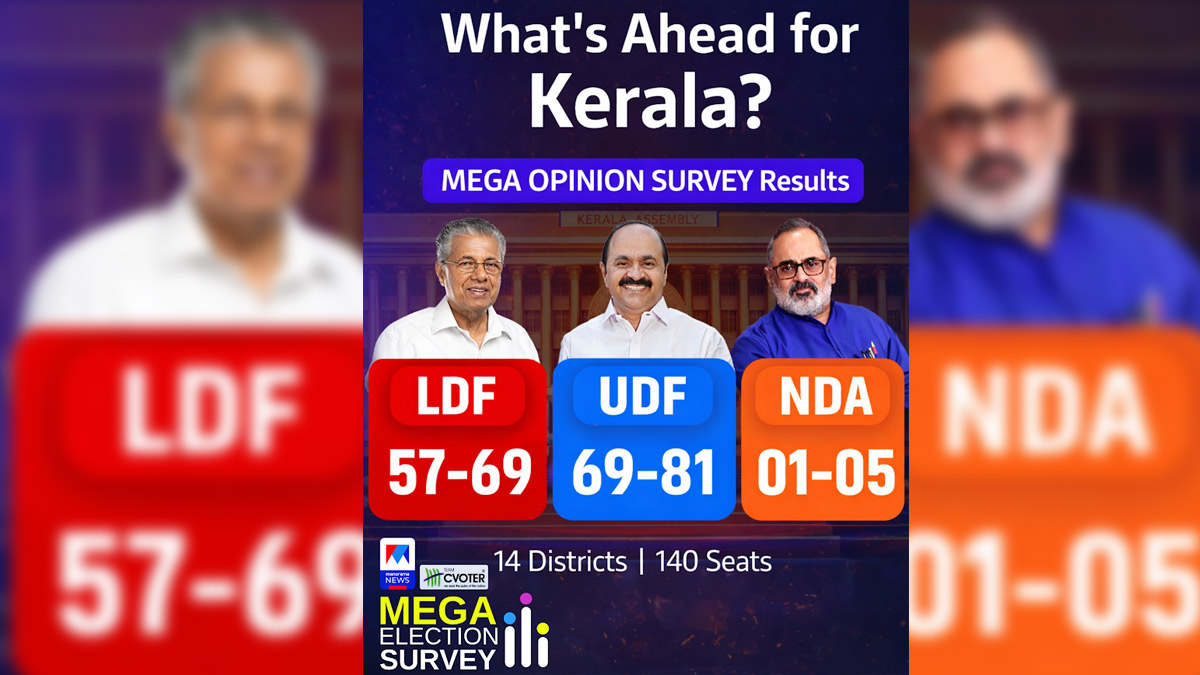
MUMBAI: The winds of change appear to be blowing through Kerala’s political landscape and this time, they seem to favour the United Democratic Front. A comprehensive mega opinion survey conducted by Manorama News in partnership with CVoter projects a potential comeback for the UDF in the upcoming Kerala Legislative Assembly Elections 2026. The survey, covering all 140 constituencies with a massive sample size of nearly 90,000 respondents, predicts the UDF could win between 69 and 81 seats.
The ruling Left Democratic Front (LDF) is expected to secure 57 to 69 seats, a significant drop from the 99 seats it won in the 2021 elections. This would mean the LDF losing 30 to 42 of its sitting seats. Meanwhile, the National Democratic Alliance (NDA), which drew a blank in 2021, is projected to open its account with 1 to 5 seats.
Region-wise, the UDF is expected to make strong gains in Malabar, winning 25 to 34 out of 48 seats, and in Central Kerala, where it could bag 29 to 33 out of 53 seats. In South Kerala, the LDF is likely to retain an edge with 21 to 25 seats, while the UDF may improve to 12 to 16 seats. The NDA could pick up 1 to 3 seats in the southern region.
The survey was conducted between 14 and 26 March 2026, with additional tracker and snap polls carried out from December 2025 to March 2026. A total of 89,693 respondents participated, ensuring representation across all demographics and social segments.
Manorama News has a strong track record of accuracy, with its previous projections closely matching the actual results of the 2019 and 2024 Lok Sabha elections as well as the 2021 Kerala Assembly polls.
In Kerala’s famously fierce political battles, this survey suggests the pendulum may be swinging back. Whether the final verdict matches these numbers or throws up another surprise, one thing is clear, the 2026 Assembly elections are shaping up to be one of the most keenly watched contests in the state’s history.






