I&B Ministry
I&B Ministry explains to PMO its reasons for postponing digitisation dates

NEW DELHI: The Information and Broadcasting Ministry feels that digitisation is a tool to empower the people and not create difficulties, and therefore does not agree that it will create any setback to the Digital India Plan.
Ministry sources told indiantelevision.com that this had been conveyed by the Ministry to the Prime Minister’s Office (PMO) in response to the communication to PMO by Telecom Regulatory Authority of India chairman Rahul Khullar.

The sources also pointed out that the pace of digitisation had slowed down over the past year due to lack of adequate publicity and paucity of fund allocation.
The Ministry said cable TV digitisation was only a small though major part of Digital India.
The main purpose was not to delay digitisation of cable television networks but to encourage greater indigenisation of both set top boxes and other equipment, the sources informed.
The dates proposed by the Ministry were only the outer limit and every effort would be made to ensure digitisation of cable TV is achieved before that. It was also pointed out that the consumer’s capacity to pay was of great importance in the last two phases which were reaching out to semi-urban or rural areas.
It was also emphasised that TRAI was being consulted on the proposal about the new dates and the views of the regulator would be taken into account.
Khullar in his note to the PMO has said staggering implementation of the cable TV digitisation plan will be a major setback to the Digital India plan.
He said, “For the last six months, we have been working on phase-III and phase-IV. If implementation is now staggered, it will be a body blow to the project, primarily because momentum will be lost and it is truly very difficult to enforce compliance countrywide.”
Under the current plan, the third phase of the cable TV digitisation plan is expected to end on 30 September, and phase IV by 31 December this year, while the Ministry feels the new dates should be December 2015 and December 2016 respectively.
“Should this happen, it will be a major setback to digitisation in the country. Further, a huge effort was made by TRAI to enforce compliance. We encountered significant difficulties in ensuring that phase I and phase II were effectively completed,” the TRAI chief wrote.
There are 100 million homes with cable TV connection of which 20 million are digital. In addition, there are 56 million DTH homes. This is more than the fixed line telephony subscriber base. Digitisation would enable cable TV networks to be used for two-way communications, a pre-requisite for internet services.
TRAI said that digitisation offers much cheaper means of providing broadband to consumers compared to the National Optical Fibre Network project, which aims to roll out fibre cables across the country as broadband is the main supplier of TV signals in all developed countries.







I&B Ministry
CBFC speeds up film certification; average approval time cut to 22 days
Over 71,900 films cleared in five years as digital system shortens approval timelines
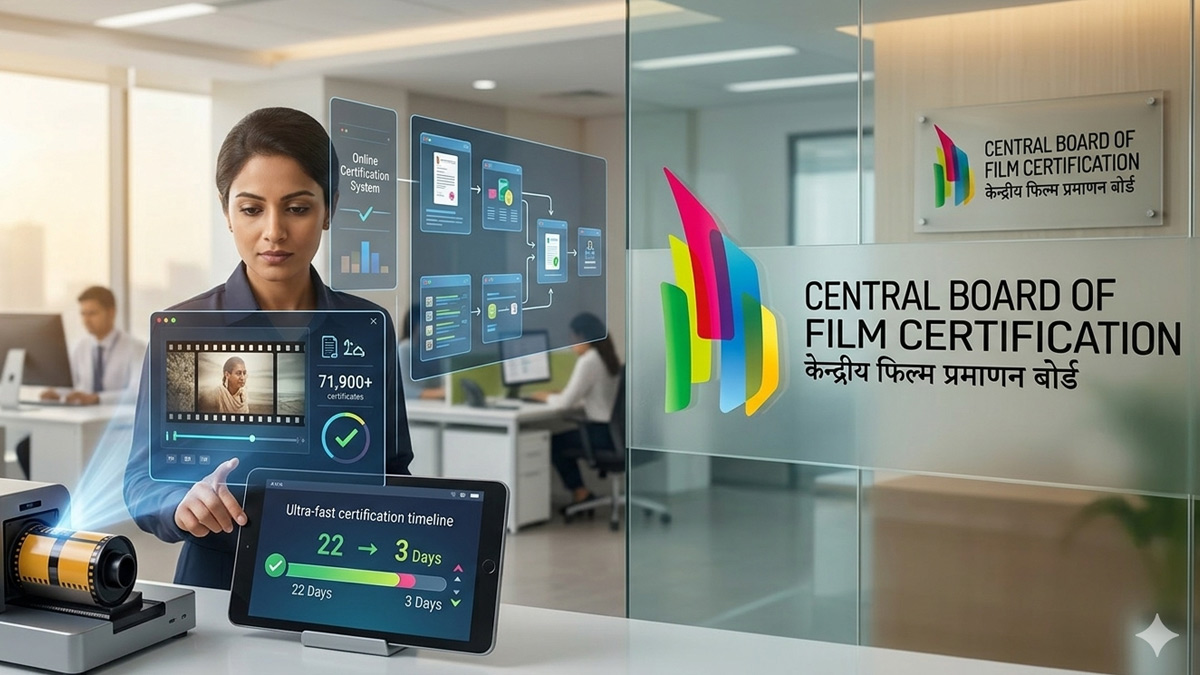
MUMBAI: The Central Board of Film Certification (CBFC) has significantly reduced the time taken to certify films, with the average approval timeline now down to 22 working days for feature films and just three days for short films.
Operating under the Ministry of Information and Broadcasting, the statutory body certifies films for public exhibition in line with the Cinematograph Act, 1952 and the Cinematograph (Certification) Rules, 2024. The rules prescribe a maximum certification period of 48 working days, though the adoption of the Online Certification System has sharply accelerated the process.
Over the past five years, from 2020-21 to 2024-25, the board certified a total of 71,963 films across formats. Of these, the majority fell under the U category with 41,817 titles, followed by UA with 28,268 films and A with 1,878 films. No films were certified under the S category during the period.
Film approvals have also steadily risen in recent years. The CBFC cleared 8,299 films in 2020-21, a figure that peaked at 18,070 in 2022-23 before settling at 15,444 films in 2024-25. During the same period, 11,064 films were certified with cuts or modifications.
Despite the high volume of certifications, outright refusals remain rare. Only three films were denied certification over the last five years, with one refusal recorded in 2022-23 and two in 2024-25.
The board may recommend cuts or modifications if a film violates statutory parameters relating to the sovereignty and integrity of India, security of the state, friendly relations with foreign states, public order, decency or morality, defamation, contempt of court or incitement to an offence.
Filmmakers can challenge CBFC decisions in court. Data shows that such disputes remain limited but have seen some fluctuation. Between 2021 and 2025, a total of 21 certification decisions were challenged before High Courts, with the number rising to 10 cases in 2025.
Responding to a question in the Rajya Sabha, minister of state for information and broadcasting L. Murugan shared the data. The question was raised by Mallikarjun Kharge.
With faster timelines and a largely digital workflow, the certification process appears to be moving at a far brisker pace, signalling a shift towards quicker clearances for India’s growing film output.







