News Broadcasting
Hungama TV on programme commissioning spree


MUMBAI: Programming overdrive! That is what Hungama is calling its latest venture.
UTV’s to be launched channel Hungama TV has given commissioning letters to 16 production houses for 27 pilots of original programming.
In a company press release, Hungama TV COO Purnendu Bose offered, “With more than eight hours of original programming everyday, our intent is to be armed with a strong line-up of programs across all genres that appeal to all sub segments within our target group. So, even when the research identifies some of the strong and not so strong programs, we will be ready with another round of winning ideas.”

Amongst the 16 production houses that Hungama has commissioned are Eagle Films, Garima, Contiloe, Picasso, Edit 2, Sphere, Rose, Inhouse, Media Track and UTV productions.
UTV’s in-house production company is naturally, going to be the major content provider.
As unique as it sounds, Hungama TV has been researching each and every programming idea, whether live action or animation, with the core target of 4-15 years in all key TRP markets. That apart, the channel is also in the process of establishing the proposed governing council of the 15 member kids board of directors for the channel. The move, as the channel heads claim, further reinforces the seriousness with which they are taking their kids’ opinions.
The Ronnie Screwvala promoted United Home Entertainment’s kids channel aims at becoming a channel of, for and by the kids, adds the release.







News Broadcasting
UDF poised to return to power in Kerala, says Manorama-CVoter survey
Massive opinion poll projects shift in Kerala politics ahead of 2026 Assembly elections.
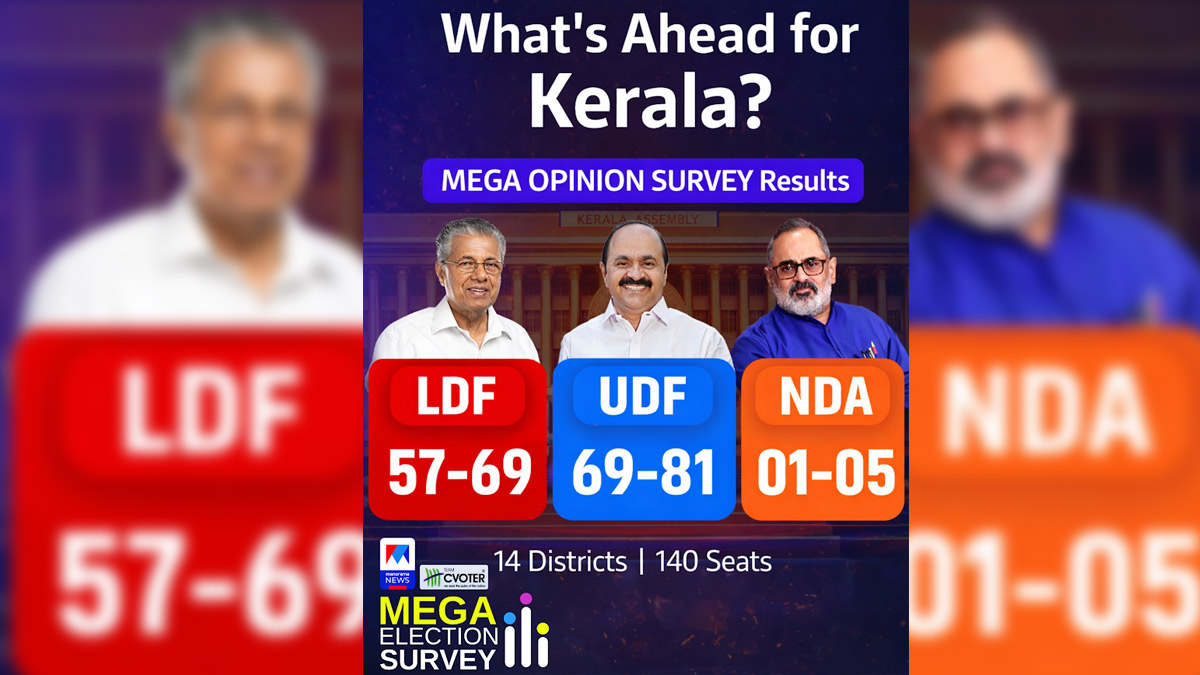
MUMBAI: The winds of change appear to be blowing through Kerala’s political landscape and this time, they seem to favour the United Democratic Front. A comprehensive mega opinion survey conducted by Manorama News in partnership with CVoter projects a potential comeback for the UDF in the upcoming Kerala Legislative Assembly Elections 2026. The survey, covering all 140 constituencies with a massive sample size of nearly 90,000 respondents, predicts the UDF could win between 69 and 81 seats.
The ruling Left Democratic Front (LDF) is expected to secure 57 to 69 seats, a significant drop from the 99 seats it won in the 2021 elections. This would mean the LDF losing 30 to 42 of its sitting seats. Meanwhile, the National Democratic Alliance (NDA), which drew a blank in 2021, is projected to open its account with 1 to 5 seats.
Region-wise, the UDF is expected to make strong gains in Malabar, winning 25 to 34 out of 48 seats, and in Central Kerala, where it could bag 29 to 33 out of 53 seats. In South Kerala, the LDF is likely to retain an edge with 21 to 25 seats, while the UDF may improve to 12 to 16 seats. The NDA could pick up 1 to 3 seats in the southern region.
The survey was conducted between 14 and 26 March 2026, with additional tracker and snap polls carried out from December 2025 to March 2026. A total of 89,693 respondents participated, ensuring representation across all demographics and social segments.
Manorama News has a strong track record of accuracy, with its previous projections closely matching the actual results of the 2019 and 2024 Lok Sabha elections as well as the 2021 Kerala Assembly polls.
In Kerala’s famously fierce political battles, this survey suggests the pendulum may be swinging back. Whether the final verdict matches these numbers or throws up another surprise, one thing is clear, the 2026 Assembly elections are shaping up to be one of the most keenly watched contests in the state’s history.






